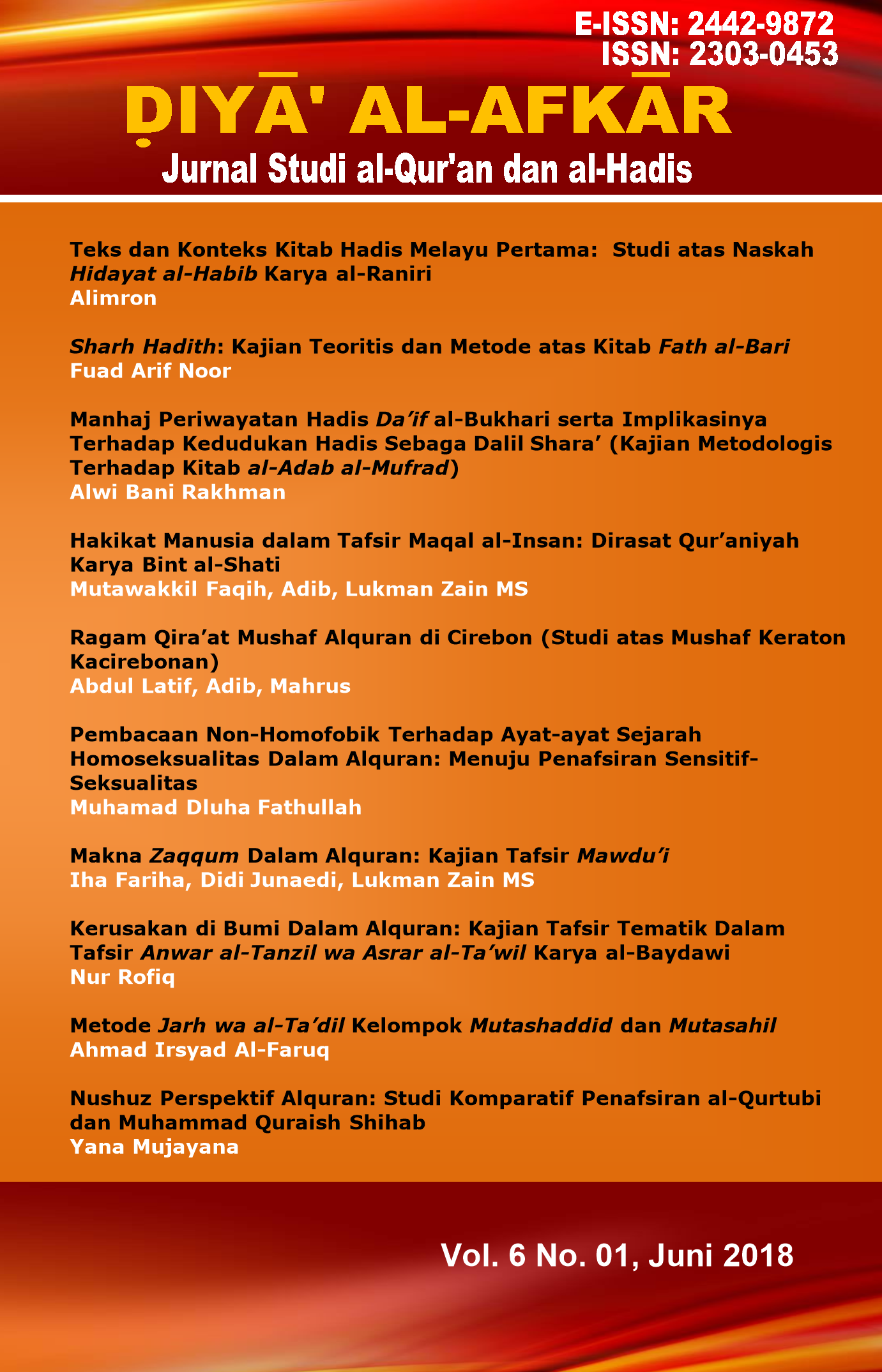
Nushuz Perspektif Alquran: Studi Komparatif Penafsiran Al-Qurá¹ubi Dan Muhammad Quraish Shihab
DOI:
https://doi.org/10.24235/diyaafkar.v6i01.2806Keywords:
nushuz, interpretation of al-Qurtubi and M. Quraish Shihab, equivalence of gender.Abstract
The possible cause of divorce is the happening of nushuz from wife (party/side) and also husband. As for wife, nushuz is explained by at Q.S. al-Nisa‘ [4] sentence 34 and nushuz from husband at Q.S. al-Nisa‘ [4] sentence 128. This paper explain the view of al-Qurtubi and M. Quraish Shihab cited from al-Jami' Li Ahkam al-Qur‘an and Tafsir al-Misbah by considering the nowadays context particularly about gender equality as a means to revisit the concept in al-Qur'an about nushuz. The research belongs to library research. The data are managed using descriptive method in the form of comparative method and is also related to the perspective of gender equality in the concept of nushuz of wife as well as husband.
Â
Â
Downloads
References
Abrar, Indal. Al-Jami’ li Ahkam al-Qur‘an wa al-Mubayyin lima Tadammanah min al-Sunnah wa Ay al-Qur‘an Karya al-Qurtubi†dalam A. Rafiq (ed.), Studi Kitab Tafsir. Yogyakarta: Teras, 2004.
Badan Litbang dan Diklat Lajnah Pentashihan Mushaf Alquran. Tafsir Alquran Tematik “Membangun Keluarga Harmonisâ€. Jakarta: Departemen RI, 2008.
Baidowi, Ahmad. Tafsir Feminis, Kajian perempuan dalam Alquran dan para mufassir kontemporer. Bandung: Nuansa, 2005.
Dahlan, Abdul Aziz. Ensiklopedia Hukum Islam. Jakarta: Ichtiar Baru van Hoeve, 2003.
Ghofur, Saiful Amin. Profil Para Mufassir Alquran. Yogyakarta: Pustaka Insan Madani, 2008.
Gusmian, Islah. Khazanah Tafsir di Indonesia. Yogyakarta: LKIS, 2013.
Kamal, Abu Malik. Fiqih Sunnah Wanita. Jakarta. Pena Pundi Aksara, 2007.
Mernissi, Fatima. Wanita di dalam Islam. Bandung: Pustaka, 1994.
Muhammad, Husein. Fiqh Perempuan: Refleksi Kiai atas Wacana Agama dan Gender. Yogyakarta: LKIS Yogyakarta, 2001.
Al-Qurtubi, Abu ’Abdillah Muhammad bin Ahmad al-Ansari. Al-Jami’ li Ahkam al-Qur‘an. Beirut: Dar al-Fikr, 2011.
Shihab, M. Quraish. Kaidah Tafsir (Syarat, Ketentuan dan Aturan yang Patut Anda diketahui dalam Memahami Alquran. Tanggerang: Lentera Hati, 2013.
_________________.Tafsir al-Misbah: pesan, kesan dan keserasian Alquran. Jakarta: Lentera Hati, 2002.
Shihab, Umar. Kontekstualitas Alquran. Jakarta: Pena Madani, 2005
Sudarsono, A munir. Dasar-Dasar Agama Islam. Jakarta: Rineka Cipta, 2013.
Syarifudin, Amir. Hukum Perkawinan Islam Indonesia: antara Fiqih Munakahat dan Undang-Undang Perkawina. Jakarta: Kencana, 2009.
Yayasan Penyelenggara Penterjemah Alquran. Alquran dan Terjemahnya; Departemen Agama RI. Bandung: Gema Risalah Press, 1991.
Muhdhar, Ahmad Yunus. Sampaikah Pahala Bacaan Yasin & Tahlil kepada Mayit. Surabaya: Cahaya Ilmu, t.th.
Mustofa, Bisri. Tafsīr al-Ibriz, Ed. Bisri Adib Hattani. Wonosobo: Lembaga Kajian Strategis Indonesia, 2015.
-------------------- Al-Ibriz lima‘rifah Tafsir al-Qur‘an al-’Aziz. Kudus: Menara Kudus, 2015.
Al-Naysaburi, Abu al-Husayn Muslim ibn al-Hajjaj al-Qushayri. Sahih Muslim. Beirut: Dar al-Kutub al-‘Ilmiyyah, 2010.
Al-Qadi, ‘Abd al-Rahim ibn Ahmad. Daqa‘iq al-Akhbar fi Dhikr al-Jannah wa al-Nar. Surabaya: Dar al-‘Ilmi, t.th.
Downloads
Published
Issue
Section
License
Copyright (c) 2019 Diya Al-Afkar: Jurnal Studi al-Quran dan al-Hadis

This work is licensed under a Creative Commons Attribution-NonCommercial 4.0 International License.
Authors who publish with this journal agree to the following terms:
- Authors retain copyright and grant the journal right of first publication with the work simultaneously licensed under a Creative Commons Attribution License that allows others to share the work with an acknowledgment of the work's authorship and initial publication in this journal.
- Authors are able to enter into separate, additional contractual arrangements for the non-exclusive distribution of the journal's published version of the work (e.g., post it to an institutional repository or publish it in a book), with an acknowledgment of its initial publication in this journal.
- Authors are permitted and encouraged to post their work online (e.g., in institutional repositories or on their website) prior to and during the submission process, as it can lead to productive exchanges, as well as earlier and greater citation of published work






3.png)