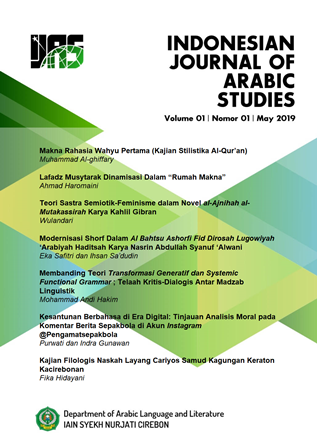
Lafadz Musytarak Dinamisasi Dalam Rumah Makna
DOI:
https://doi.org/10.24235/ijas.v1i1.4905Keywords:
Lafadz, Language, MusytarakAbstract
As a medium of human communication, the role of language is very important for human life. Language helps him express what is in his mind that is applied in the language system, even though it is intrinsically arbitrary "which is like" but in order to establish good communication it must be agreed by the user community. In its journey, the development of language faces the dynamics of meaning possessed by lafadz which is a container of meaning. Does it mean one meaning or allows another meaning to represent the lafadz? Arabic linguistic discourse known as musytarak Study of lafadz musytarak becomes important and - for a interpreter - he becomes a parameter of his competence in understanding the content of the Qur'an and - for ushuliyyin - is a condition that must be fulfilled considering they will perform istinbath al-ahkam-urgen for language learning and the development of Arabic linguistic studies. This short article attempts to explore the basicly of the study of musytarak.
References
Al-Faruqi, I. R., & Al-Faruqi, L. (1998). Atlas Budaya Islam. Bandung: Mizan.
Al-Ghalayaini, M. (1994). Jami’ Ad-Durus Al-’Arabiyah. Beirut:
Mansurot Al Maktabah Al 'Ashriyah.
Al-Jazairi, A. B. J. (2003). Aysar At-Tafsir. Madinah: Maktabah al'Ulum wa al-Hikam.
Al-Ma'arif, W. (1985). Al-Adab, Nushushuhu wa Tarikhuhu (6 ed.).
Mekah: Wazarah al-Ma'arif.
Al-Zuhaili, W. (2009). Tafsir Al-Munir. Damaskus: Dar al-Fikr.
Alfairuzzabadi. (1987). Al-Qamus al-Muhith. Beirut: Mu'asasah al-
Risalah.
Alwasilah, C. (1993). Linguistik Suatu Pengantar. Bandung: Angkasa.
Chaer, A. (2002). Pengantar Semantik Bahasa Indonesia. Jakarta: Rineka Cipta.
Djalil, A. B. (2014). Ilmu Ushul Fiqh. Jakarta: Kencana.
Hidayat, K. (2004). Menafsirkan Kehendak Tuhan. Jakarta: Teraju.
Kridalaksana, H. (2001). Kamus Linguistik. Jakarta: Gramedia.
Rakhmat, J. (2011). Retorika Modern. 2011: Rosda.
Sanusi, A., & Sohari. (2017). Ushul Fiqh. Jakarta: Rajawali Press.
Shahrur, M. (2004). Prinsip dan Dasar Hermeneutika Al-Qur’an
Kontemporer. Yogyakarta: Elsaq.
Shihab, M. Q. (2005a). Dia di Mana-mana. Jakarta: Lentera Hati.
Shihab, M. Q. (2005b). Tafsir Al-Misbah. Jakarta: Lentera Hati.
Shihab, M. Q. (2015). Kaidah Tafsir. Jakarta: Lentera Hati.
Suriasumantri, J. S. (2010). Filsafat Ilmu, Sebuah Pengantar Populer.
Jakarta: Sinar Harapan.
Syarifuddin, A. (2014). Ushul Fiqh. Jakarta: Kencana.
Zaidan, Z. (1996). Tarikh Adab al-Lughah al-‘Arabiyyah. Beirut: Dar al-Fikr.
Zayd, N. H. A. (2005). Tekstualitas Al-Qur’an (K. Nahdliyin, penerj.).
Yogyakarta: LKiS.
Zein, S. E. M. (2005). Ushul Fiqh. Jakarta: Kencana.
Downloads
Published
Issue
Section
License
Copyright (c) 2022 Ahmad Haromaini

This work is licensed under a Creative Commons Attribution-ShareAlike 4.0 International License.
- The author retains the copyright and grants the journal the right of first publication of the work simultaneously licensed under the Creative Commons Attribution-ShareAlike 4.0 License that allows others to share the work with an acknowledgment of the work's authorship and initial publication in this journal
- The author is able to enter into separate, additional contractual arrangements for the non-exclusive distribution of the journal's published version of the work (e.g., post it to an institutional repository or publish it in a book) with the acknowledgement of its initial publication in this journal.
- The author is permitted and encouraged to post his/her work online (e.g., in institutional repositories or on their website) prior to and during the submission process, as it can lead to productive exchanges, as well as earlier and greater citation of the published work.Â

Articles are licensed under a Lisensi Creative Commons Atribusi-BerbagiSerupa 4.0 Internasional.