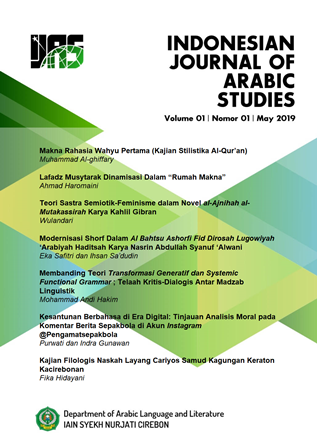
Kesantunan Berbahasa di Era Digital: Tinjauan Analisis Moral Pada Komentar Berita Sepakbola di Akun Instagram Pengamat sepak bola
DOI:
https://doi.org/10.24235/ijas.v1i1.4908Keywords:
politeness language, netizens, social media, commentsAbstract
Social media is a new space for the public to interact in the digital era. This crowded means of interaction raises new problems in social relations that is the number of netizens who use abusive language in comments. As a result, social media becomes a tool to insult people, fight and spread hatred. Therefore, this study has the aim to describe the use of impolite language of netizens in the social media comment column and the factors that influence it. This study uses a qualitative descriptive approach, note taking techniques, theory triangulation, and analysis techniques based on a moral’s point of view. The subject is netizens, while the object is politeness in language on social media. The results of this study are: a) netizens' language in commenting is categorized as impolite because it is contrary to the maxim of wisdom, generosity, appreciation, simplicity, consensus, and sympathy; b) factors that influence netizens in commenting are moral knowledge, recognized needs, mental readiness to accept new public spaces, cyberspace character, equality and a sense of friendship. Based on this research, it is needed material for digital society in using social media.
References
Aziz, M. A. (2018). Netizen Jurnalisme dan Tantangan Dakwah di Media Baru. Islamic Comunication, 3(2), 121–140.
Dari, A. W., Chandra, D. E., & Sugiyati, S. (2017). Analisis Kesantunan Berbahasa pada Kegiatan Pembelajaran Kelas VIII E Smpn 2 Kota Bengkulu Tahun Ajaran 2016/2017. 10–21.
Friedman, H. S., & Schustack, M. W. (2008). Kepribadian Teori Klasik dan Riset Modern (3 ed.). Jakarta: Erlangga.
Gunawan, I. (2018). Hubungan Sebab Akibat Ungkapan Pahlawan Tanpa Tanda Jasa terhadap Identitas dan Kesejahteraan Guru di Indonesia. Pedagogia: Jurnal Ilmu Pendidikan, 16(2), 123–130.
Hafiz, S. E. (2016). Moralitas di Internet: Kegagapan akan Ruang Publik Baru. In Psikologi dan Teknologi Informasi (hal. 191–125). Jakarta: Himpunan Psikologi Indonesia.
Inderasari, E., Achsani, F., & Lestari, B. (2019). Bahasa Sarkasme Netizen dalam Komentar Akun Instragram “Lambe Turah.†Semantik, 8(1), 37–49.
Lickona, T. (1997). Educating for character: A comprehensive approach. In The construction of children’s character.
Navarro, J. (2015). Cara Cepat Membaca Bahasa Tubuh. Jakarta Selatan: Change.
Pantu, A., & Luneto, B. (2017). Pendidikan Karakter dan Bahasa. Journal Al-Ulum, 14(1), 153–170.
Purwati. (2018). Analisis Interaksi Simbolik di Sekolah Dasar dalam Membangun Karakter Siswa. UPI.
Rahardi, R. K. (2005). Pragmatik Kesantunan Imperatif Bahasa Indonesia. Jakarta: Erlangga.
Sauri, S. (2017). Kesantunan Berbahasa (Kajian Nilai, Moral, Etika, Akhlak, dan Karakter). Bandung: Royyan Press.
Sudaryanto. (1992). Metode Linguistik. Yogyakarta: Gajah Mada University Press.
Supratman. (2017). Kesantunan Berbahasa Indonesia Santri dalam Pergaulan di Lingkungan Pondok Pesantren Al Bayan Makassar.
Yule, G. (2006). Pragmatik. Yogyakarta: Pustaka Pelajar.
Downloads
Published
Issue
Section
License
Copyright (c) 2022 Purwati Purwati, Indra Gunawan

This work is licensed under a Creative Commons Attribution-ShareAlike 4.0 International License.
- The author retains the copyright and grants the journal the right of first publication of the work simultaneously licensed under the Creative Commons Attribution-ShareAlike 4.0 License that allows others to share the work with an acknowledgment of the work's authorship and initial publication in this journal
- The author is able to enter into separate, additional contractual arrangements for the non-exclusive distribution of the journal's published version of the work (e.g., post it to an institutional repository or publish it in a book) with the acknowledgement of its initial publication in this journal.
- The author is permitted and encouraged to post his/her work online (e.g., in institutional repositories or on their website) prior to and during the submission process, as it can lead to productive exchanges, as well as earlier and greater citation of the published work.Â

Articles are licensed under a Lisensi Creative Commons Atribusi-BerbagiSerupa 4.0 Internasional.