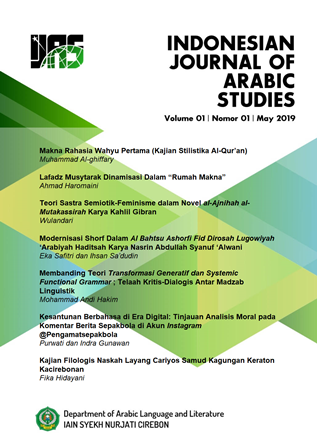
Kajian Filologis Naskah Layang Carios Samud Kagungan Kraton Kacirebonan
DOI:
https://doi.org/10.24235/ijas.v1i1.4921Keywords:
Philology, manuscript, Cirebon, Layang Carios Samud Kagungan Kraton Kacirebonan, religion.Abstract
Philology is a medium to explore a classical scientific treasures. This knowledge had been studied because there are values contained in  manuscripts that are still relevant to present life. These works are able to inform the thought, feeling, and information about various aspects of life that ever existed. One of the manuscript is Layang Carios Samud Kagungan Kraton Kacirebonan, which is from Cirebon. The manuscript is a translation from the Book of Hazar Masail that written in Persian (Iran) is a popular manuscript in the world in the Middle Ages, because it has been translated into various languages in the world. This manuscipt is expected be an additional reference in terms of religion for academics and the community.References
Baried, S. B., Sutrisno, S., Soeratno, S. C., Sawu, & Istanti, K. Z. (1994). Pengantar Teori Filologi. Yogyakarta: Badan Penelitian dan Publikasi Fakultas Seksi Filologi Fakultas Sastra Universitas Gadjah Mada.
Catford, J. C. (1965). A Linguistic Theory of Translation. London: Oxford University Press.
Djamaris, E. (1994). Hikayat Seribu Masalah. Jakarta: Pusat Pembinaan dan Pengembangan Bahasa Depertemen Pendidikan dan Kebudayaan.
Djamaris, E. (1997). Filologi dan Cara Kerja Penelitian Filologi, Bahasa dan Sastra. Jakarta: CV Manasco.
Djamaris, E. (2002). Metode Penelitian Filologi. Jakarta: CV Manasco.
Luthfi, K. M. (2016). Kontekstualisasi Filologi dalam Teks-Teks Islam Nusantara. Ibda’, 14, 114–128.
Mulyani, H. (2009). Membaca Manuskrip Jawa 2.
Munajjad, á¹¢alÄh al-DÄ«n. (1982). QawÄ’id al-Mahá¹Å«tÄt. BayrÅ«t: DÄr al-KitÄb al-JadÄ«d.
Pijper, G. F. (1924). Her Boek der Duizend Vragen. Leiden: E.J.Brill.
Robingatun. (2002). Kajian Filologi Serat Sekar Wijayakusuma. Universitas Negeri Yogyakarta.
Robinson, T. H. (1992). Linguistik Umum: Suatu Pengantar (S. Djajanegara, Penerj.). Yogyakarta: Kanisius.
Shipley, J. T. (1962). Dictionary of World Literature. Paterson-New Jersey: Littlefield Adam & co.
Sudibyo. (2007). Kembali Ke Filologi : Filologi Indonesia dan Tradisi Orientalisme. Humaniora, 19(2), 107–118.
Sudjiman, P. (1994). Filologi Melayu. Pustaka Jaya.
Suryani, E. (2012). Filologi. Bogor: Ghalia Indonesia.
Winstedt, S. R. (1969). No Title. Kuala Lumpur: Oxford University Press.
Downloads
Published
Issue
Section
License
Copyright (c) 2022 Fika Hidayani

This work is licensed under a Creative Commons Attribution-ShareAlike 4.0 International License.
- The author retains the copyright and grants the journal the right of first publication of the work simultaneously licensed under the Creative Commons Attribution-ShareAlike 4.0 License that allows others to share the work with an acknowledgment of the work's authorship and initial publication in this journal
- The author is able to enter into separate, additional contractual arrangements for the non-exclusive distribution of the journal's published version of the work (e.g., post it to an institutional repository or publish it in a book) with the acknowledgement of its initial publication in this journal.
- The author is permitted and encouraged to post his/her work online (e.g., in institutional repositories or on their website) prior to and during the submission process, as it can lead to productive exchanges, as well as earlier and greater citation of the published work.Â

Articles are licensed under a Lisensi Creative Commons Atribusi-BerbagiSerupa 4.0 Internasional.