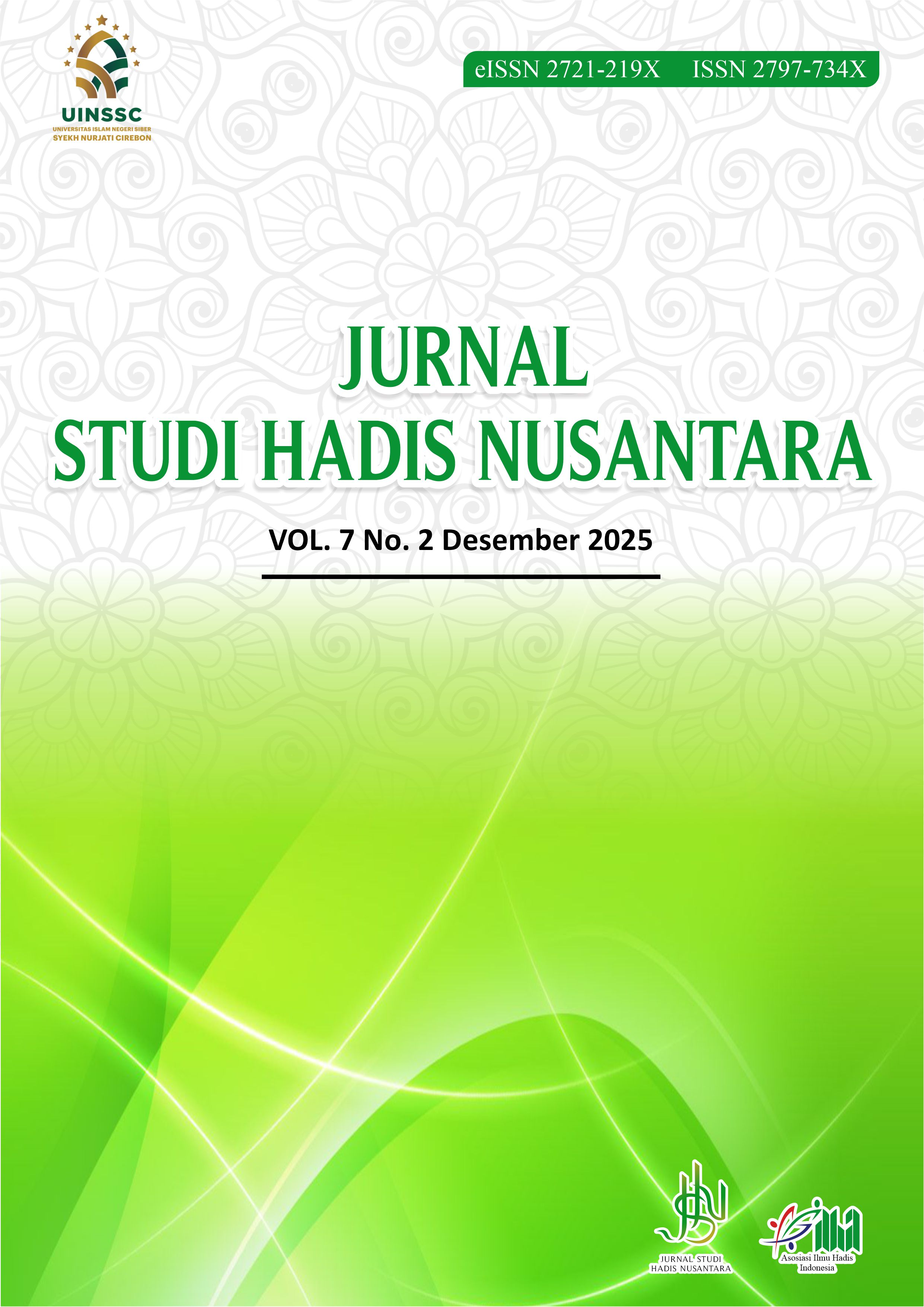
THE PROHIBITION OF SITTING ON GRAVES IN THE PERSPECTIVE OF HADITH: A NORMATIVE AND ETHICAL STUDY IN ISLAMIC TRADITION
DOI:
https://doi.org/10.24235/xsty4q84Abstract
This article examines the prohibition of sitting on graves from the perspective of the Prophetic Hadith by emphasizing historical, normative, and contextual dimensions. The study is motivated by contemporary phenomena in which graveyards are not only used as sites of pilgrimage but also function as spaces for social activities, such as commercial practices found in the Pocong Market in Palembang. Employing a qualitative descriptiveanalytical method, this research analyzes relevant Hadiths through the lenses of asbāb alwurūd, linguistic structure, meanings and wisdom, as well as scholarly debates regarding their legal implications. The findings indicate that the prohibition of sitting on graves is grounded in strong Hadith transmission and aims to preserve human dignity after death and maintain the sanctity of burial sites. Scholarly differences concerning whether the ruling is ḥarām or makrūh stem mainly from contextual considerations and the intention behind the act, yet converge on the shared principle of honoring the deceased. This study concludes that the prohibition functions not merely as a legal injunction but also as an ethical and spiritual guideline that remains relevant for regulating proper conduct (adab) toward graves in contemporary Muslim society.
Downloads
Published
Issue
Section
License
Copyright (c) 2026 Alfi Syahrin Ramadhan, Uswatun Hasanah, Nurchalidin Nurchalidin

This work is licensed under a Creative Commons Attribution 4.0 International License.
- Authors retain copyright and grant the journal right of first publication with the work simultaneously licensed under a Creative Commons Attribution License that allows others to share the work with an acknowledgement of the work's authorship and initial publication in this journal.
- Authors are able to enter into separate, additional contractual arrangements for the non-exclusive distribution of the journal's published version of the work (e.g., post it to an institutional repository or publish it in a book), with an acknowledgement of its initial publication in this journal.
- Authors are permitted and encouraged to post their work online (e.g., in institutional repositories or on their website) prior to and during the submission process, as it can lead to productive exchanges, as well as earlier and greater citation of published work.
This work is licensed under CC BY 4.0