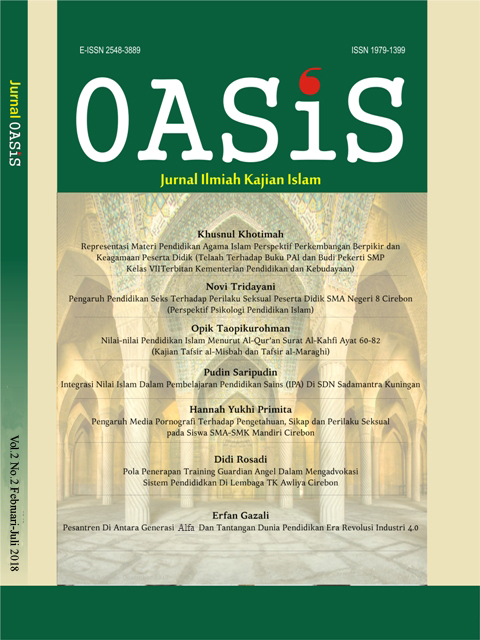
POLA PENERAPAN TRAINING GUARDIAN ANGEL DALAM MENGADVOKASI SISTEM PENDIDIDKAN DI LEMBAGA TK AWLIYA CIREBON
DOI:
https://doi.org/10.24235/oasis.v2i2.2758Keywords:
Multiple Intelligences, Awliya, Guardian AngelAbstract
It is unfortunate that many children who have talent, are not awarded, School only emphasizes the ability of logic and language. The result of research by using case study technique and field with interview method, it can be concluded that: Guardian Angel guidance pattern is education accompaniment by using design that involves institution, teacher, parents, community around. With Guardian Angel guidance teaching system at Awliya Cirebon Kindergarten become more innovative and creative.So fun and comfortable for educators in institutionalized Kindergarten Awliya Cirebon. Implementation of a socialized system in every activity from start understanding the system, how to work and evaluation in the application of the system continues to be accompanied. Among the system design paradigm learning, making product learning outcomes, authentic assessment, process-based assessment. The barrier factor is divided into two, internal factors lack of teacher awareness in receiving the fund system running the teacher system is not fully ready with the new system, especially the detailed lesson plan. external factors is the low socialization activities to parents and the surrounding environment.
Â
Pola pendampingan Guardian Angel merupakan pendampingan pendidikan dengan menggunakan desain yang melibatkan lembaga, guru, orang tua, masyarakat sekitar.Dengan pendampingan Guardian Angel sistem pengajaran di TK Awliya Cirebon menjadi lebih inovatif dan kreatif. Sehingga menyenangkan dan nyaman bagi pelaku pendidikan dilembaga TK Awliya Cirebon. Implementasi sistem yang disosialisasikan disetiap kegiatan dari mulai pemahaman sistem, cara kerja serta evaluasi dalam penerapannya sistem terus didampingi. Diantaranya desain sistemnya yaitu: paradigm belajar, modalitas belajar, memori jangka panjang, membuat produk hasil belajar, penilaiana utentik, penilaian berbasis proses. Adapun faktor hambatan terbagi dua, faktor internal kekurangan siapnya guru dalam menerima sistem dana menjalankan sistem guru belum sepenuhnya siap dengan sistem yang baru, terutama lesson plan yang detail. faktor eksternal adalah rendahnya kegiatan sosialisasi kepada orang tua dan lingkungan sekitar.
Â
References
Arif, R. (2007). Pengantar Penelitian Dalam Pendidikan. Yogyakarta: Pustaka pelajar.
Chatib, M. (2009). Sekolahnya Manusia. Bandung: Mizan Pustaka.
Hamalik, O. (2001). Psikologi Belajar Dan Mengajar. Bandung: Sinar Baru.
Megawangi, R. (2007). Pendidikan Karakter Solusi Yang Tepat Untuk Membangun Bangsa. Jakarta: Indonesia Heritage Foundation.
Miarso. (2004). Menyemai Benih Teknologi Pendidikan. Jakarta: Kencana.
Mulyasa, E. (2002). Manajemen PAUD. Bandung: Remaja Rosdakarya.
Pekik, D. (2002). Dasar Kepelatihan. Yogyakarta: Andi.
Rahmawati. (2010). Pengelolaan Lingkungna Belajar. Jakarta: Kencana.
Rohendi, T. (1992). Analisis Data Kualitatif. Jakarta: UI Pres.
Sukmadinata, S. (2005). Metode Penelitian Pendidikan. Bandung: Remaja Rosdakarya.
Yuliani, S., & Nurani. (2009). Konsep Dasar Pendidikan Anak Usia Dini. Jakarta: PT Indeks.
Downloads
Published
Issue
Section
License
Copyright (c) 2018 Oasis : Jurnal Ilmiah Kajian Islam

This work is licensed under a Creative Commons Attribution-ShareAlike 4.0 International License.
Authors whose manuscripts are published agree to the following provisions:
1. Publication rights for all journal manuscript materials published/published on the OASIS E-Journal site Jurnal Ilmiah Kajian Islam is held by the editorial board with the knowledge of the author (moral rights remain with the author of the manuscript).
2. Formal legal provisions for access to digital articles in this electronic journal are subject to the terms of the Creative Commons Attribution-ShareAlike (CC BY-SA) license, which means that the OASIS Journal Jurnal Ilmiah Kajian Islam has the right to store, transfer media/format, manage in the form of a database, maintain, and publish articles without asking permission from the Author as long as the Author's name is listed as the Copyright owner.
3. Manuscripts published/published in print and electronically are open access for educational, research, and library purposes. Apart from these purposes, the editorial board is not responsible for violations of copyright law.