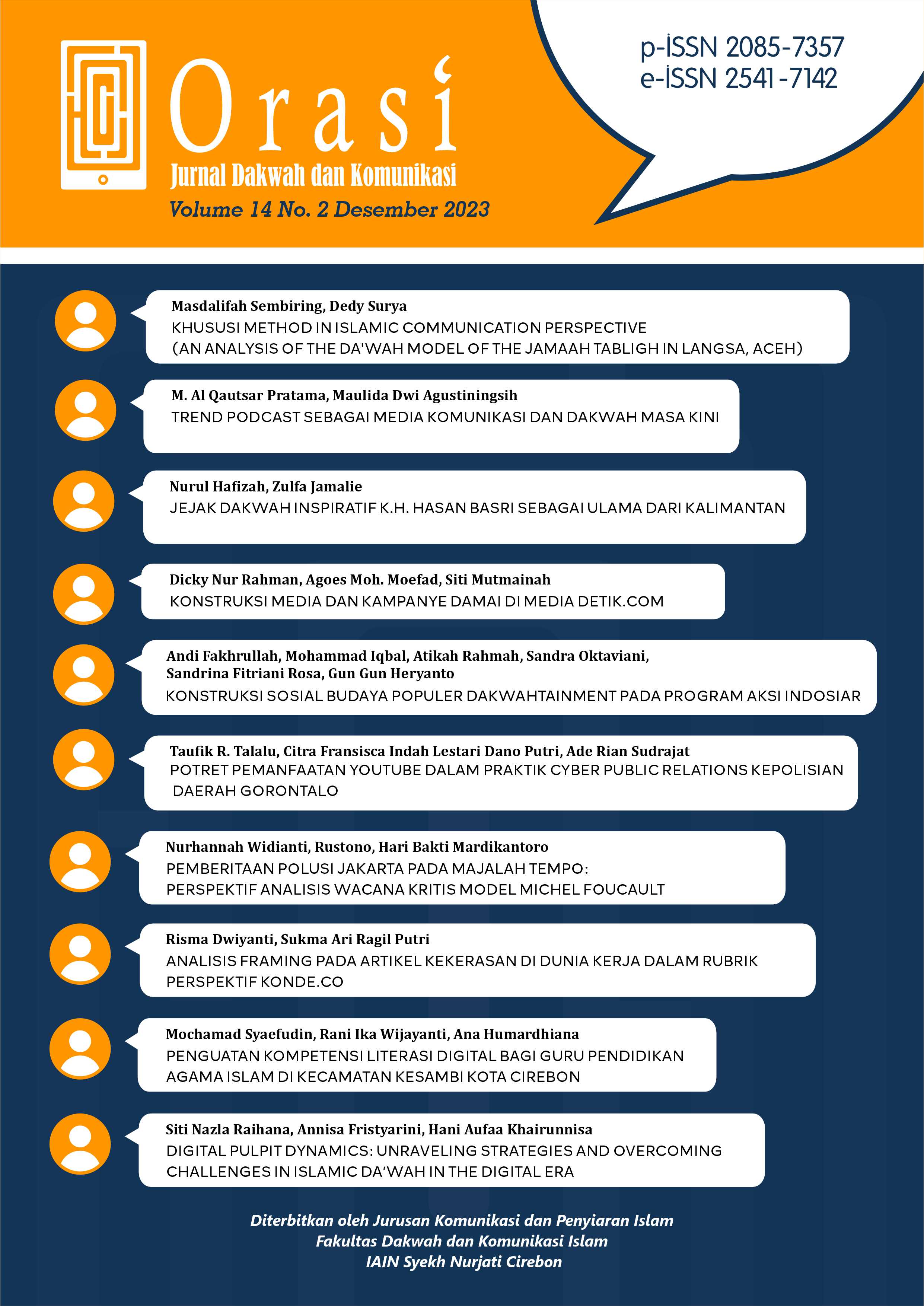
KHUSUSI METHOD IN ISLAMIC COMMUNICATION PERSPECTIVE (AN ANALYSIS OF THE DAKWAH MODEL OF THE JAMAAH TABLIGH IN LANGSA, ACEH)
DOI:
https://doi.org/10.24235/orasi.v14i2.11957Keywords:
Aceh, Dakwah Model, Islamic Communication, Jamaah Tabligh, Khususi MethodAbstract
This study explains the particular dakwah model as a communication method carried out by the Jamaah Tabligh (JT). Some questions studied are how the model is specialized in the dakwah of JT and how this dakwah method is in the perspective of Islamic communication. By using qualitative methods, this study concludes that specialization is a program carried out by JT by visiting or visiting peoples homes. During the visit, messages will be communicated according to the person visited. There are five variants of the particular method. The systematic series of the unique method pays excellent attention to the communicant. This is in accordance with the ethical principles of Islamic communication, namely communication procedures that are in accordance with moral values by containing Islamic elements that direct humans to the benefit of the world and the hereafter in the form of human relationships with God (faith), fellow humans and the universe.
References
Al-Hafni, Abdul Munâim. 2005. Ensiklopedia Golongan, Kelompok, Aliran, Mazhab, Partau, dan Gerakan Islam Seluruh Dunia. Grafindo Khazanah Ilmu.
Al-Zaman, Md Sayeed. 2020. Religious Communication in Digital Public Sphere. Jurnal Penelitian, 17(1), 29. https://doi.org/10.28918/jupe.v17i1.2743
Bustamam-Ahmad, Kamaruzzaman. 2008. The History of Jamaah Tabligh in Southeast Asia: The Role of Islamic Sufism in Islamic Revival. Al-Jamiah: Journal of Islamic Studies, 46(2), 353-400. https://doi.org/10.14421/ajis.2008.462.353-400
Dayyan, Muhammad, Ainun Mardhiah, and Masdalifah Sembiring. 2019. Dakwah Experience, Spiritual, and Economic Resilience of Jamaah Tabligh in Langsa Aceh. Jurnal Ilmiah Islam Futura, 19(2), 203. https://doi.org/10.22373/jiif.v19i2.4545
Furqan. 2015. Peran Jamaah Tabligh Dalam Pengembangan Dakwah. Jurnal Al-Bayan: Media Kajian Dan Pengembangan Ilmu Dakwah, 21(2), 32. https://www.jurnal.ar-raniry.ac.id/index.php/bayan/article/view/419
Husein, Fatimah, & Slama, Martin. 2018. Online piety and its discontent: revisiting Islamic anxieties on Indonesian social media. Indonesia and the Malay World, 46(134), 80-93. https://doi.org/10.1080/13639811.2018.1415056
Kementerian Agama. 2012. Al-Quran dan Tafsirnya. PT Sinergi Pustaka Indonesia.
Mujiburrahman. 2017. Urgensi Kebijakan Program Beut Al-Quran BaDa Magrib Terhadap Peningkatan Literasi Al-Quran Bagi Anak Usia Sekolah Di Aceh Besar. Jurnal MUDARRISUNA: Media Kajian Pendidikan Agama Islam, 7(2), 213. https://doi.org/10.22373/jm.v7i2.2362
Muslimah. 2016. Etika Komunikasi dalam Persfektif Islam. Sosial Budaya, 13(2), 115-125.
Nisa, Eva F. 2018. Social media and the birth of an Islamic social movement: ODOJ (One Day One Juz) in contemporary Indonesia. Indonesia and the Malay World, 46(134), 24-43. https://doi.org/10.1080/13639811.2017.1416758
Purwanto. 2017. Methode Dakwah Jamaah Tabligh; Studi Atas Methode Dakwah Jamaah Tabligh Di Lingkungan Pondok Pesantren Al Fatah, Temboro, Karas, Magetan. IAIN Ponorogo.
Rosyid. 2019. Esensi Komunikasi Islam. http://ilkom.unida.gontor.ac.id/esensi-komunikasi-islam/
Saepuloh, Ujang. 2014. Model Komunikasi Dakwah Jamaah Tabligh. Ilmu Dakwah: Academic Journal for Homiletic Studies, 4(14), 657-688.
Soeradi. 2013. Perubahan Sosial Dan Ketahanan Keluarga: Meretas Kebijakan Berbasis Kekuatan Lokal. Sosio Informa, 18(2), 83-94. https://doi.org/10.33007/inf.v18i2.74
Wulan, Eneng Sri. 2017. Hadis-hadis tentang keutamaan dakwah. Ilmu Dakwah, 1, 1-12.
Downloads
Published
Issue
Section
License
Copyright (c) 2023 ORASI: Jurnal Dakwah dan Komunikasi

This work is licensed under a Creative Commons Attribution-ShareAlike 4.0 International License.

Copyright Notice
An author who publishes in the Orasi: Jurnal Dakwah dan Komunikasi agrees to the following terms:
- Author retains the copyright and grants the journal the right of first publication of the work simultaneously licensed under the Creative Commons Attribution 4.0 International License that allows others to share the work with an acknowledgement of the work's authorship and initial publication in this journal
- Author is able to enter into separate, additional contractual arrangements for the non-exclusive distribution of the journal's published version of the work (e.g., post it to an institutional repository or publish it in a book) with the acknowledgement of its initial publication in this journal.
- Author is permitted and encouraged to post his/her work online (e.g., in institutional repositories or on their website) prior to and during the submission process, as it can lead to productive exchanges, as well as earlier and greater citation of the published work (See The Effect of Open Access).