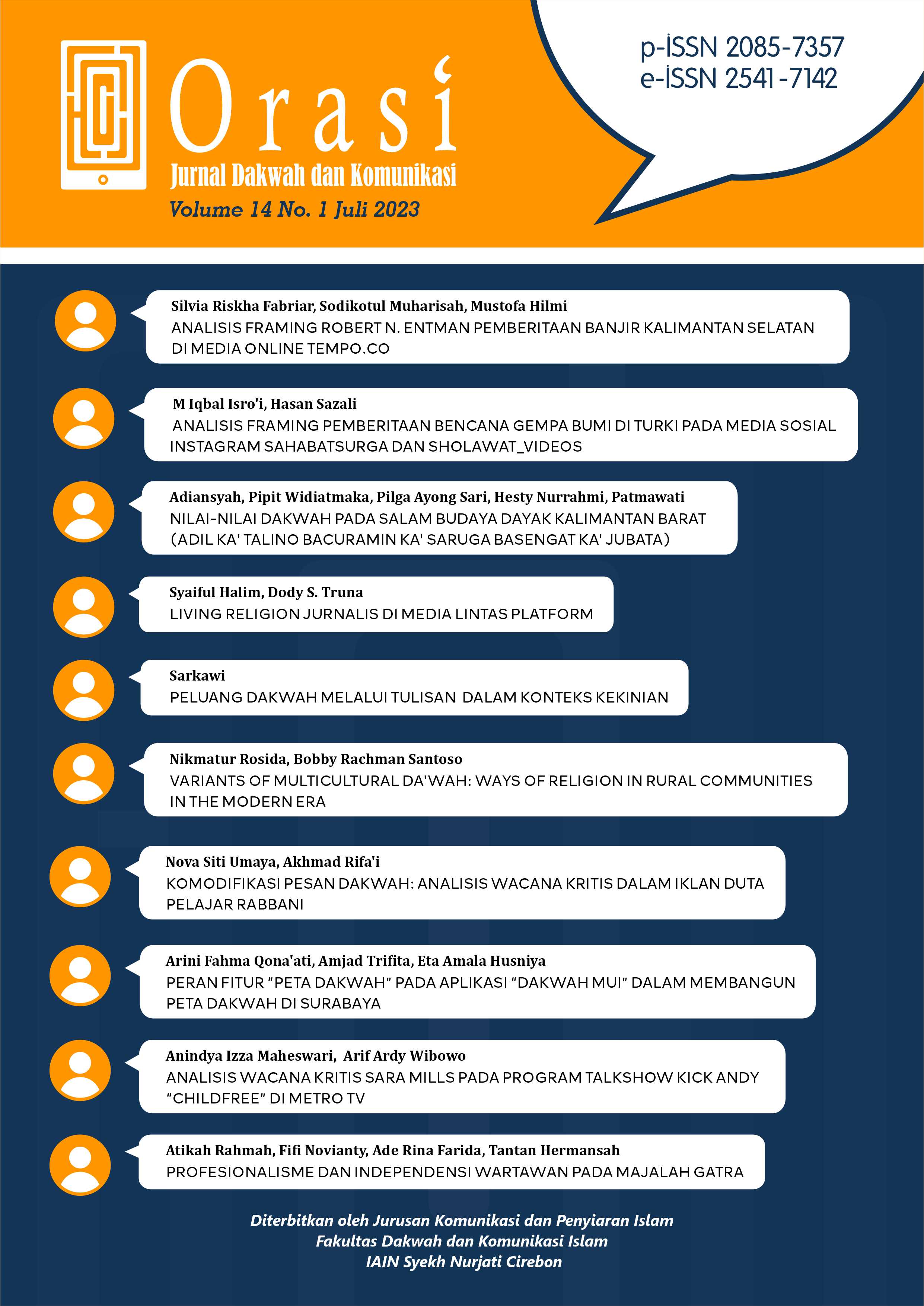
VARIANTS OF MULTICULTURAL DAWAH: WAYS OF RELIGION IN RURAL COMMUNITIES IN THE MODERN ERA
DOI:
https://doi.org/10.24235/orasi.v14i1.13388Keywords:
Da'wah, Multiculturalism, Rural Mad'uAbstract
In the modern era, da'wah is increasingly required to be carried out according to the social changes existing in society. Not only do Mad'u (da'wah audience) nowadays consume da'wah presented directly by the da'i (preacher), but also through social media and the influence of modernism. Interestingly, in Kesamben Village, some mad'u still listen to the da'wah presented culturally. It indicates that there are variants of da'wah that occur in the lives of rural communities. One of them is multicultural da'wah. Multicultural da'wah is an effort to invite mad'u on the right path amid cultural diversity through tolerance, ukhuwah, and many more. So, there are two main problem formulations, namely (1) What are the da'wah criteria needed by the community in Kesamben Village? and (2) What are the ways in practicing religion amidst cultural diversity? To answer the formulation of the problem, researchers used qualitative research methods with a sociological approach. The primary source used was the Muslim community of Kesamben Village, while the secondary sources were books, journals, and articles related to the research objects. The data collection techniques were observation, interview, and documentation. The research results show that rural communities need da'wah delivered by da'i in a polite, humane, and humorous manner. In addition, village people tend to follow a culture that does not violate Islamic law. Even though the modern era has had a major influence on people's lives, mad'u in Kesamben Village still preserve religious culture by not denying technological developments.
References
Abdullah. 2018. Ilmu Dakwah: Kajian Ontologi, Epistimologi, Aksiologi, Dan Aplikasi Dakwah. Depok: Rajawali Pers.
Amin, Samsul Munir. 2009. Ilmu Dakwah. Jakarta: Hamzah.
Ancok, Djamaludin, and Fuat Nashori Suroso. 1994. PSIKOLOGI ISLAMI Solusi Islam Atas Problem-Problem Psikologi. Yogyakarta: Pustaka Pelajar.
Anshari, Hafi. 1993. Pemahaman Dan Pengamalan Dakwah (Pedoman Untuk Mujahid Dakwah). Surabaya: Al-Ikhlas.
Aripudin, Acep, and Syukriadi Sambas. 2012. Dakwah Damai : Pengantar Dakwah Antarbudaya. Bandung: PT. Remaja Rosda Karya.
AS, Enjang, and Aliyudin. 2009. Dasar-Dasar Ilmu Dakwah. Bandung: Widya Padjajaran.
Azis, Abdul, Nor Muslim, and Biti Zainab. 2018. Tantangan Dakwah Pada Masyarakat Multikultural Di Kalimantan Tengah. Wardah 19 (2): 122 “34. https://doi.org/https://doi.org/10.19109/wardah.v19i2.
Aziz, Moh. Ali. 2015. Ilmu Dakwah. Edisi Revi. Jakarta: Kencana Prenada Media Group.
Darmansyah. 2010. Strategi Pembelajaran Menyenangkan Dengan Humor. Jakarta: PT. Bumi Aksara.
Hendra, Tomi. 2020. Dakwah Pada Masyarakat Multikultural. Hikmah : Jurnal Ilmu Dakwah Dan Komunikasi Islam 14 (1): 1 “14. https://doi.org/https://doi.org/10.24952/hik.v14i1.2536.
Lutfi. 2010. Peran Selingan Humor Dalam Kesuksesan Penyampaian Materi Dakwah. Jakarta: Jurnal UINSU.
Moleong. 2014. Metodologi Penelitian Kualitatif. Bandung: PT. Remaja Rosdakarya.
Mufida, Hindy Rahma, and Ahmad Nurcholis. 2021. Dakwah Multikultural Kiai Pedesaan Di Era Modern. Al Hikmah 15 (1): 37 “52. https://doi.org/https://doi.org/10.24260/jhjd.v15i1.1897.g986.
Munir, Muhammad, and Wahyu Ilaihi. 2006. Manajemen Dakwah. Cetakan 1. Jakarta: Kencana.
Santoso, Bobby Rachman. 2019. Revitalisasi Metode Dakwah Anakronitis Dai Generasi Milenial. Tasamuh 17 (1): 133 . https://doi.org/https://doi.org/10.20414/tasamuh.v17i1.1350.
Saputra, Wahidin. 2011. Pengantar Ilmu Dakwah. Jakarta: PT. Raja Grafindo Persada.
Sedyawaty, Edy. 2006. Budaya Indonesia, Kajian Arkeologi, Seni, Dan Sejarah. Jakarta: Raja Grafindo Persada.
Downloads
Published
Issue
Section
License
Copyright (c) 2023 ORASI: Jurnal Dakwah dan Komunikasi

This work is licensed under a Creative Commons Attribution-ShareAlike 4.0 International License.

Copyright Notice
An author who publishes in the Orasi: Jurnal Dakwah dan Komunikasi agrees to the following terms:
- Author retains the copyright and grants the journal the right of first publication of the work simultaneously licensed under the Creative Commons Attribution 4.0 International License that allows others to share the work with an acknowledgement of the work's authorship and initial publication in this journal
- Author is able to enter into separate, additional contractual arrangements for the non-exclusive distribution of the journal's published version of the work (e.g., post it to an institutional repository or publish it in a book) with the acknowledgement of its initial publication in this journal.
- Author is permitted and encouraged to post his/her work online (e.g., in institutional repositories or on their website) prior to and during the submission process, as it can lead to productive exchanges, as well as earlier and greater citation of the published work (See The Effect of Open Access).