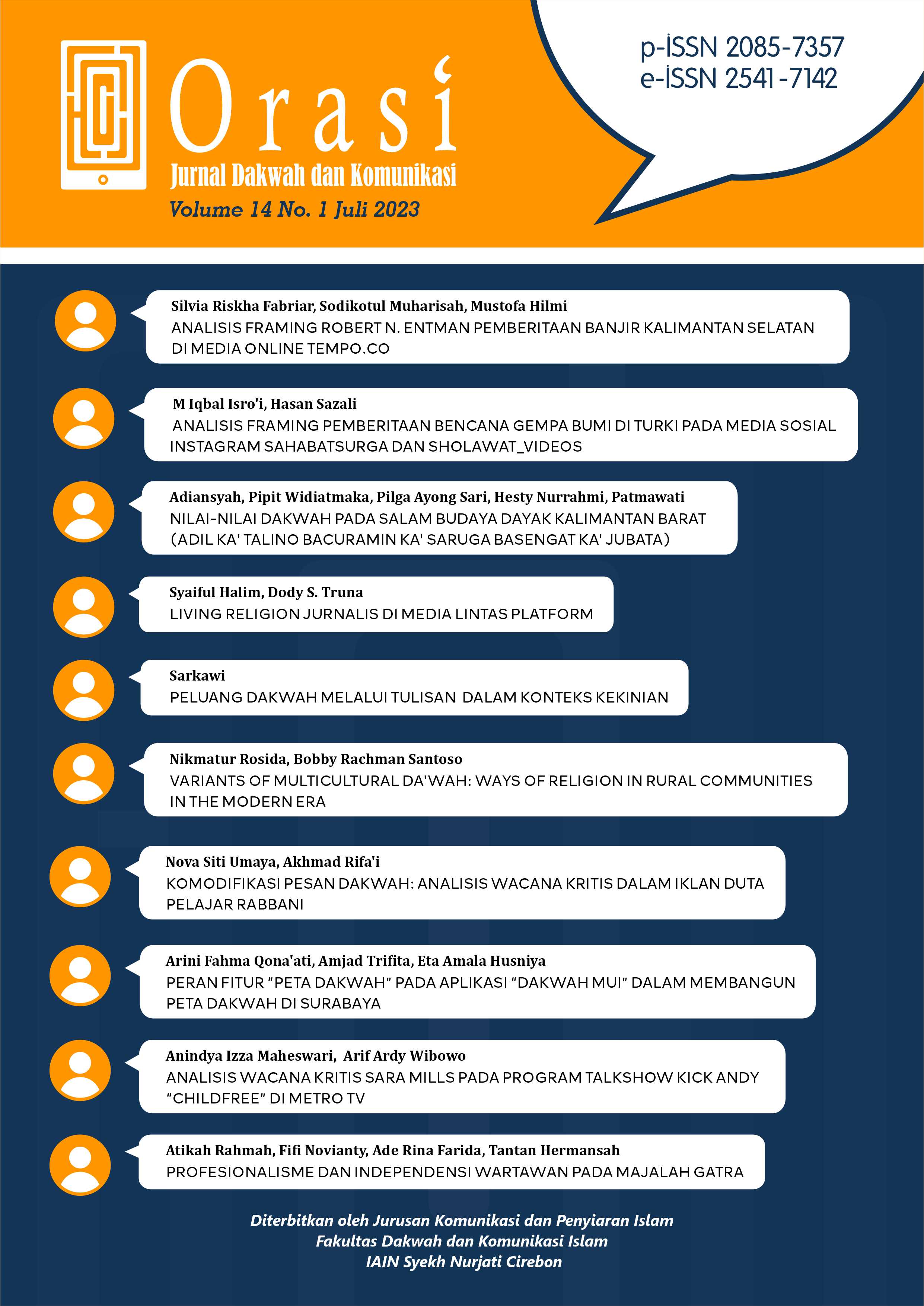
ANALISIS WACANA KRITIS SARA MILLS PADA PROGRAM TALKSHOW KICK ANDY CHILDFREE DI METRO TV
DOI:
https://doi.org/10.24235/orasi.v14i1.13454Keywords:
Analisis Wacana Kritis Sara Mills, Childfree, Kick Andy, Posisi Pembaca, Posisi Subjek-ObjekAbstract
Tujuan penelitian ini ialah untuk menganalisis dan mendeskripsikan wacana kritis pada program talkshow Kick Andy berjudul childfree dengan pendekatan Sara Mills. Jenis penelitian ini adalah penelitian kualitatif dengan menggunakan metode deskriptif. Objek penelitian yaitu representasi childfree yang terdapat dalam program talkshow Kick Andy berjudul Childfree. Hasil penelitian ini adalah posisi sebagai subjek di dalam tayangan program talkshow Kick Andy berjudul Childfree ditempati oleh narasumber yang menyampaikan narasi tentang childfree. Sedangkan posisi pembaca ditempati oleh penonton tayangan program tersebut. Representasi childfree yang muncul dalam talkshow adalah terdapat beberapa latar belakang seseorang memutuskan untuk childfree yaitu adanya pengalaman traumatis di masa lalu yang pernah dialami seseorang di keluarganya, menganggap keberadaan anak sebagai beban, tidak memiliki kesiapan mental, dan pelaku childfree sudah merasa cukup Bahagia dengan pasangannya.References
Alamsyah, Femi Fauziah. 2020. Representasi, Ideologi Dan Rekonstruksi Media. Universitas Muhammadiyah Bandung.
Andriana, Mella, and Ngusman Abdul Manaf. 2022. Analisis Wacana Kritis Sara Mills Dalam Novel Berkisar Merah Karya Ahmad Tohari. Deiksis 14 (1): 73. https://doi.org/10.30998/deiksis.v14i1.9961.
Cabrera, Mar a Silvestre. 2021. The Fourth Wave in Audiovisual Content: A True Achievement of Feminism? International Journal of Communication 15 (January): 416 “38.
Erantika, Dewi Erawati, and Asnawi. 2021. Analisis Wacana Kritis Model Sara Mills Dalam Novel Sunyi Di Dada Sumirah Karya Artie Ahmad. J-LELC: Journal of Language Education, Linguistics, and Cultur 1 (3): 12 “29.
Griffin, E A, A Ledbetter, and G G Sparks. 2019. A First Look at Communication Theory. 10th ed. New York: McGraw-Hill Education. https://books.google.co.id/books?id=mrRAswEACAAJ.
Haryati, Sri. 2017. Aliran Feminisme Modern Dan Aliran Feminisme. Jurnal Hukum Jatiswara, 145 “60.
Ilaa, Dhiyaa Thurfah. 2021. Feminisme Dan Kebebasan Perempuan Indonesia Dalam Filosofi. Jurnal Filsafat Indonesia 4 (3): 211. https://doi.org/10.23887/jfi.v4i3.31115.
Irawan, Mohamad Deny. 2021. Childfree, Produk Individualisme, Feminisme Atau Pesimisme? 2021.
Khasanah, Uswatul, and Muhammad Rosyid Ridho. 2021. Childfree Perspektif Hak Reproduksi Perempuan Dalam Islam. Al-Syakhsiyyah: Journal of Law & Family Studies 3 (2): 104 “28. https://doi.org/10.21154/syakhsiyyah.v3i2.3454.
Media Indonesia. 2021. Fenomena Childfree Indonesia. 2021.
Nugrahani, Dr Farida. 2014. Metode Penelitian Kualitatif. 1st ed. Solo: CV Djiwa Amarta.
Nugroho, Azis, Suseno, and Dyah Prabaningrum. 2021. Jurnal Sastra Indonesia Perspektif Feminisme Dalam Novel Si Parasit Lajang Karya Ayu Utami: Kajian Feminist Standpoint Theory Nancy C. M. Hartsock. Jurnal Sastra Indonesia 10 (2): 133 “41. https://doi.org/10.15294/jsi.v10i2.48329.
Rohana & Syamsuddin. 2015. Buku Analisis Wacana.
Downloads
Published
Issue
Section
License
Copyright (c) 2023 ORASI: Jurnal Dakwah dan Komunikasi

This work is licensed under a Creative Commons Attribution-ShareAlike 4.0 International License.
Copyright Notice
An author who publishes in the Orasi: Jurnal Dakwah dan Komunikasi agrees to the following terms:
- Author retains the copyright and grants the journal the right of first publication of the work simultaneously licensed under the Creative Commons Attribution 4.0 International License that allows others to share the work with an acknowledgement of the work's authorship and initial publication in this journal
- Author is able to enter into separate, additional contractual arrangements for the non-exclusive distribution of the journal's published version of the work (e.g., post it to an institutional repository or publish it in a book) with the acknowledgement of its initial publication in this journal.
- Author is permitted and encouraged to post his/her work online (e.g., in institutional repositories or on their website) prior to and during the submission process, as it can lead to productive exchanges, as well as earlier and greater citation of the published work (See The Effect of Open Access).