
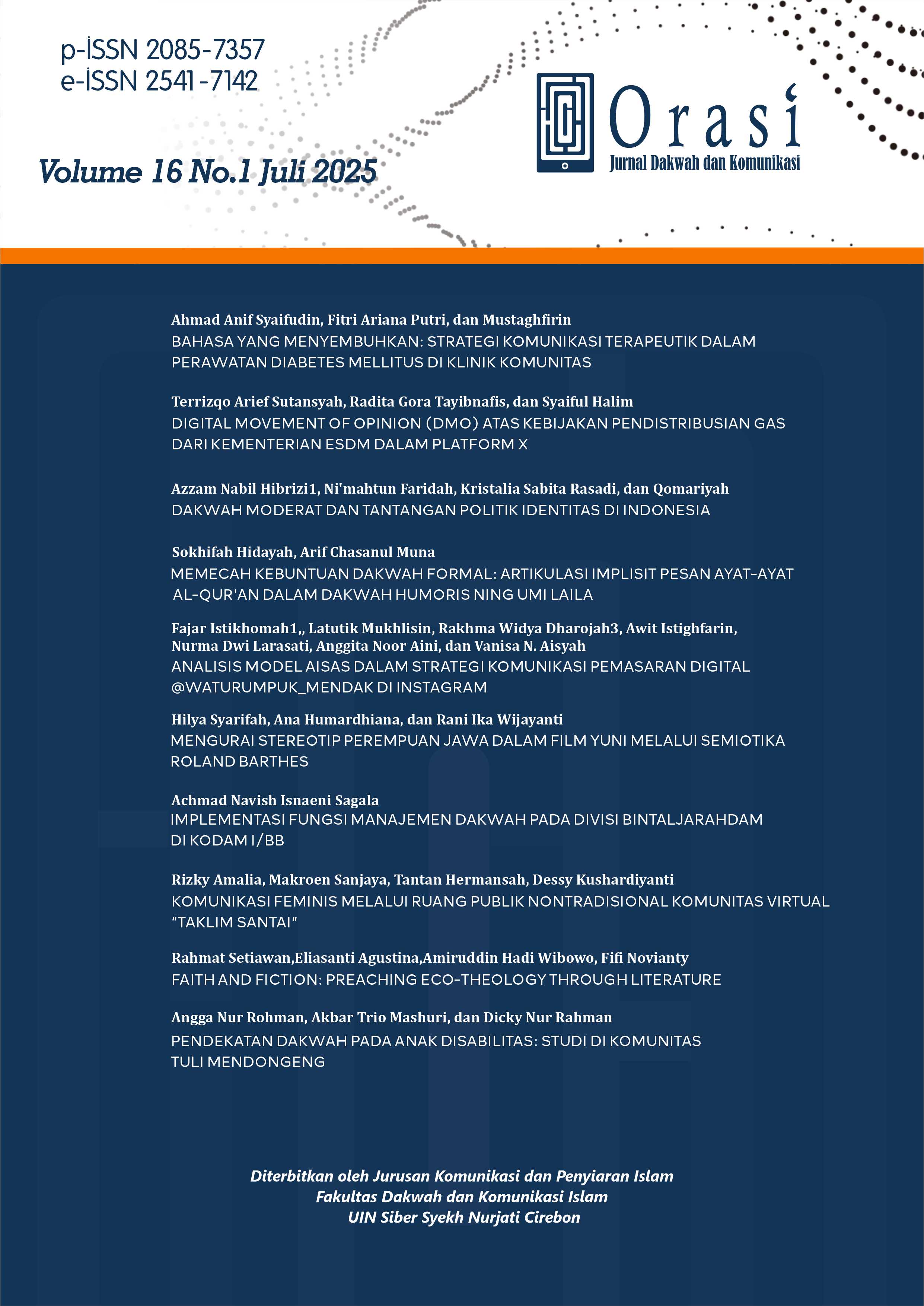
Faith and Fiction: Preaching Eco-theology through Literature
DOI:
https://doi.org/10.24235/orasi.v16i1.20382Keywords:
Literature, Eco-theology, Preaching, LiteracyAbstract
This research aims to reveal how literature lecturers communicate eco-theological values through the teaching of literature, as well as identify the obstacles. This type of research is qualitative, with a narrative approach. The main data were taken from in-depth interviews with literature lecturers. The data analysis technique used in this research is thematic analysis with a hermeneutic approach. Data validity uses triangulation of data sources, member checking, and critical reflection from the researcher. The results showed that: 1) eco-theological becomes a theoretical reflection on the approach used by the speakers; 2) literary works can act as ecological and spiritual preaching spaces; 3) insignificant ecological literacy, curriculum limitations, and students’ unpreparedness become structural and cultural challenges in literary education with an eco-theological perspective); and 4) the need for curriculum reformulation in literature to improve the eco-theological approach. In this pivotal point, teaching can be seen as da’wah and da’wah is not merely about religiosity in orthodox perception.
References
Abdelzaher, D. M., Kotb, A., & Helfaya, A. (2019). Eco-Islam: Beyond the Principles of Why and What, and Into the Principles of How. Journal of Business Ethics, 155(3). https://doi.org/10.1007/s10551-017-3518-2
Aditama, A., Muthohirin, N., & Rafliyanto, M. (2023). Analyzing Ecotheology from The Perspective of Islam and Christianity. Progresiva : Jurnal Pemikiran Dan Pendidikan Islam, 12(01). https://doi.org/10.22219/progresiva.v12i01.27291
Affandi, Y., Riyadi, A., Taufiq, I., Kasdi, A., Farida, U., Karim, A., & Mufid, A. (2022). Da’wah Qur’aniyah Based on Environmental Conversation: Revitalizing Spiritual Capital Ecotheology, Environmentally Friendly, Gender Responsive. Pertanika Journal of Social Sciences and Humanities, 30(1). https://doi.org/10.47836/pjssh.30.1.09
Afzal Farooq, M. A., & Chandra, N. D. R. (2012). Ecocriticism: Relevance of William Wordsworth’s “Tintern Abbey” and “The World is too Much with Us.” Journal of Literature, Culture and Media Studies, 4(7 & 8).
Ahmad, S. (2020). Moral Kekhalifahan Manusia Dalam Al-Quran Menurut Teori Ecotheology Islam: Studi Tafsir Tematik. Jurnal Perspektif, 4(2).
Ahmad Wani, S., & Tiwari, S. (2023). Estrangement of Man from Nature: An Ecocritical Study of Kiran Desai’s The Inheritance of Loss. Research Journal of Humanities and Social Sciences. https://doi.org/10.52711/2321-5828.2023.00022
Alves, I. M. S., & De Oliveira, S. R. F. (2021). Education, utopia and paulo freire. Praxis Educativa, 16. https://doi.org/10.5212/PraxEduc.v.16.16596.048
Andi Muda Purniawan, Y. (2020). Ecotheology Menurut Seyyed Hossein Nasr dan Sallie McFague. Jurnal Teologi, 9(1).
Bahrawi, N. (2013). Hope of a hopeless world: eco-teleology in Margaret Atwood’s Oryx and Crake and The Year of the Flood . Green Letters, 17(3). https://doi.org/10.1080/14688417.2013.862156
Blessy, C., & Alexander, A. (2019). Eradication of dichotomies between theology and the natural world in wendell berry’s jayber crow. Humanities & Social Sciences Reviews, 7(5). https://doi.org/10.18510/hssr.2019.75173
Darmaji, A. (2014). Dasar-Dasar Ontologis Pemahaman Hermeneutik Hans-Georg Gadamer. Refleksi, 13(4). https://doi.org/10.15408/ref.v13i4.911
Demirel Ucan, A., & Wright, A. (2019). Improving the pedagogy of Islamic religious education through an application of critical religious education, variation theory and the learning study model. British Journal of Religious Education, 41(2). https://doi.org/10.1080/01416200.2018.1484695
Fleming, T. (2022). Mezirow’s Theory of Transformative Learning and Freire’s Pedagogy. Adult Education Critical Issues, 2(2). https://doi.org/10.12681/haea.32302
Giroux, H. A. (2021). Paulo Freire and the Politics of Critical Pedagogy: a Legacy for Struggle. Revista Enfoques Educacionales, 18(2).
Hayatuddiniyah, H. (2021). Kritik Hermeneutika Filsafat Hans Georg Gadamer. Jurnal Filsafat Indonesia, 4(2). https://doi.org/10.23887/jfi.v4i2.33874
Hussien, S. (2007). Critical pedagogy, Islamisation of knowledge and Muslim education. Intellectual Discourse, 15(1).
Ibadulloh, I., & Mutaqin, R. S. (2023). Islamic Eco-Theological as Local Wisdom for The Preservation of Natural Environment. Islam Transformatif : Journal of Islamic Studies, 6(2). https://doi.org/10.30983/it.v6i2.5913
Illeris, K. (2014). Transformative Learning and Identity. Journal of Transformative Education, 12(2). https://doi.org/10.1177/1541344614548423
Iwuji, U. O. (2023). Nature and Environmental Security in Philip Onuoha’s “Song for my Mother.” Tasambo Journal of Language, Literature, and Culture, 2(01). https://doi.org/10.36349/tjllc.2023.v02i01.005
Karimullah, S. S., Said, N. M., Rahmah, St., Wasalmi, W., & Syafi’i, A. G. (2023). Da’wah for Social Justice: Creating Awareness of Social Issues Through a Religious Approach. Jurnal Dakwah Risalah, 34(2). https://doi.org/10.24014/jdr.v34i2.25373
Khayat, M. H. M. El, Al-Shafi’i, M. M. O., Yusof, Z. bin, & Mansor, N. S. binti A. (2019). Environmental Protection in the Light of Islamic Da‘Wah: Purposes and Values. International Journal of Academic Research in Business and Social Sciences, 9(2). https://doi.org/10.6007/ijarbss/v9-i2/5520
Knight, D. (2007). Literature from an aesthetic point of view. In Philosophical Studies (Vol. 135, Issue 1). https://doi.org/10.1007/s11098-007-9091-2
Kordecki, L. (2023). Ecocriticism. In The Chaucer Encyclopedia (Vols. 2–4).
Latour, B. (2009). Will non-humans be saved? An argument in ecotheology. Journal of the Royal Anthropological Institute, 15(3). https://doi.org/10.1111/j.1467-9655.2009.01568.x
Mahmoudi, A., Khoshnood, A., & Babaei, A. (2014). Paulo Freire Critical Pedagogy and its Implications in Curriculum Planning. Journal of Education and Practice , 5(14).
Marland, P. (2013). Ecocriticism. Literature Compass, 10(11). https://doi.org/10.1111/lic3.12105
Masyhuda, H. M., Suwandi, S., & Anindyarini, A. (2021). Representation of Islamic Ecotheology in the Novel “Si Anak Kuat”, Tere Liye. International Journal of Multicultural and Multireligious Understanding, 8(7). https://doi.org/10.18415/ijmmu.v8i7.2749
Mejía Delgadillo, A. (2020). Paulo Freire, post-critical pedagogies, and the pedagogical dilemma. Teoria de La Educacion, 32(2). https://doi.org/10.14201/TERI.22718
Muchtar, A., & Alam, N. A. R. (2019). Da’wah ecology: The concept of education and development da’wah in a whole. Humanities and Social Sciences Reviews, 7(4). https://doi.org/10.18510/hssr.2019.7493
Muhyiddin, A. (2010). Dakwah Lingkungan Perspektif Al-Qur’an. Jurnal Ilmu Dakwah, 4(15).
Nesbit, T. (1999). The Theory and Practice of Transformative Learning: A Critical Review. Canadian Journal of University Continuing Education, 25(1). https://doi.org/10.21225/d59892
Ningsih, K. (2019). The Function of Culture and Literary Works in ELT. https://doi.org/10.2991/icoelt-18.2019.13
Nurhayati, E., Junaedi, D., & Sahliah, S. (2020). Dakwah Islam Melalui Karya Sastra. Hanifiya: Jurnal Studi Agama-Agama, 2(2). https://doi.org/10.15575/hanifiya.v2i2.7303
Oburumu, A. (2023). Exploring the Symbiosis of Nature and Culture in Caribbean Literature through Ecocritical Prisms: Insights from De Lisser’s Jane’s Career and Selected Poems of Derek Walcott. International Journal of Research and Innovation in Social Science, VII(VIII). https://doi.org/10.47772/ijriss.2023.7918
Ogundokun, S. A. (2021). Functions of Literature. Journal for Foreign Languages, 13(1). https://doi.org/10.4312/vestnik.13.281-295
Phelan, J. (2006). Rhetorical aesthetics and other issues in the study of literary narrative. Narrative Inquiry, 16(1). https://doi.org/10.1075/ni.16.1.12phe
Price, C. (2003). Artificial functions and the meaning of literary works. British Journal of Aesthetics, 43(1). https://doi.org/10.1093/bjaesthetics/43.1.1
Prihananto. (2014). Hermeneutika Gadamer Sebagai Teknik Analisi Pesan Dakwah. Jurnal Komunikasi Islam (Journal of Islamic Comunication), 4(1).
Quddus, A. (2017). Ecotheology Islam: Teologi Konstruktif Atasi Krisis Lingkungan. Ulumuna, 16(2). https://doi.org/10.20414/ujis.v16i2.181
Ragozina, S. A. (2023). Environmentalism in Modern Islamic Philosophy. RUDN Journal of Philosophy, 27(2). https://doi.org/10.22363/2313-2302-2023-27-2-233-250
Rockmore, T. (2012). Gadamer, Rorty and Epistemology as Hermeneutics. Laval Théologique et Philosophique, 53(1). https://doi.org/10.7202/401043ar
Ryan, J. C. (2019). Ecocriticism. Year’s Work in Critical and Cultural Theory, 27(1). https://doi.org/10.1093/ywcct/mbz006
Saada, N., & Magadlah, H. (2021). The meanings and possible implications of critical Islamic religious education. In British Journal of Religious Education (Vol. 43, Issue 2). https://doi.org/10.1080/01416200.2020.1785844
Sahin, A. (2018). Critical issues in islamic education studies: Rethinking islamic and western liberal secular values of education. Religions, 9(11). https://doi.org/10.3390/rel9110335
Samacá Bohórquez, Y. (2020). Self-Dialogue with the Thoughts of Paulo Freire: A Critical Pedagogy Encounter. HOW, 27(1). https://doi.org/10.19183/how.27.1.520
Sarker, Md. A. R. (2019). Ecocritical Analysis of R. K. Narayan’s The Man-eater of Malgudi. Global Journal of Human-Social Science. https://doi.org/10.34257/gjhssavol19is11pg45
Sikumbang, A. T., Dalimunthe, M. A., Kholil, S., & Nasution, N. F. (2024). Digital Da’wah Indonesia Ulema in the Discourse of Theology. Pharos Journal of Theology, 105(1). https://doi.org/10.46222/pharosjot.1051
Slamet, Y. B. M. (2018). Fungsi dan Peran Karya Sastra dari Masa ke Masa. PRAXIS, 1(1). https://doi.org/10.24167/praxis.v1i1.1609
Tahir, M. (2023). Effective Da’wah in the Era of Society 5.0 : The Perspective of Students in Indonesian State Islamic Higher Education. Jurnal Dakwah Risalah, 34(1). https://doi.org/10.24014/jdr.v34i1.23277
Terzi, A. M., Matos, D. P., Rodrigues, M. L., & Demarzo, M. (2020). Mindfulness in education and Paulo Freire: A reflective approach. Interface: Communication, Health, Education, 24. https://doi.org/10.1590/Interface.200015
Torres, C. A., & Morrow, R. A. (1998). Paulo Freire, Jürgen Habermas, and critical pedagogy: Implications for comparative education∗. Melbourne Studies in Education, 39(2). https://doi.org/10.1080/17508489809556315
Wasil, W., & Muizudin, M. (2023). Ekoteologi dalam Menyikapi Krisis Ekologi di Indonesia Perspektif Seyyed Hossein Nasr. Refleksi, 22(1). https://doi.org/10.15408/ref.v22i1.31403
YANAR, M. (2023). A Posthumanist Ecocritical Approach to Children’s Literature: José Saramago’s “An Unexpected Light,” “The Lizard,” and “The World’s Largest Flower.” Söylem Filoloji Dergisi, 8(3). https://doi.org/10.29110/soylemdergi.1381938
Zapf, H. (2006). Literature and ecology: Introductory remarks on a new paradigm of literary studies. In Anglia (Vol. 124, Issue 1). https://doi.org/10.1515/ANGL.2006.1
Downloads
Published
Issue
Section
License
Copyright (c) 2025 ORASI: Jurnal Dakwah dan Komunikasi

This work is licensed under a Creative Commons Attribution 4.0 International License.

Copyright Notice
An author who publishes in the Orasi: Jurnal Dakwah dan Komunikasi agrees to the following terms:
- Author retains the copyright and grants the journal the right of first publication of the work simultaneously licensed under the Creative Commons Attribution 4.0 International License that allows others to share the work with an acknowledgement of the work's authorship and initial publication in this journal
- Author is able to enter into separate, additional contractual arrangements for the non-exclusive distribution of the journal's published version of the work (e.g., post it to an institutional repository or publish it in a book) with the acknowledgement of its initial publication in this journal.
- Author is permitted and encouraged to post his/her work online (e.g., in institutional repositories or on their website) prior to and during the submission process, as it can lead to productive exchanges, as well as earlier and greater citation of the published work (See The Effect of Open Access).