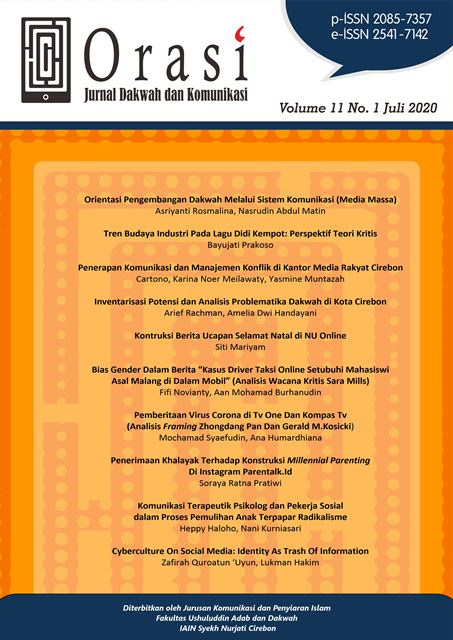
CYBER CULTURE OF SOCIAL MEDIA: IDENTITY AS TRASH OF INFORMATION
DOI:
https://doi.org/10.24235/orasi.v11i1.6264Keywords:
Cyber culture, Identity and Trash of informationAbstract
Abstract
This article goes from the disturbing anxiety of social media users to cyber culture such as phenomenon of trash information. Some social media users feel necessary to reveal true identity while others insult identity as something that the public will never know. While in communication there are no messages in the media that contain no meaning and no messages distributed without purpose. Even though the purpose of communication is different, the purpose of information even if it is mere text. In the case of social media, these messages distort more than just meaning. With observation methods and discourse analysis knife, the research found that cyber culture in social media is more than a form of information trash because of overlapping of information is particularly unclear of user identity. The study tried to see interesting phenomena that occur especially with regard to virtual/online and real-world/offline communication patterns. Social media at some point is a place where they can be identified or just a stockpile of inconclusive information. By combining cyber cultural concept and information sircuit, this research also found of identity ambivalence in social media that end by trash of information.
References
Berger, Artur. 2014. Tanda Tanda Dalam Kebudayaan Kontemporer, Yogyakarta : Tiara Wacana.
Bell, David, Manuel Castells and Donna Haraway. 2007. Cyberculture Theorist. London-New York: Routledge.
Chaney, David. 2004. Lifestyle Sebuah Pengantar Komprehensif. Yogyakarta, Jalasutra.
Haraway, Donna J. 1991. Simians, Cyborgs, and Women: The Reinvention of Nature. New York:Routledge.
Jenkins, Henry. 2006. Convergence Culture: where old and new media collide. New York, London, New York University Press.
Krotoski, Aleks K. 2012. Online Evaluation of Creativity and the Arts. London: Rouletdge.
Luhmann, Niklas and Kathleen Cross. 1996. The Reality of Mass Media. First Edition. Bibliovault OAI Repository, the University of Chicago Press.
Manovich, Lev. 2003. New Media from Borges to HTML. The MIT Press. http://manovich.net/content/04-projects/033-new-media-from-borges-to-html/30_article_2001.pdf.
Piliang, Yasraf Amir. 2003. Hipersemiotika: Tafsir Cultural Studies Atas Matinya Makna, Yogyakarta: Jalasutra.
Wood, Andrew. F., and Matthew. J. Smith. 2005. LEA's communication series.Online communication: Linking technology, identity, and culture (2nd ed.). Lawrence Erlbaum Associates Publishers.
Downloads
Published
Issue
Section
License
Copyright (c) 2020 ORASI: Jurnal Dakwah dan Komunikasi

This work is licensed under a Creative Commons Attribution-ShareAlike 4.0 International License.

Copyright Notice
An author who publishes in the Orasi: Jurnal Dakwah dan Komunikasi agrees to the following terms:
- Author retains the copyright and grants the journal the right of first publication of the work simultaneously licensed under the Creative Commons Attribution 4.0 International License that allows others to share the work with an acknowledgement of the work's authorship and initial publication in this journal
- Author is able to enter into separate, additional contractual arrangements for the non-exclusive distribution of the journal's published version of the work (e.g., post it to an institutional repository or publish it in a book) with the acknowledgement of its initial publication in this journal.
- Author is permitted and encouraged to post his/her work online (e.g., in institutional repositories or on their website) prior to and during the submission process, as it can lead to productive exchanges, as well as earlier and greater citation of the published work (See The Effect of Open Access).