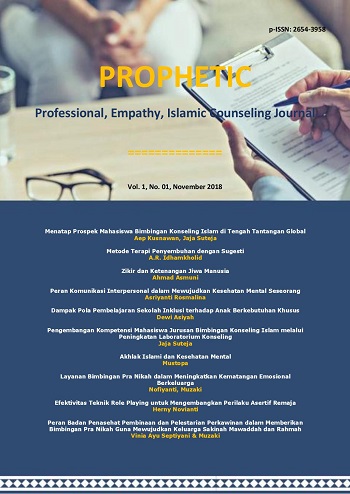
Efektivitas Teknik Role Playing untuk Mengembangkan Perilaku Asertif Remaja
DOI:
https://doi.org/10.24235/prophetic.v1i01.3483Abstract
This research aimed to produce effectiveness of role playing tehnicque for developing adolescence assertive behavior. The method of research used quasi-experimental research design with non-equivalent pretest-posttest control group design. The sample in this study were adolescence of Child Social Welfare Institution (LKSA) Nugraha 2015, aged 15-17 years, totaling 28 adolescents. Data was collected by assertiveness instrument, arranged on the aspects of thought, feeling, and action. The results showed role playing tehnicque effective to develop adolescence assertive behavior, increased of ten indicator. of self respect and respect for others, positive thinking, responsible for the opinions expressed, open to change, confidence, self esteem, self-acceptance, listening to others, eye contact, give and receive feedback, indicators were not significant for empathy, open body posture, and participate in the association. Recommendations showed for guidance and counseling study program, child social welfare institution (LKSA) and further research.
Â
References
Alberti, R. & Emmons, M. (2008). Your Perfect Right: Assertiveness and Equality in Your Life and Relationships (9th.ed). Atascadero, California: Impact Publisher.
Anindyajati, M. & Karima, C. (2004). Peran Harga Diri Terhadap Assertivitas Remaja Penyalahgunaan Narkoba. Jurnal Psikologi. 2(1). 49-73.
Bıçakçı, M. (2011). Analysis Of Social Adaption and friend relationships among adolescent living in orphanage and adolescent living with their family. Social and Natural Sciences Journal. 3. 25-30.
Bishop, S. (2006). Develop Your Assertiveness.London: Kogan Page.
Creswell, J. (2008), Educational Research, New Jersey: Pearson Education
Dahlan, H. T. (2011). Model Konseling Singkat Berfokus Solusi (Solution- Focused Brief Counseling) dalam Setting Kelompok untuk Meningkatkan Daya Psikologis Mahasiswa. Disertasi Doktor pada FIP UPI Bandung: tidak diterbitkan.
Effendi, M. (2013). Hubungan Antara Konsep Diri dan Pola Asuh Orang Tua Dengan Konformitas Santri. Jurnal Penelitian Humaniora. 14(1). 1-8.
Encheva, I. (2010). Assertiveness in The Personal Profile of Adolescents. Trakia Journal of Sciences. 8(3). 376-380
Fajarwati, A. (2012). Teknik Konseling Assertive Training Untuk Meningkatkan Tanggung Jawab Pribadi Siswa di SMP Negeri 1 Batu Jajar. Tesis pada jurusan BK UPI Bandung: Tidak diterbitkan.
Fensterhim & Bear. (1980). Jangan Bilang YA Bila Anda akan Mengatakan Tidak. Jakarta: Gunung Jati.
Heppner, P., Wampold, E.B., & Kivlinghan, M.D. (2008). Research Design in Counseling. USA: Thomson Higher Education.
Hurlock, E. (1974). Adolescent development. Tokyo: Mc Graw- Hill Kogakusha.
Joyce,B., Weil, M., dan Calhoun, E. (2011). Models of Teaching. Boston: Allyn & Bacon.
Marini, L. & Andriani, E. (2005). Perbedaan Asertivas Remaja Ditinjau Dari Pola Asuh Orang Tua. Jurnal Pemikiran & Penelitian Psikologi. 2. 46-5.
Novianti, Christina, dan Tjalla. (2008). Assertive Behavior on Early Teen. Universitas Gunadarma. [online]. Tersedia: http://www.gunadarma.ac.id.
Peneva, I. & Mavrodiev, S. (2013). A Historical Approach to Assertiveness. Journal of Psychological Thought. 6, (1). 3- 26.
Pipas, M. & Jaradat, M. (2010). Assertive Communication Skills. Annales Universitatis Apulensi Series Oeconomica. 12, (2). 649-656.
Rathus, S., & Nevid, J. (1980). Behavior Therapy of Solving Problem in Living.
New York : The New AmericanLibrary, Inc.
Rees, S. & Graham, R. Assertion Training. (.2006). Taylor: Routledge
Sugiyono. (2010). Metode Penelitian Pendidikan Pendekatan Kuantitatif , Kualitatif, dan R&D.Bandung: Alfabeta.
Sukardi, K. & Kusmawati, N. (2008). Proses Bimbingan dan Konseling di Sekolah. Jakarta: Rineka Cipta.
Tohirin. (2007). Bimbingan dan Konseling. Jakarta: Rineka Cipta.
Towned, A., Assertiveness and Diversity, (New York: Palgrave Macmillan, 2007), hal.13.
Jayanti, T. (2012). Mengurangi Perilaku Siswa Tidak Tegas Melalui Teknik Assertive Training. 1, (1). 1-5.
Yusuf, S. ( 2009). Program Bimbingan dan Konseling di Sekolah. Bandung: Rizqi.
Downloads
Issue
Section
License
Copyright (c) 2019 Prophetic : Professional, Empathy, Islamic, Counseling Journal

This work is licensed under a Creative Commons Attribution-NonCommercial 4.0 International License.
Proposed Policy for Journals That Offer Open Access
Authors who publish with this journal agree to the following terms:
- Authors retain copyright and grant the journal right of first publication with the work simultaneously licensed under a Creative Commons Attribution License that allows others to share the work with an acknowledgement of the work's authorship and initial publication in this journal.
- Authors are able to enter into separate, additional contractual arrangements for the non-exclusive distribution of the journal's published version of the work (e.g., post it to an institutional repository or publish it in a book), with an acknowledgement of its initial publication in this journal.
- Authors are permitted and encouraged to post their work online (e.g., in institutional repositories or on their website) prior to and during the submission process, as it can lead to productive exchanges, as well as earlier and greater citation of published work (See The Effect of Open Access).
Proposed Policy for Journals That Offer Delayed Open Access
Authors who publish with this journal agree to the following terms:
- Authors retain copyright and grant the journal right of first publication, with the work [SPECIFY PERIOD OF TIME] after publication simultaneously licensed under a Creative Commons Attribution License that allows others to share the work with an acknowledgement of the work's authorship and initial publication in this journal.
- Authors are able to enter into separate, additional contractual arrangements for the non-exclusive distribution of the journal's published version of the work (e.g., post it to an institutional repository or publish it in a book), with an acknowledgement of its initial publication in this journal.
- Authors are permitted and encouraged to post their work online (e.g., in institutional repositories or on their website) prior to and during the submission process, as it can lead to productive exchanges, as well as earlier and greater citation of published work (See The Effect of Open Access).