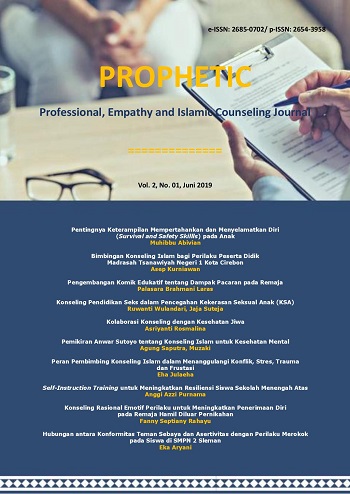
Peran Pembimbing Konseling Islam dalam Menangulangi Konflik, Stres, Trauma dan Frustrasi
DOI:
https://doi.org/10.24235/prophetic.v2i1.4754Abstract
Pada dasarnya setiap manusia pasti tak pernah lepas dari konflik, stress, trauma bahkan frustasi. Baik yang disebabkan oleh faktor internal maupun eksternal. Hal-hal tersebut sangatlah lumrah. Karena manusia merupakan makhluk sosial. Yang bisa dikatakan selalu membutuhkan relasi dengan orang lain. Namun dalam menjalin relasi tersebut bisa menimbulkan suatu dampak, entah itu dampak positif maupun dampak negatif. Dampak positif seperti seseorang bisa lebih luas mengenal satu sama lain, mendapatkan wawasan yang baru, dan lain sebagainya. Sedangkan dampak negatifnya yaitu bisa menimbulkan permasalahan jika teijadi ketidakseimbangan dalam relasi tersebut. Dan dari masalah itulah akan muncul konflik yang mengakibatkan seseorang menjadi stress, trauma bahkan frustasi. Akan tetapi bukan berarti manusia harus takut akan permasalahan tersebut, lantas tidak ingin menjalin relasi dengan lingkungan disekitarnya. Karena permasalahan itu sudah merupakan hal yang selalu melekat dalam hidup manusia.
Â
Kata Kunci: Pembimbing Konseling Islam; Stress; Trauma; Frustasi.
References
Achmad Mubarok, al-Irsyad al-Nals. (2000). Konseling Agama Teori dan kasus. Jakarta: Bina Rena Prawira.
HM. Arifin. (1996). Teori-Teori Konseling Agama. Jakarta: Gralindo.
Makmun Khairani. Psikologi Umum. Yogyakarta: Aswaja Pressindo.
HS, Siti Sundari. (2005). KesehatanMontal. Jakarta : Rineka Cipta.
Kaplan, Harold I., Benjamin, J., and Greb, Jack A. (1996). Sinopsis Psikiarti, Jilid I. (Diterjemahkan oeh Widjaja Kusuma). Jakarta: Binarupa Aksara.
Najati, Utsman M. (1997). Al-Quran dan Ilmu j'/n/a. Bandung: Pustaka.
Semiun, Yustinus. (2006). Kesehatan Mental I. Yogyakarta: Kanisius.
_______________. (2006). Kesehatan Mental 2. Yogyakarta: Kanisius.
_______________. (2006). Kesehatan Mental 3. Yogyakarta: Kanisius.
Thohari Musnamar dkk. (hd). Dasar-Dasar Konseptual Bimbingan dan Konseling Islami.
Yusuf, Syamsu. (2008). Teori Kepribadian. Bandung,: Rosda.
Downloads
Issue
Section
License
Copyright (c) 2019 Prophetic : Professional, Empathy, Islamic, Counseling Journal

This work is licensed under a Creative Commons Attribution-NonCommercial 4.0 International License.
Proposed Policy for Journals That Offer Open Access
Authors who publish with this journal agree to the following terms:
- Authors retain copyright and grant the journal right of first publication with the work simultaneously licensed under a Creative Commons Attribution License that allows others to share the work with an acknowledgement of the work's authorship and initial publication in this journal.
- Authors are able to enter into separate, additional contractual arrangements for the non-exclusive distribution of the journal's published version of the work (e.g., post it to an institutional repository or publish it in a book), with an acknowledgement of its initial publication in this journal.
- Authors are permitted and encouraged to post their work online (e.g., in institutional repositories or on their website) prior to and during the submission process, as it can lead to productive exchanges, as well as earlier and greater citation of published work (See The Effect of Open Access).
Proposed Policy for Journals That Offer Delayed Open Access
Authors who publish with this journal agree to the following terms:
- Authors retain copyright and grant the journal right of first publication, with the work [SPECIFY PERIOD OF TIME] after publication simultaneously licensed under a Creative Commons Attribution License that allows others to share the work with an acknowledgement of the work's authorship and initial publication in this journal.
- Authors are able to enter into separate, additional contractual arrangements for the non-exclusive distribution of the journal's published version of the work (e.g., post it to an institutional repository or publish it in a book), with an acknowledgement of its initial publication in this journal.
- Authors are permitted and encouraged to post their work online (e.g., in institutional repositories or on their website) prior to and during the submission process, as it can lead to productive exchanges, as well as earlier and greater citation of published work (See The Effect of Open Access).