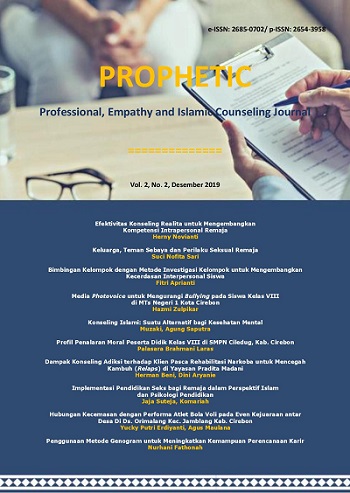
Bimbingan Kelompok dengan Metode Investigasi Kelompok untuk Mengembangkan Kecerdasan Interpersonal Siswa
DOI:
https://doi.org/10.24235/prophetic.v2i2.5766Keywords:
Kecerdasan Interpersonal, Metode Investigas Kelompok, Bimbingan Kelompok.Abstract
Penelitian ini bertujuan menguji efektivitas bimbingan kelompok menggunakan metode investigasi kelompok dalam mengembangkan kecerdasan interpersonal siswa. Dalam penelitian ini digunakan pendekatan kuantitatif, dengan metode penelitian Quasi Experimental. Desain eksperimen yang digunakan adalah desain eksperimen Nonequivalent Pretest-Postest Control Group Design. Penelitian dilakukan di MAN Talaga dengan mengambil subjek penelitian yakni siswa kelas X yang ditentukan menggunakan teknik purposive sampling (sampel bertujuan). Instrumen penelitian yang digunakan adalah Angket Kecerdasan Interpersonal. Hasil penelitian menunjukkan bahwa intervensi bimbingan kelompok menggunakan metode investigasi kelompok teruji efektif dalam mengembangkan kecerdasan interpersonal siswa.
References
Armstrong, T. (2004). Sekolah Para Juara: Menerapkan Multiple Intelligences di Dunia Pendidikan. Bandung: Kaifa.
Berlina, B. (2012). Profil Kecerdasan Interpersonal Siswa dan Implikasinya Bagi Bimbingan dan Konseling. Skripsi. PPB FIP UPI Bandung. Tidak Diterbitkan.
Chaplin, J. P. (2000). Kamus Lengkap Psikologi (Terjemahan Kartono, K). Jakarta: PT Raja Grafindo Persada.
Feningstein, A. (1979). Self-Consciousness, Self-Attention, and Social Interaction. Journal of Personality and Social Psychology. 37, 75-86.
Franzoi, S. L. (1983). Self-Concept Differences as a Function of Private Self Consciousness and a Social Anxiety. Journal of Research in Personality. 17, 275-287.
Gardner, H. (2003). Multiple intelligences (Kecerdasan Majemuk). Batam: Interaksara.
Greenberger, E., Josselson, R., Knerr, C., and Knerr, B. (1975). “The Measurement and Structure of Psychosocial Maturityâ€. Journal of Youth and Adolescence. 4, 127-143.
Hartati, A. (2009). Program Bimbingan dan Konseling Pribadi-Sosial untuk Mengembangkan Kecerdasan Interpersonal Siswa. Skripsi. PPB FIP UPI Bandung. Tidak Diterbitkan.
Indiyani, N. E., Widodo, P. B., Listiara, A. (2006). Efektivitas Metode Pembelajaran Gotong Royong (Cooperative Learning) untuk Menurunkan Kecemasan Siswa dalam Menghadapi Pelajaran Matematika. Jurnal Psikologi. 3, (1), 10-28.
McCall, M. & Lombardo, M. (1983). Off the Track: Why and You Successful Executives Get Gerailed. Technical Report No.21, Center for Creative Leadership. Greensboroo, NC.
Mirna, R. (2009). Program Bimbingan dan Konseling untuk Mengembangkan Kecerdasan Intrapersonal dan Kecerdasan Interpersonal Anak Berbakat Akademik. Skripsi. PPB FIP UPI Bandung. Tidak Diterbitkan.
Perkins, H. W., Craig, D. W., and Perkins J. M. (2011). Using Social Norms to Reduce Bullying: A Research Intervention Among Adolescents in Five Middle Schools. Journal of Group Processes & Intergroup Relation. 14, (5), 703-722.
Purwati, S. dkk. (2012). Model Bimbingan Kelompok dengan Teknik Fun Game untuk Mengurangi Kecemasan Berbicara Didepan Kelas. Jurnal Bimbingan Konseling. 1, (2), 81-87.
Ramdhani, N. dkk. (2003). Empati dan Perilaku Merokok di Tempat Umum, Jurnal Psikologi. 30, (2), 81-90.
Safaria, T. (2005). Interpersonal Intelligence: Metode Pengembangan Kecerdasan Interpersonal Anak. Yogyakarta: Amara Books.
Schultz, P. W., Khazian, A. M., & Zaleski, A. C. (2008). Using Normative Social Influence To Promote Conservation Among Hotel Guests. Social Influence. 3, (1), 4–23.
Setyarini, T. (2009). Peningkatan Partisipasi Siswa dalam Pembelajaran Biologi melalui Perangsangan Kecerdasan Interpersonal Siswa dengan Penerapan Metode Group Investigation (GI) Di Kelas Vii C SMP Negeri 5 Surakarta. Skripsi. Fakultas Keguruan dan Ilmu Pendidikan Universitas Sebelas Maret Surakarta. Tidak Diterbitkan.
Slavin, R. (2008). Cooperative Learning: Teori Riset Dan Praktik. Bandung: Nusamedia.
Sugiyono. (2012). Metode Penelitian Pendidikan (Cet.Ke-15). Bandung: Alfabeta.
Susanto, H. (2005). Penerapan Multiplle Intelligence dalam Sistem Pembelajaran. Jurnal Pendidikan Penabur - No.04/ Th.IV/ Juli 2005. 3-4.
Zingaro, D. (2008). Group Investigation: Theory and Practice. Journal International of Group Investigation. [Online] Tersedia: http://www.danielzingaro.com/gi.pdf (Diunduh 2 Agustus 2012).
Downloads
Issue
Section
License
Copyright (c) 2019 Prophetic : Professional, Empathy and Islamic Counseling Journal

This work is licensed under a Creative Commons Attribution-NonCommercial 4.0 International License.
Proposed Policy for Journals That Offer Open Access
Authors who publish with this journal agree to the following terms:
- Authors retain copyright and grant the journal right of first publication with the work simultaneously licensed under a Creative Commons Attribution License that allows others to share the work with an acknowledgement of the work's authorship and initial publication in this journal.
- Authors are able to enter into separate, additional contractual arrangements for the non-exclusive distribution of the journal's published version of the work (e.g., post it to an institutional repository or publish it in a book), with an acknowledgement of its initial publication in this journal.
- Authors are permitted and encouraged to post their work online (e.g., in institutional repositories or on their website) prior to and during the submission process, as it can lead to productive exchanges, as well as earlier and greater citation of published work (See The Effect of Open Access).
Proposed Policy for Journals That Offer Delayed Open Access
Authors who publish with this journal agree to the following terms:
- Authors retain copyright and grant the journal right of first publication, with the work [SPECIFY PERIOD OF TIME] after publication simultaneously licensed under a Creative Commons Attribution License that allows others to share the work with an acknowledgement of the work's authorship and initial publication in this journal.
- Authors are able to enter into separate, additional contractual arrangements for the non-exclusive distribution of the journal's published version of the work (e.g., post it to an institutional repository or publish it in a book), with an acknowledgement of its initial publication in this journal.
- Authors are permitted and encouraged to post their work online (e.g., in institutional repositories or on their website) prior to and during the submission process, as it can lead to productive exchanges, as well as earlier and greater citation of published work (See The Effect of Open Access).