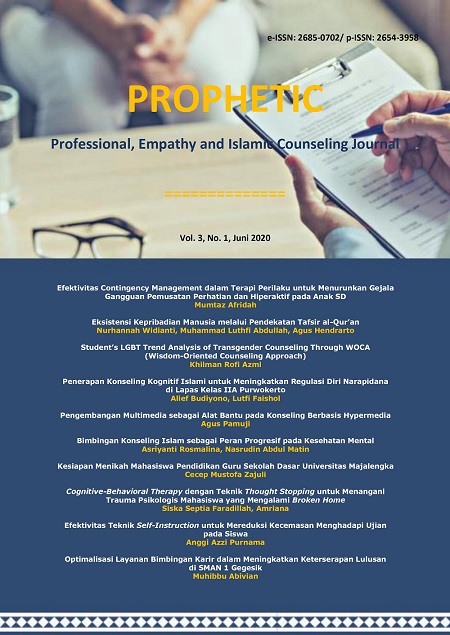
Pengembangan Multimedia sebagai Alat Bantu pada Konseling Berbasis Hypermedia
DOI:
https://doi.org/10.24235/prophetic.v3i1.6955Keywords:
Konseling, Pengembangan, Teknologi Informasi, Interaktif, Hypermedia.Abstract
Aktifitas layanan konseling menjadi perhatian utama sehubungan dengan berkembangnya teknologi informasi. Kondisi ini bersamaan dengan bergantungnya pada perangkat teknologi. Aktiftas konseling sangat membutuhkan media yang dapat mengantarkan informasi yang berkaitan dengan pengembangan diri terhadap konseli. Metode yang dikembangkan menggunakan pendeketan berbasis Graphical User Interface berkolaborasi dengan konsep hypermedia pengembangan dari pemrosesan teks. Hasil akhirnya adalah dimulai dengan membuat rancangan antar-muka (interface)Â sampai pada tahap akhir ketika aplikasi dijalankan (running). Oleh sebab itu, media berbasis hypermedia akan meningkatkan layanan konseling menjadi interaktif.
References
Bangun, N., & Saragih, A. H. (2015). Pengembangan Media Web Bimbingan Konseling. Jurnal Teknologi Informasi & Komunikasi dalam Pendidikan, 99-110.
Dainton, M., & Elaine , Z. D. (2019). Applying Communication Theory for Professional Life. New York: SAGE.
Gray, W. D. (2007). Integrated Models of Cognitive Systems. Oxford: Oxford University Press.
Hidayati, A. (2017). Layanan informasi belajar berbasis multimedia. ASEAN School Counselor Conference on Innovation and Creativity in Counseling, (pp. 151 - 161).
Jandt, F. E. (2018). An Introduction to Intercultural Communication. California: SAGE Publications Inc.
MacKenzie, I. S. (2013). Human-Computer Interaction. Amsterdam: Elsevier.
Moallem, A. (2019). Human-Computer Interaction and Cybersecurity Handbook. Boca Raton: CRC Press.
Mutmainnah, A. N., Yulidah, R., & Yuniarti, S. (2017). Media Bimbingan Konseling Berbasis Hypermedia. Seminar Nasional BK FIP-UPGRIS, (pp. 186-191).
Nupus , H., Hermaliani , E. H., & Syamsiah, N. O. (2015). Rancangan Media Pembelajaran Interaktif Mengenal HIV AIDS Pada Materi Bimbingan Konseling Sekolah. Jurnal Teknik Komputer, 1(1), 96-105.
Nursalim, M. (2015). Pengembangan Media Bimbingan dan Konseling. Jakarta: Indeks.
Permatasari, N. R., & Winingsih, E. (2018). Pengembangan Multimedia Interaktif Untuk Layanan Informasi Tentang Komuikasi Interpersonal Pada Siswa di SMPN 2 Sumbergempol Tulungagung. Jurnal BK Unesa, 152 - 160.
Pierce, J. R., & Posner, E. C. (1980). Introduction Communication Science and Systems. New York: Springer.
Prasetiawan, H. (2017). Optimalisasi Multimedia Dalam Layanan Bimbingan dan Konseling. Prosiding Seminar Bimbingan dan Konseling, (pp. 199-204). Yogyakarta.
Prasetiawan, H. (2017). Optimalisasi Multimedia Dalam Layanan Bimbingan Dan Konseling. Prosiding Seminar Bimbingan dan Konseling (pp. 199 - 204). Yogyakarta: -.
Prayitno, & Amti, E. (2015). Dasar - Dasar Bimbingan dan Konseling. Jakarta: Rineka Cipta.
Smith, P. J. (2018). Cognitive Systems Engineering. Boca Raton: CRC Press.
Sumarwiyah, & Zamroni, E. (2018). Pemanfaatan Tekonologi Informasi (TI) Dalam Layanan Bimbingan Dan Konseling Sebagai Representasi Berkembangnya Budaya Profesional Konselor Dalam Melayani Siswa. Jurnal Bimbingan Konseling, 2(1), 1 - 14.
Watson, J. (1998). Media Communication An Introduction to Theory and Process. New York: Macmillan Education.
Wood, D. (2014). Interface Design. London: Bloomburry.
Downloads
Issue
Section
License
Copyright (c) 2020 Prophetic : Professional, Empathy and Islamic Counseling Journal

This work is licensed under a Creative Commons Attribution-NonCommercial 4.0 International License.
Proposed Policy for Journals That Offer Open Access
Authors who publish with this journal agree to the following terms:
- Authors retain copyright and grant the journal right of first publication with the work simultaneously licensed under a Creative Commons Attribution License that allows others to share the work with an acknowledgement of the work's authorship and initial publication in this journal.
- Authors are able to enter into separate, additional contractual arrangements for the non-exclusive distribution of the journal's published version of the work (e.g., post it to an institutional repository or publish it in a book), with an acknowledgement of its initial publication in this journal.
- Authors are permitted and encouraged to post their work online (e.g., in institutional repositories or on their website) prior to and during the submission process, as it can lead to productive exchanges, as well as earlier and greater citation of published work (See The Effect of Open Access).
Proposed Policy for Journals That Offer Delayed Open Access
Authors who publish with this journal agree to the following terms:
- Authors retain copyright and grant the journal right of first publication, with the work [SPECIFY PERIOD OF TIME] after publication simultaneously licensed under a Creative Commons Attribution License that allows others to share the work with an acknowledgement of the work's authorship and initial publication in this journal.
- Authors are able to enter into separate, additional contractual arrangements for the non-exclusive distribution of the journal's published version of the work (e.g., post it to an institutional repository or publish it in a book), with an acknowledgement of its initial publication in this journal.
- Authors are permitted and encouraged to post their work online (e.g., in institutional repositories or on their website) prior to and during the submission process, as it can lead to productive exchanges, as well as earlier and greater citation of published work (See The Effect of Open Access).