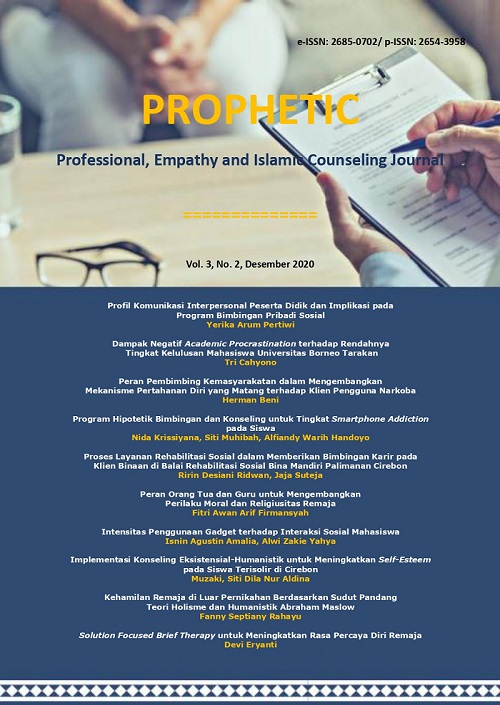
Dampak Negatif Academic Procrastination terhadap Rendahnya Tingkat Kelulusan Mahasiswa Universitas Borneo Tarakan
DOI:
https://doi.org/10.24235/prophetic.v3i2.7589Keywords:
Academic Procrastination, Tingkat Kelulusan, Mahasiswa Tingkat Akhir.Abstract
Academic procrastination merupakan sebuah perilaku negatif yang hampir terjadi pada seluruh peserta didik. Academic procrastination merupakan perilaku penghindaran terhadap tugas-tugas akademik dengan alasan adanya aktifitas lain sehingga membuat tugas-tugas utama terabaikan. Gejala academic procrastination sebagian besar ditunjukkan dari beberapa perilaku seperti sering menunda tugas-tugas pribadi, menghindari tanggung jawab akademik dan mementingkan kegiatan lain yang sebenarnya itu hanyalah sebuah bentuk penghindaran terhadap tanggung jawab yang diembannya. Dalam skala yang lebih luas, AP bisa berdampak keputus-asaan, stress dan paranoid terhadap tanggung jawabnya sendiri. Hal itu bisa terjadi karena beberapa faktor. Beberapa penelitian mengenai faktor penyebab AP pada mahasiswa sangat bervariasi. Hal itu disebabkan berbedanya situasi yang melatarbelakangi keadaan pikologis dan sosial mahasiswa. Artinya, faktor penyebab AP pada satu instansi pendidikan tinggi akan berbeda dengan instansi pendidikan tinggi lainnya. Berdasarkan hasil penelitian diketahui bahwa indeks kelulusan mahasiswa yang lulus tepat waktu dibawah 50%. Pada faktor primer, AP bisa terjadi karena anxiety, time disorganization, poor task approach, stress and fatigue. Selain itu, faktor sekunder yang juga menjadi penyebab AP seperti low discomfort tolerance and pleasure seeking, self-depreciation, environmental disorganization dan lack of assertion.References
Borg, R. & Gall, M. D. (1983). Educational Reseach.An Introduction. White Plain, New York: Longman, Inc.
Catrunada, L. (2008). Perbedaan kecenderungan prokrastinasi tugas skripsi berdasarkan tipe kepribadian introvert dan ekstrovert (Tesis tidak dipublikasikan). Universitas Gunadarma, Jakarta.
Ferari, J. R., Johnson, J. L., & McCown, W. (1995). Procrastination and task avoidance: theory, research, and treatment. New York: Plenun Press.
Ferari, J. R., & Morales, J. F. D. (2007). Perceptions of self-concept and self-presentation by procrastinators: Further Evidence. The Spanish Journal of Psychology, 10 (1), hlm. 91-96.
Ghufron, M. N. (2003). Hubungan kontrol diri dan persepsi remaja terhadap penerapan disiplin orangtua dengan prokrastinasi akademik (Tesis tidak dipublikasikan). Universitas Gadjah Mada, Yogyakarta.
Janssen, T., & Carton, J. S. (2009). The effects of locus of control and task difficulty on procrastination. The Journal of Genetic Psychology, 160 (4), hlm. 436-452.
Muhid, A. (2009). Hubungan antara self-control dan self-efficacy dengan kecenderungan perilaku prokrastinasi akademik mahasiswa Fakultas Dakwah IAIN Sunan Ampel Surabaya. Jurnal Ilmu Dakwah, 18 (1), hlm. 578.
Ray, J. V. (2011). Developmental trajectories of self-control: Assessing the stability hypothesis. Disertasi (tidak diterbitkan), University of South Florida, South Florida.
Stake, R. E. (2005). Qualitative Case Studies. In N. K. Denzin & Y. S. Lincoln (Eds.), The Sage handbook of qualitative research (p. 443–466). Sage Publications Ltd.
Solomon, L. J. & Rothblum, E. D. (2015). Academic procrastination: Frequency and cognitive-behavioral correlates. Journal of Counseling Psychology, 31, hlm. 503-509.
Steel, P. (2007). The nature of procrastination: A meta analytic and theoretical review of quintessential self regulatory failure. Psychological Bulletin, 133 (1), hlm. 65–94.
Steel, P. (2010). Arousal, avoidant and decisional procrastinators: Do they exist? Journal of Personality and Individual Differences, 48, hlm. 926-934.
Tangney, J. P., Baumeister, R. F., & Boone, A. L. (2014). High self-control predicts good adjustment, less pathology, better grades, and interpersonal success. Journal of Personality, 72 (2), hlm. 271-322.
Tice, D. M. & Baumeister, R. F. (2017). Longitudinal study of procrastination, performance, stress, and health: The cost and benefits of dawdling. Journal of Psychological Science, 8 (6), 454-458.
Downloads
Issue
Section
License
Copyright (c) 2020 Prophetic : Professional, Empathy and Islamic Counseling Journal

This work is licensed under a Creative Commons Attribution-NonCommercial 4.0 International License.
Proposed Policy for Journals That Offer Open Access
Authors who publish with this journal agree to the following terms:
- Authors retain copyright and grant the journal right of first publication with the work simultaneously licensed under a Creative Commons Attribution License that allows others to share the work with an acknowledgement of the work's authorship and initial publication in this journal.
- Authors are able to enter into separate, additional contractual arrangements for the non-exclusive distribution of the journal's published version of the work (e.g., post it to an institutional repository or publish it in a book), with an acknowledgement of its initial publication in this journal.
- Authors are permitted and encouraged to post their work online (e.g., in institutional repositories or on their website) prior to and during the submission process, as it can lead to productive exchanges, as well as earlier and greater citation of published work (See The Effect of Open Access).
Proposed Policy for Journals That Offer Delayed Open Access
Authors who publish with this journal agree to the following terms:
- Authors retain copyright and grant the journal right of first publication, with the work [SPECIFY PERIOD OF TIME] after publication simultaneously licensed under a Creative Commons Attribution License that allows others to share the work with an acknowledgement of the work's authorship and initial publication in this journal.
- Authors are able to enter into separate, additional contractual arrangements for the non-exclusive distribution of the journal's published version of the work (e.g., post it to an institutional repository or publish it in a book), with an acknowledgement of its initial publication in this journal.
- Authors are permitted and encouraged to post their work online (e.g., in institutional repositories or on their website) prior to and during the submission process, as it can lead to productive exchanges, as well as earlier and greater citation of published work (See The Effect of Open Access).