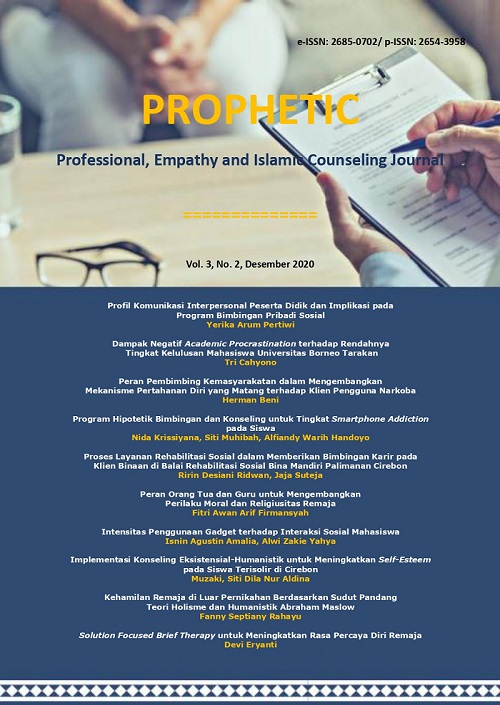
Program Hipotetik Bimbingan dan Konseling untuk Tingkat Smartphone Addiction pada Siswa
DOI:
https://doi.org/10.24235/prophetic.v3i2.7591Keywords:
Smartphone Addiction, Program Bimbingan dan Konseling, Siswa.Abstract
Penelitian ini dilakukan dengan tujuan untuk mengetahui dan mendeskripsikan gambaran tingkat smartphone addiction pada siswa dan mengetahui rancangan program bimbingan dan konseling untuk tingkat smartphone addiction pada siswa kelas IX SMPN 2 Kota Serang. Teknik pengambilan sampel penelitian menggunakan sampel jenuh atau sensus dengan cara mengambil jumlah seluruh anggota populasi sebagai responden yang berjumlah 322 siswa. Penelitian mengenai smartphone addiction dilakukan dengan melihat dari 6 aspek yaitu daily life disturbance, positive anticipation, withdrawal, cyberspace-oriented relationship, overuse, dan tolerance. Teknik pengumpulan data yaitu dengan menyebarkan instrumen berupa kuesioner. Hasil analisis kuesioner tingkat smartphone addiction pada siswa kelas IX SMPN 2 Kota Serang berada pada kategori rendah dengan persentase sebesar 15%, kategori sedang dengan persentase sebesar 68%, dan kategori tinggi dengan persentase sebesar 17%. Setelah mengetahui gambaran tingkat smartphone addiction, maka rancangan program bimbingan dan konseling dibuat berdasarkan hasil penelitian yang didapat.
Downloads
References
Afifah, R. (2015). Pengaruh Penggunaan Smartphone Terhadap Aktifitas Kehidupan Siswa (Studi Kasus MAN 1 Rengat Barat). JOM FISIP. 2, (2), hlm 9.
Bisen, S., & Deshpande, Y. (2016). An Analitycal Study of Smartphone Addiction Among Engineering Students: A Gender Differences. Journal Of Indian Psychology , 4, hlm 70-83.
Dejanasz, S. C. (2002). Interpersonal Skills In Organization. Boston: Mc-Graw Hill.
Hidayat, S., & Mustikasari. (2014). Kecanduan Penggunaan Smartphone dan Kualitas Tidur Pada Mahasiswa RIK UI.
Jahja. (2011). Psikologi Perkembangan. Jakarta: Kencana.
Karuniawan, A., & Cahyanti, I. Y. (2013). Hubungan Antara Akademik Stress dengan Smartphone Addiction pada Mahasiswa Pengguna Smartphone. Jurnal Psikologi Klinis dan Kesehatan Mental , 2, hlm 16-21.
Kurniawan, I. G. (2017). Hubungan Depresi dan Kecemasan dengan Smartphone Addiction pada Coass Program Studi Pendidikan Dokter di Provinsi Bali. Tesis. Denpasar, Bali, Indonesia: Universitas Udayana.
Kwon, dkk (2013). Development and Validition of A Smartphone Addiction Scale (SAS). Plos One , 8 (12), hlm 1-7.
Kwon, dkk (2013). The Smartphone Addiction Scale: Development and Validation of Short Version For Adolescents. Plos One, 8 (12), hlm 1-7.
Meirianto, M. T. (2018). Hubungan Kecanduan Smartphone Addiction dengan Kualitas Tidur pada Remaja. Skripsi. Yogyakarta, Daerah Istimewa Yogyakarta, Indonesia: Universitas Islam Indonesia.
Rahmah. D, dkk. (2020). Profil Kepercayaan Diri Siswa dan Implikasinya Bagi Program Bimbingan Pribadi Sosial. Prophetic : Professional, Empathy and Islamic Counseling Journal. 7, (2). hlm 3.
Santrock. (2003). Perkembangan Remaja, Edisi Ke Enam. Jakarta: Erlangga.
Sudarsono. (1993). Kamus Filsafat dan Psikologi. Jakarta: Rineka Cipta.
Sugiyono. (2013). Metode Penelitian Kuantitatif, Kualitatif dan R&D. Bandung: Alfabeta.
Downloads
Issue
Section
License
Copyright (c) 2020 Prophetic : Professional, Empathy and Islamic Counseling Journal

This work is licensed under a Creative Commons Attribution-NonCommercial 4.0 International License.
Proposed Policy for Journals That Offer Open Access
Authors who publish with this journal agree to the following terms:
- Authors retain copyright and grant the journal right of first publication with the work simultaneously licensed under a Creative Commons Attribution License that allows others to share the work with an acknowledgement of the work's authorship and initial publication in this journal.
- Authors are able to enter into separate, additional contractual arrangements for the non-exclusive distribution of the journal's published version of the work (e.g., post it to an institutional repository or publish it in a book), with an acknowledgement of its initial publication in this journal.
- Authors are permitted and encouraged to post their work online (e.g., in institutional repositories or on their website) prior to and during the submission process, as it can lead to productive exchanges, as well as earlier and greater citation of published work (See The Effect of Open Access).
Proposed Policy for Journals That Offer Delayed Open Access
Authors who publish with this journal agree to the following terms:
- Authors retain copyright and grant the journal right of first publication, with the work [SPECIFY PERIOD OF TIME] after publication simultaneously licensed under a Creative Commons Attribution License that allows others to share the work with an acknowledgement of the work's authorship and initial publication in this journal.
- Authors are able to enter into separate, additional contractual arrangements for the non-exclusive distribution of the journal's published version of the work (e.g., post it to an institutional repository or publish it in a book), with an acknowledgement of its initial publication in this journal.
- Authors are permitted and encouraged to post their work online (e.g., in institutional repositories or on their website) prior to and during the submission process, as it can lead to productive exchanges, as well as earlier and greater citation of published work (See The Effect of Open Access).