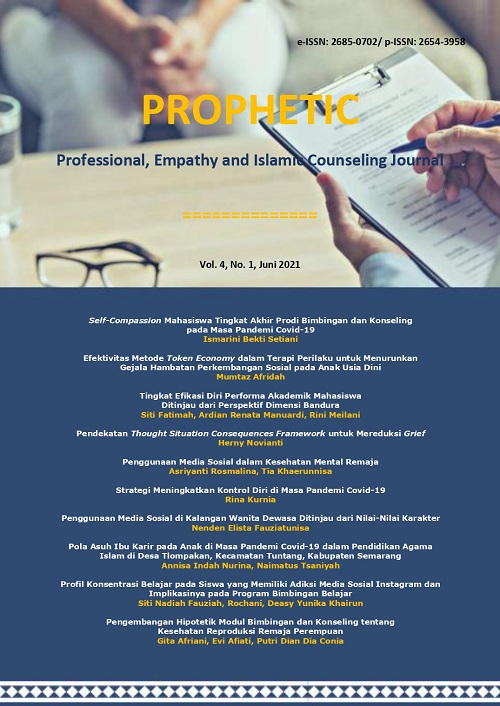
Penggunaan Media Sosial di Kalangan Wanita Dewasa Ditinjau dari Nilai-Nilai Karakter
DOI:
https://doi.org/10.24235/prophetic.v4i1.8759Keywords:
Social Media, Character Values, Adult Women.Abstract
The purpose of this research is to analyze and find out the dynamics of the use of social media among adult women in the formation of character values, this is both seen from the pros and cons of advances in communication technology among adult women seen from the character values, where in the present social media has it is no stranger to every circle, be it teenagers, adults or even the elderly. The research method used a qualitative approach and also Library Research. Data collection was carried out by observation, in-depth interviews with adult women of UIN SUKA postgraduate students who actively use social media. The results of the study found that social media is determined by several applications, content, and also the effect it causes in shaping the character of women. Social media in particular has a close relationship in shaping values and also personal character. Social media also reflects that the positive impact of technological advances in education is able to create good learning activities, make it easier for students to find learning resources, and with technology can help students learn to apply technology in the teaching and learning process, so that students are more interested in learning. The findings also show that the negative impact of technological development, one of which is the low character value, especially from the social aspect, and the lack of communication between students and their surroundings. Consumptive, and also tend to be ignorant of the surrounding environment.
References
Afriluyanto, Tegar Roli. (2018). Fenomena Remaja Menggunakan Media Sosial Dalam Membentuk Identitas. KOMUNIKA: Jurnal Dakwah Dan Komunikasi 11, no. 2: 184–97. https://doi.org/10.24090/komunika.v11i2.1365.
Amanda, Della. (2019). Penggunaan Media Sosial Pada Ibu Rumah Tangga Dalam Tinjauan Teori Dramaturgi Di Kota Surabaya.. http://lib.unair.ac.id.
Amanda, Della. (2019). Penggunaan Media Sosial Pada Ibu Rumah Tangga Dalam Tinjauan Teori Dramaturgi Di Kota Surabaya. http://repository.unair.ac.id/87337/.
Connaway dan Lynn Silipigni. (2010) Basic Research Methods for Librarians. California: Libraries Unlimited.
Felita, Pamela, Christine Siahaja, Vania Wijaya, Gracia Melisa, Marcella Chandra, and Rayini Dahesihsari. (2016). Pemakaian Media Sosial Dan Self Concept Pada Remaja. Jurnal Ilmiah Psikologi 5, no. 1: 30–41.
https://id.wikipedia.org/wiki/Universitas_Islam_Negeri_Sunan_Kalijaga_Yogyakarta
Heri Cahyono. (2017). Pendidikan Karakter: Strategi Pendidikan Nilai dalam Membentuk Karakter Religiusâ€, Jurnal, Ri’ayah, Vol. 01, no.02 Juli-Desember.
Imam Mundzir Al Asy’ari, “Implementasi Pendidikan Nilai-Nilai KH. Hasyim Asy’ Ari di Madrasah
Mu’Allimin Pesantren Tebuireng Jombangâ€, tesis, fakultas ilmu tarbiyah dan keguruan, UIN Sunan Kalijaga.
Maksudin. (2009). Pendidikan Nilai Komprehensif Teori dan Praktik, (Yogyakarta: UNY Press.
Downloads
Issue
Section
License
Copyright (c) 2021 Prophetic : Professional, Empathy and Islamic Counseling Journal

This work is licensed under a Creative Commons Attribution-NonCommercial 4.0 International License.
Proposed Policy for Journals That Offer Open Access
Authors who publish with this journal agree to the following terms:
- Authors retain copyright and grant the journal right of first publication with the work simultaneously licensed under a Creative Commons Attribution License that allows others to share the work with an acknowledgement of the work's authorship and initial publication in this journal.
- Authors are able to enter into separate, additional contractual arrangements for the non-exclusive distribution of the journal's published version of the work (e.g., post it to an institutional repository or publish it in a book), with an acknowledgement of its initial publication in this journal.
- Authors are permitted and encouraged to post their work online (e.g., in institutional repositories or on their website) prior to and during the submission process, as it can lead to productive exchanges, as well as earlier and greater citation of published work (See The Effect of Open Access).
Proposed Policy for Journals That Offer Delayed Open Access
Authors who publish with this journal agree to the following terms:
- Authors retain copyright and grant the journal right of first publication, with the work [SPECIFY PERIOD OF TIME] after publication simultaneously licensed under a Creative Commons Attribution License that allows others to share the work with an acknowledgement of the work's authorship and initial publication in this journal.
- Authors are able to enter into separate, additional contractual arrangements for the non-exclusive distribution of the journal's published version of the work (e.g., post it to an institutional repository or publish it in a book), with an acknowledgement of its initial publication in this journal.
- Authors are permitted and encouraged to post their work online (e.g., in institutional repositories or on their website) prior to and during the submission process, as it can lead to productive exchanges, as well as earlier and greater citation of published work (See The Effect of Open Access).