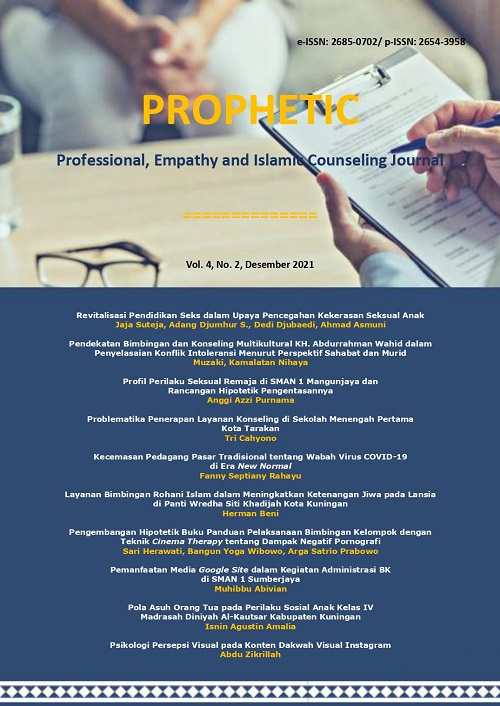
Problematika Penerapan Layanan Konseling di Sekolah Menengah Pertama Kota Tarakan
DOI:
https://doi.org/10.24235/prophetic.v4i2.9661Keywords:
Problematika Layanan Konseling, SMP Kota Tarakan.Abstract
Konseling individual merupakan proses interaktif yang dicirikan oleh hubungan yang unik antara guru bimbingan dan konseling atau konselor dan peserta didik/konseli yang mengarah pada perubahan perilaku, konstruksi pribadi, kemampuan mengatasi situasi hidup dan keterampilan membuat keputusan. Pelaksanaan konseling di jenjang sekolah menengah mencakup berbagai aspek perserta didik seperti aspek poribadi, sosial, belajar, karir. Keberhasilan proses konseling terhadap pemecahan masalah peserta didik/konseli dievaluasi oleh guru bimbingan dan konseling atau konselor melalui pengungkapan kepuasan konseli terhadap proses konseling. Pelaksanaan layanan konseling tentunya tidak serta merta berjalan lurus tanpa ada problematika yang mengikuti. Dalam perjalanannya, terdapat berbagai macam persoalan yang mengikuti perkembangan layanan konseling di kota Tarakan. Dalam penelitian ini, penulis akan memaparkan berbagai problematika pelaksanaan layanan konseling di sekolah menegah di Kota Tarakan. Hasil temuan terhadap problematika layanan konseling jenjang SMP di Kota Tarakan diakibatkan faktor internal maupun eksternal. Data problematika layanan konseling yang paling tinggi dari faktor internal adalah konselor yang tidak memahami tahapan konseling dengan baik, sedangkan data problematika layanan konseling dari faktor eksternal yang paling tinggi adalah buruknya perspektif siswa terhadap fungsi konseling yang menyebabkan siswa enggan berpartisipasi aktif mengikuti layanan konseling.
References
Depdibud. (2007). Rambu-Rambu Pelaksanaan Bimbingan dan Konseling pada Jalur Pendidikan Formal, Jakarta: Direktorat Jenderal PMPTK, Jakarta.
Kemendikbud. (2016). Panduan operasional Penyelenggaraan bimbingan dan konseling Sekolah menengah pertama (SMP). Jakarta: Direktorat Jenderal PMPTK, Jakarta.
Gysbers, N C, & Henderson, P. (2000). Developing and managing your school guidance program Ord ed. Alexandria, VA: American Counseling Association.
Gysbers, Norman C., & Henderson, P. (2014). Developing and managing your school guidance and counseling program. John Wiley & Sons.
Royse, D., Thyer, B. A., & Padgett, D. K. (2010). Program Evaluation: : An introduction. Nelson Education. Stufflebeam, D. L. (1973). Toward a science of educational evaluation. Evaluation of Education, 11, 20.
Worthen, B. R., Sanders, J. R., & Fitzpatrick, J. L. (1997). Program evaluation. Alternative Approaches and Practical Guidelines, 2.
Downloads
Issue
Section
License
Copyright (c) 2021 Prophetic : Professional, Empathy, Islamic Counseling Journal

This work is licensed under a Creative Commons Attribution-NonCommercial 4.0 International License.
Proposed Policy for Journals That Offer Open Access
Authors who publish with this journal agree to the following terms:
- Authors retain copyright and grant the journal right of first publication with the work simultaneously licensed under a Creative Commons Attribution License that allows others to share the work with an acknowledgement of the work's authorship and initial publication in this journal.
- Authors are able to enter into separate, additional contractual arrangements for the non-exclusive distribution of the journal's published version of the work (e.g., post it to an institutional repository or publish it in a book), with an acknowledgement of its initial publication in this journal.
- Authors are permitted and encouraged to post their work online (e.g., in institutional repositories or on their website) prior to and during the submission process, as it can lead to productive exchanges, as well as earlier and greater citation of published work (See The Effect of Open Access).
Proposed Policy for Journals That Offer Delayed Open Access
Authors who publish with this journal agree to the following terms:
- Authors retain copyright and grant the journal right of first publication, with the work [SPECIFY PERIOD OF TIME] after publication simultaneously licensed under a Creative Commons Attribution License that allows others to share the work with an acknowledgement of the work's authorship and initial publication in this journal.
- Authors are able to enter into separate, additional contractual arrangements for the non-exclusive distribution of the journal's published version of the work (e.g., post it to an institutional repository or publish it in a book), with an acknowledgement of its initial publication in this journal.
- Authors are permitted and encouraged to post their work online (e.g., in institutional repositories or on their website) prior to and during the submission process, as it can lead to productive exchanges, as well as earlier and greater citation of published work (See The Effect of Open Access).