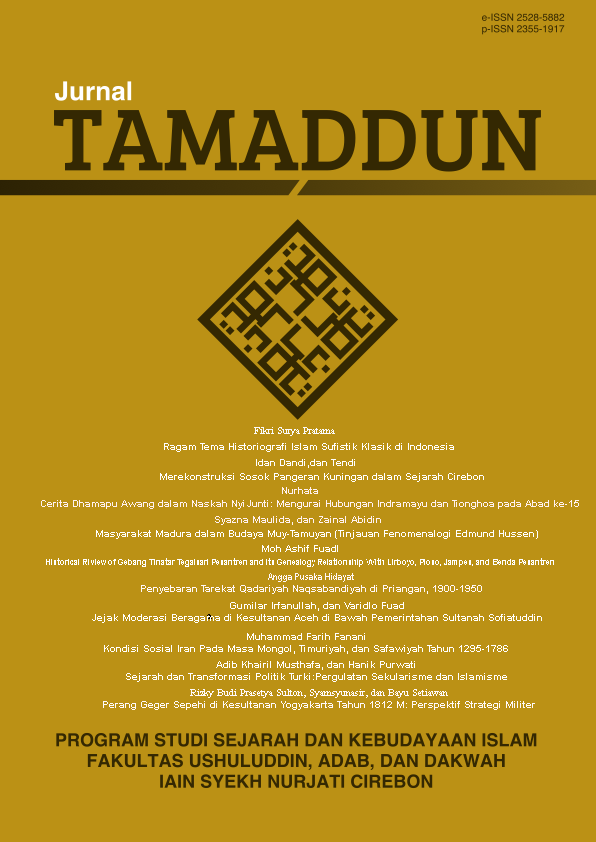
Perang Geger Sepehi di Kesultanan Yogyakarta Tahun 1812 M: Prespektif Strategi Militer
DOI:
https://doi.org/10.24235/tamaddun.v10i1.10345Keywords:
Geger Sepehi, Inggris, Yogyakarta, KonflikAbstract
This paper discusses the attacks carried out by the British Colonial Government in Java with the Sultanate of Yogyakarta Hadiningrat which occurred from July 18 to July 20, 1812 AD. This study uses historical research methods that emphasize heuristic processes, verification, interpretation, and historiography. The results of this study explain that the background of the conflict originated from the unwillingness of Sultan Hamengkubuwono II to submit to the demands of Lieutenant Governor Raffles fully to the rules and political power of the British Empire in colonies. The strategy of the Sultanate of Yogyakarta was to consolidate regular troops and other troops to defend the Keraton and build military facilities by building weapons factories independently. The British took advantage of their indigenous allies, although they were few in number, with experience and qualified military capacity, they succeeded in controlling Yogyakarta.References
Carey, Peter. 2017. Inggris di Jawa 1811-1816. Jakarta: Kompas.
Juwono, Djoko Marihandono dan Harto. 2008. Sultan Hamengkubuwono II. Yogyakarta: Banjar Aji.
Murdiyastomo, Agus, dkk. 2015. Pangeran Notokusumo. Yogyakarta: Dinas Kebudayaan DIY.
Kusumoparastho. 2019. Selayang Pandang Sejarah Berdirinya Kadipaten Pakualaman. Yogyakarta: Puro Pakualaman.
Mangkudiningrat. 2017. Babad Sepehi. Jakarta: Perpustakaan Nasional.
Merriam-Webster, http://www.merriam-webster.com/dictionary/sepoy, diakses pada 3 Agustus 2020
Sabdacarakatama, Ki. 2009. Sejarah Keraton Yogyakarta. Yogyakarta: Narasi.
Thorn, William. 2019. Sejarah Penaklukan Jawa. Yogyakarta: IndoLiterasi.
Werdoyo, TS. 1990. Tan Jin Sing. Jakarta: Grafiti.
Wawancara dengan Bapak V Agus Sulistya S.Pd M.A di Kantor Museum Benteng Vredeburgh Yogyakarta, Senin, 4 November 2019.
Wawancara dengan KPH Parastokusumo di Puro Pakualaman Yogyakarta, Selasa 5 November 2019.
Downloads
Published
Issue
Section
License
Copyright (c) 2022 Jurnal Tamaddun : Jurnal Sejarah dan Kebudayaan Islam

This work is licensed under a Creative Commons Attribution-NonCommercial 4.0 International License.
Authors who publish with this journal agree to the following terms:
- Authors retain copyright and grant the journal right of first publication with the work simultaneously licensed under a Creative Commons Attribution License that allows others to share the work with an acknowledgement of the work's authorship and initial publication in this journal.
- Authors are able to enter into separate, additional contractual arrangements for the non-exclusive distribution of the journal's published version of the work (e.g., post it to an institutional repository or publish it in a book), with an acknowledgement of its initial publication in this journal.
- Authors are permitted and encouraged to post their work online (e.g., in institutional repositories or on their website) prior to and during the submission process, as it can lead to productive exchanges, as well as earlier and greater citation of published work
