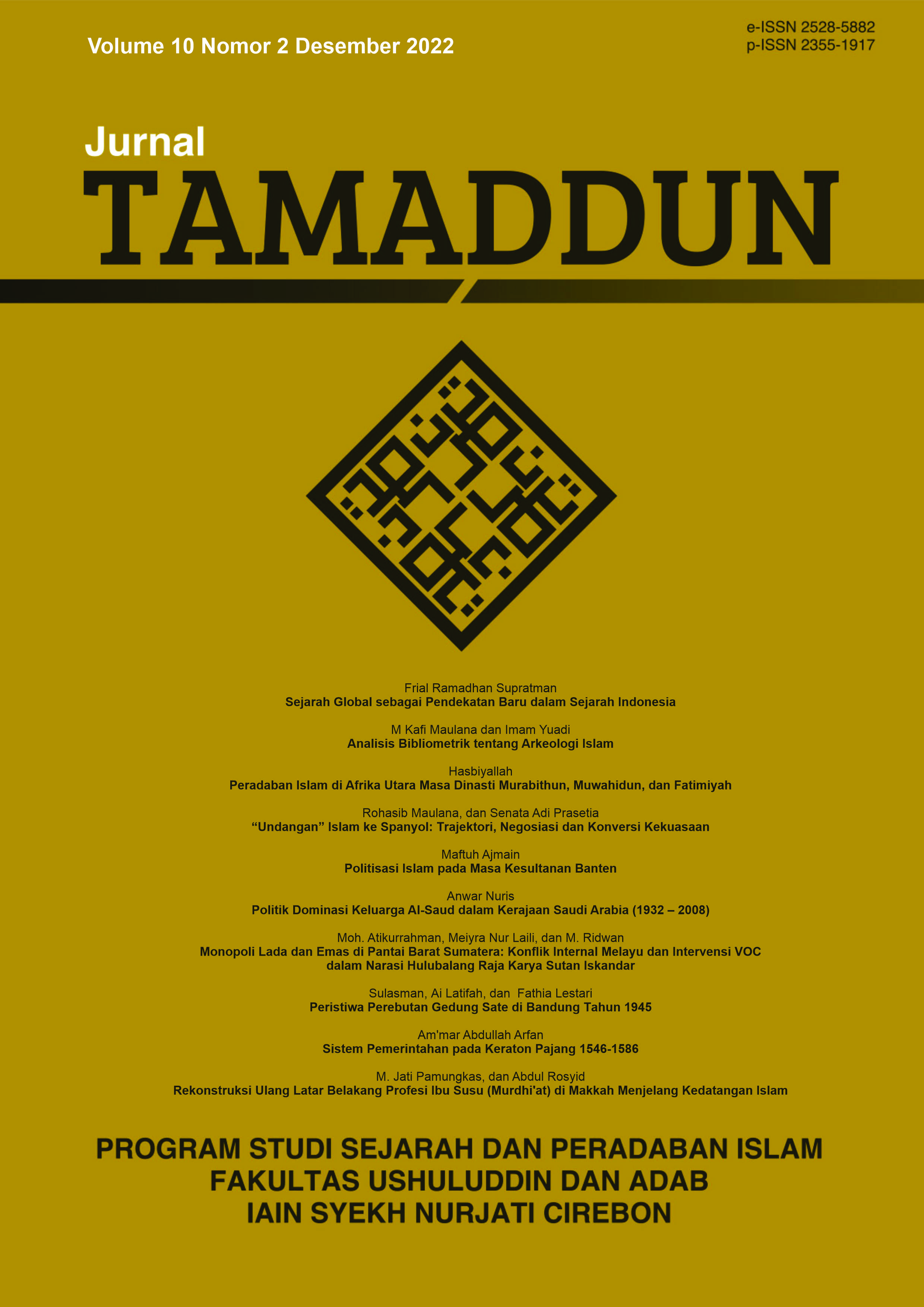
POLITIK DOMINASI KELUARGA AL-SAUD DALAM KERAJAAN SAUDI ARABIA (1932 – 2008)
DOI:
https://doi.org/10.24235/tamaddun.v10i2.11744Keywords:
Al Saud Kingdom, Domination Politic, Saudi Arabia KingdomAbstract
Saudi Arabia is an absolute monarchy that places a king from the descendants of Abdul Aziz bin Abdurahman al-Saud (d. 1953) as the highest authority in government. At another level, apart from the position of king, positions such as prime minister, vice prime minister, minister of defence, minister of interior, commander of the national army, head of intelligence, governor, and other important positions within departments are positions reserved for princes from the al-Saud lineage. This kind of condition then makes the domestic political dynamics of the Kingdom of Saudi Arabia as part of the implementative dynamics of “family†internal politics. Despite being abandoned by its first initiators, the domination politics of the al-Saud family continued to survive until the latest developments in the Kingdom of Saudi Arabia. Besides that, recently the Allegiance Commission was formed in 2006 its task is to regulate the succession of power in the Kingdom of Saudi Arabia, where all of its members are princes from the al-Saud dynasty. Therefore the politics of the al-Saud family in the Kingdom of Saudi Arabia are increasingly gaining dominance momentum.
References
Aqli, Nashir bin Abdul Karim al-, 2006, Islamiyah la Wahhabiyah, (terj) Hanya Islam bukan Wahhabi, Abdur Rosyad Siddiq, Jakarta, Darul Falah.
Atsimain, Abdullah Sholeh al-, 2005, at-Tarikhu al-Mamlakat al-Arabiyyah as-Saudiyah, Juz I, Riyadh: Maktabah Abiykan.
Abdurrahman, Musthofa., 2003, Sejarah Mahkota Saudi Arabia, dalam URL http://www.fokus-kompas.com.
Amstrong, H. C., 1938, The Lord of Arabia, Penguin.
Badi, Awadh al-., 2008, Institutionalising Hereditary Succession in Saudi Arabia’s Political Governance System: The Allegiance Commission, King Faisal Centre for Research and Islamic Studies dalam http://www.arab-reform.net
Black, Antony., 2001, Pemikiran Politik Islam: dari Masa Nabi hingga masa kini, Jakarta: PT. Serambi Ilmu Semesta.
Dessouki, Ali E. Hillal., 1982, Islamic Resurgence in The Arab World, New York: Praeger Publisher.
Hadi, Abdul., 2006, Amerika ingatkan Saudi, dalam URL http://www.eramuslim.com.
Halpern, Malfred., 1963, The Politics of Social Changes in the Middle East and North Africa, Princeton University Press.
Harper, Robert. A., 2007, Saudi Arabia, Chelsea House Publisher
Hitti, Philip K., 2005, History of Arabs, Jakarta: PT. Serambi Ilmu Semesta
Kechichian, Joseph A., 1986, "The Role of the Ulama in the Politics of an Islamic State: The Case of Saudi Arabia," dalam International Journal of Middle East Studies, 18, No. 1, February 1986.
___________, 2001, Succession in Saudi Arabia, New York, Palgrave.
Lenczowski, George., 2003, Timur Tengah di Tengah Kancah Dunia, Bandung, Sinar Baru Algesindo.
Marwan, 2006, Pemilu di Saudi, dalam URL http://www.ulwani.tripod.com
Metz, Helen Chapin (ed.), 1992, Saudi Arabia: A Country Study. Washington: GPO for the Library of Congress.
Niblock, Tim., 2006, Saudi Arabia: Power, Legitimacy and Survival, London and New York, Routledge.
Rahman, Abdul., 1992, Islam Melarang Mengundang Pasukan Kafir, Jakarta, Gema Insani Press.
Rasheed, Madawi al-., 2002, A History of Sa’udi Arabia, Jakarta: PT. Serambi Ilmu Semesta.
Yin, Robert, K., 2004, Studi Kasus & Desain Metode, Jakarta: PT. Raja Grafindo Persada.
Published
Issue
Section
License
Copyright (c) 2022 Jurnal Tamaddun

This work is licensed under a Creative Commons Attribution-NonCommercial 4.0 International License.
Authors who publish with this journal agree to the following terms:
- Authors retain copyright and grant the journal right of first publication with the work simultaneously licensed under a Creative Commons Attribution License that allows others to share the work with an acknowledgement of the work's authorship and initial publication in this journal.
- Authors are able to enter into separate, additional contractual arrangements for the non-exclusive distribution of the journal's published version of the work (e.g., post it to an institutional repository or publish it in a book), with an acknowledgement of its initial publication in this journal.
- Authors are permitted and encouraged to post their work online (e.g., in institutional repositories or on their website) prior to and during the submission process, as it can lead to productive exchanges, as well as earlier and greater citation of published work
