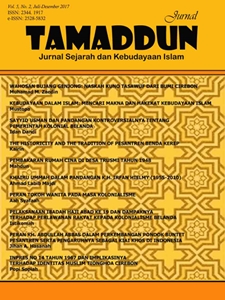
KONFLIK CINA-PRIBUMI DAN DAMPAKNYA BAGI PERTUMBUHAN INDUSTRI BATIK DI TRUSMI 1948
DOI:
https://doi.org/10.24235/tamaddun.v5i2.2012Abstract
Â
In the history of Indonesia, the period 1930 to 1950 is a very crucial period. The people of Indonesia are experiencing the events that have great impact in the future. The incident started with an explosion of economic recession and ended with a very eagerly awaited independence by the people of Indonesia. The phenomenon made Indonesian people more sentimental towards foreign ethnic groups, including to Chinese. Many horrific events occurred during that time, the expulsion, burning and killing of the Chinese people, and one of them occurred in Trusmi Village Cirebon in 1948. It certainly had an impact on the development of Trusmi batik industry. This study uses historical method (historical study) by using descriptive-analysis method as a set of procedures. From this study it is known that the situation of Trusmi society before the conflict between the Chinese and the indigenous people both in the social and religious and socio-economic sides initially went well, but after the incident it caused the Chinese to be isolated from the social life of society in general. Nevertheless, the terrible event is a gateway for indigenous people to stand independently in running the industry Batik.
Keywords: conflict, China, indigenous, implications, and Trusmi
References
Al Anshori, M.Junaedi. Sejarah Nasional Indonesia Masa Pra Sejarah Sampai Masa Proklamasi Kemerdekaan,(Jakarta : PT Mitra Aksara Panaitan, 2010).
Caldwell, Malcolm & Ernst Utrecht. ( Trj.Saut Pasaribu ). Sejarah Alternatif Indonesia, (Yogyakarta: Djaman Baroe, 2011).
Carey, Peter.( Trj. Wasmi Alhaziri ) Orang Cina Bandar Tol, Candu & Perang Jawa Perubahan Persepsi Tentang Cina.( Depok: Komunitas Bambu, 2015 ).
Daradjadi. Geger Pecinan Persekutuan Tionghoa – Jawa Melawan VOC 1740-1743.( Jakarta: PT Kompas Media Nusantara,2013).
Praptanto, Eko. Sejarah Indonesia Zaman Penduduk Jepang dan Kemerdekaan Indonesia Jilid 6 ( Jakarta: PT Bina Sumberdaya MIP, 2010).
Ricklefs, M.C. . Sejarah Indonesia Modern 1200-2008 (Jakarta: Serambi Ilmu Semesta, 2010).
W.P.Groeneveldt, Nusantara dalam catatan Tionghoa ( Depok: Komunitas Bambu 2009 ).
Poerwanto Hari. Cina Khek Di Singkawang. ( Depok: Komunitas Bambu 2014).
Masyhuri, Bakar Pecinan.Konflik Pribumi Vs Cina di Kudus Tahun 1918 ( Jakarta : Pensil 2006 )
Laksmiwati Dyah Komala. Putri Ong Tin Mengarungi Samudra Asmara Merahi Cinta Sejati Sesuhunan Jati Romantika Caruban Nagari, Ed.1, Cet. 2 ( Yogyakarta: Depublish, juni 2014 )
Jeremy Huang. Budaya Etnis Tionghoa Cirebon. Tahun 2006 hlm.18
Adeng DKK, Kota Dagang Cirebon Sebagai Jalur Sutra , Edisi 1 ( Jakarta: CV.Ekadharma,1998)
Bochari M.Sanggupri, Sejarah Kerajaan Tradisional Cirebon Edisi 1 (Jakarta : CV Sukorejo Bersinar, 2001 )
Raffles Thomas Stamford, The History Of Java Trj Eko Prasetyaningrum Dkk. (Yogyakarta : Narasi 2014)
Al Qurtuby Sumanto, Arus Cina Islam Jawa ( Jogjakarta: Inspeal Ahimsakarya Press,2003)
Taniputra Ivan, History Of China Cet, III ( Jogjakarta: Ar-Ruzz Media, 2011)
Yuanzhi Kong, Cengho Muslim Tionhoa Misteri Perjalanan Muhibah di Nusantara Cet. IV ( Jakarta : Pustaka Obor Indonesia,2011)
Reid Anthoni, Asia Tenggara Dalam Kurun Niaga 1450-1680 Jarinagan Perdagangan Global Terj.Leirissa Dkk. ( Jakarta : Yayasan Pustaka Obor Indonesia,2011 )
Downloads
Published
Issue
Section
License
Copyright (c) 2019 Jurnal Tamaddun : Jurnal Sejarah dan Kebudayaan Islam

This work is licensed under a Creative Commons Attribution-NonCommercial 4.0 International License.
Authors who publish with this journal agree to the following terms:
- Authors retain copyright and grant the journal right of first publication with the work simultaneously licensed under a Creative Commons Attribution License that allows others to share the work with an acknowledgement of the work's authorship and initial publication in this journal.
- Authors are able to enter into separate, additional contractual arrangements for the non-exclusive distribution of the journal's published version of the work (e.g., post it to an institutional repository or publish it in a book), with an acknowledgement of its initial publication in this journal.
- Authors are permitted and encouraged to post their work online (e.g., in institutional repositories or on their website) prior to and during the submission process, as it can lead to productive exchanges, as well as earlier and greater citation of published work