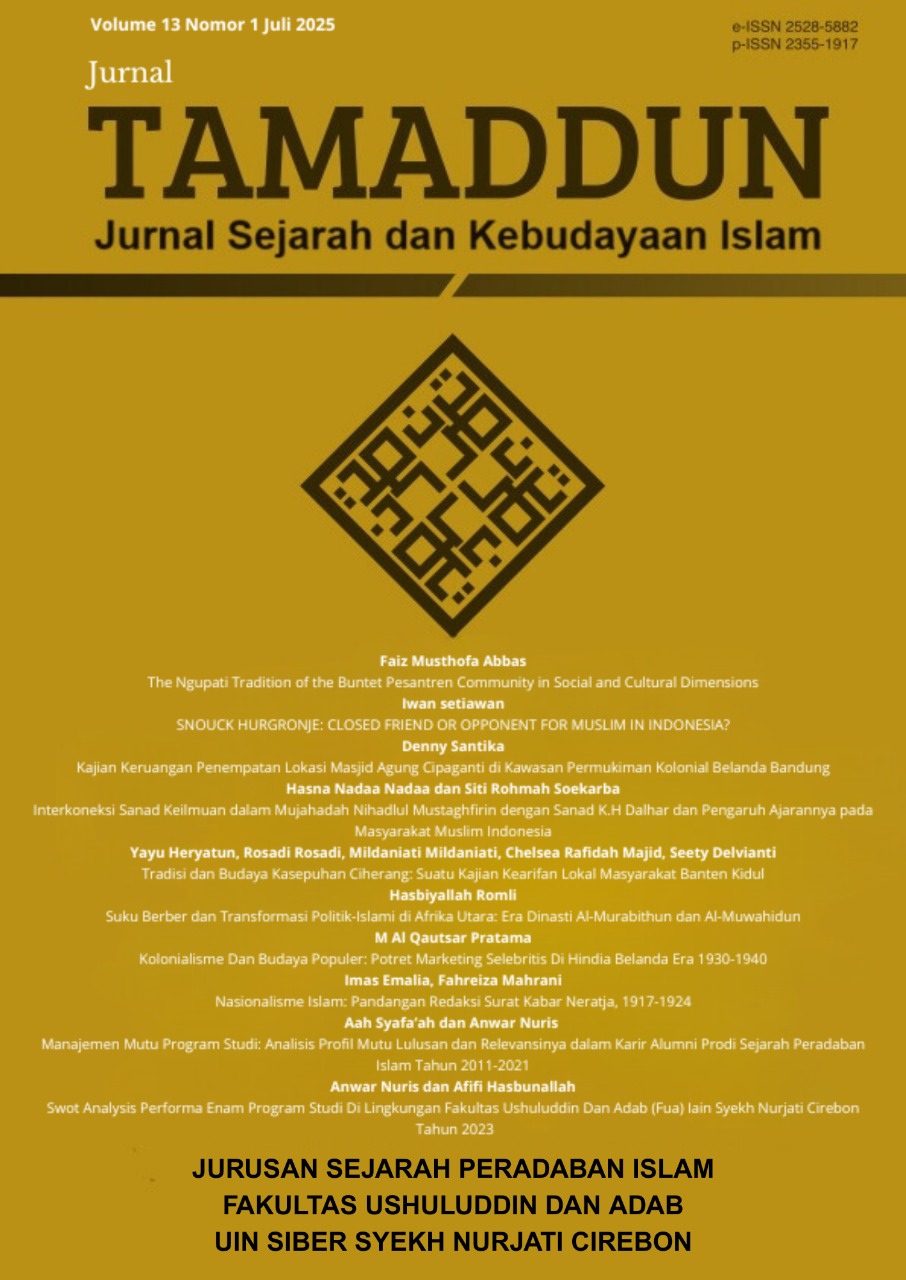
Suku Berber dan Transformasi Politik-Islami di Afrika Utara: Era Dinasti Al-Murabithun dan Al-Muwahidun
DOI:
https://doi.org/10.24235/tamaddun.v13i1.20650Keywords:
Islamisasi, Afrika Utara, Suku Berber, Sejarah Islam, Dinasti MaghribAbstract
This study aims to explore the contributions of the Berber people in the political transformation and strengthening of Islam in North Africa during the era of the Al-Murabitun and Al-Muwahhidun dynasties. Using a descriptive-analytical historical approach, the research examines the active role of the Berber people in the spread and reinforcement of Islam in the region. The findings indicate that the Berber people not only acted as mediators between Arab Muslims and local communities but also played a crucial role in establishing political, military, and intellectual structures that supported the dissemination of Islam. Additionally, cultural adaptation and the development of institutions such as mosques and madrasas further strengthened the presence of Islam in North Africa. Consequently, the study concludes that without the active participation of the Berber people, the Islamicization of North Africa would not have achieved significant success.
References
Abd. Hamid al-Ibadi, Al Mujmal fi Tarikh al-Andalus. Cet.II. (Cairo: Dar al-Qalam, 1964)
Amira K. Bennison, The Almoravid and Almohad Empires, The Edinburgh history of the Islamic empires (Eddinburgh: University Press, 2016 )
Brett, M & Fentress, E. The Berbers. (Blackwell Publishers, 1996)
Betten, Arnold, Antike, Berber traditionen und Islam-Geschichte, Kurt und Kultur im Maghreb. (Koln: DuMont, 2000)
Fabsin M. Fa’al, Sejarah Kekuasaan Islam. Jakarta: CV Artha Rivera, Tth
Hitti, Phillip K, Hostory Of The Arabs diterjmahkan oleh R. Cecep Lukman Yasin dan Dedi Slamet Riyadi dari “ History of The Arabs”.( Jakarta: Serambi Ilmu Semesta. Cet. II. 2010)
Karim, MA, Sejarah Pemikiran dan Peradaban Islam. Yogyakarta: Pustaka Book Publisher. Cet.II, 2008)
Levtzion, N., dan R.L. Pouwels (Eds.) The History of Islam in Africa . (Athens: Ohio University Press, 2008)
Louis Goothtschalk, Mengerti Sejarah, Terj. Nugroho Notosunanto ( Jakarta: UI Press, 1980)
M. Abdul karim. Sejarah Pemikiran dan Peradaban Islam. Yogyakarta: Pustaka Book Publisher, 2009)
Musyrifah Sunanto. Sejarah Islam Klasik, Perkembangan Ilmu Pengetahuan. (Bogor: Kencana, 2003)
Moh.Nurhakim, (2024). Sejarah dan Peradaban Islam. (Malang: Umm Press, 2024)
Siti Maryam dkk. Sejarah Peradaban Islam, Dari Klasik Hingga Modern. (Yogyakarta: LESFI, 2002)
Samsul Munir Amin, Sejarah Peradaban Islam, (Jakarta: Amzah, 2009)
Syed Mahmudunnasir. Islam, Konsepsi dan Sejarahnya. Terj. Adang Affandi (Bandung: Remaja Rosdakarya, 1994)
Sunanto, M. Sejarah Islam Klasik, Perkembangan Ilmu Pengetahuan. (Jakarta: Kencana, 2011)
Syantanwy, Akhmad dkk. Dairat al Maarif al Islamiyah. Jilid 10.
W. Montgomery Watt. (1990). The Majesty was Islam, terj. Hartono Hadikusumo, Kejayaan Islam, Kajian Kritis dari Tokoh Orientalis . (Yogyakarta: Tiara Wacana, 1990)
Wildan, M. Peradaban Islam di Afrika sub-Sahara dalam Siti Maryam. (edit). Sejarah Peradaban Islam, Dari Klasik Hingga Modern (Yogyakarta: LESFI. 2002 )
Vita Ery Oktaviyani. (2019) “Islam DI Afrika Utara”. Jurnal Sejarah Peradaban Islam, Vol.II, No.1, 2019.
Berber People, Michael Brett, di akses dari https://www.britannica.com/topic/Berber
Downloads
Published
Issue
Section
License
Copyright (c) 2025 Jurnal Tamaddun: Jurnal Sejarah dan Kebudayaan Islam

This work is licensed under a Creative Commons Attribution-NonCommercial 4.0 International License.
Authors who publish with this journal agree to the following terms:
- Authors retain copyright and grant the journal right of first publication with the work simultaneously licensed under a Creative Commons Attribution License that allows others to share the work with an acknowledgement of the work's authorship and initial publication in this journal.
- Authors are able to enter into separate, additional contractual arrangements for the non-exclusive distribution of the journal's published version of the work (e.g., post it to an institutional repository or publish it in a book), with an acknowledgement of its initial publication in this journal.
- Authors are permitted and encouraged to post their work online (e.g., in institutional repositories or on their website) prior to and during the submission process, as it can lead to productive exchanges, as well as earlier and greater citation of published work
