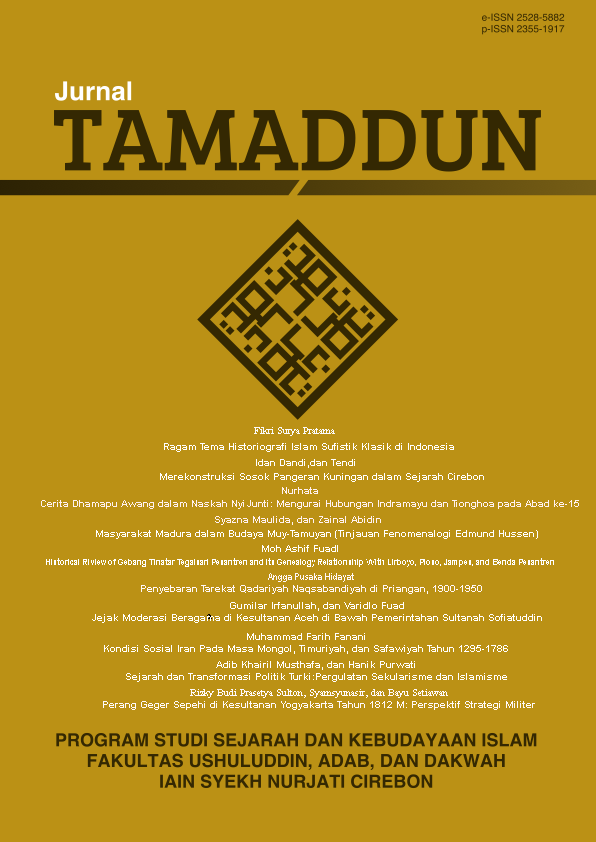
KONDISI SOSIAL IRAN PADA MASA MONGOL, TIMURIYAH, DAN SAFAWIYAH TAHUN 1295-1786 M
DOI:
https://doi.org/10.24235/tamaddun.v10i1.8702Keywords:
Islamic civilization, Iranian politics, social historyAbstract
The Mongols (Ilkhan), Timurids, and Safavids were the three kingdoms in Iran. The three kingdoms played a significant role in advancing Islamic civilization. The three Islamic kingdoms were not born from Arab circles, so it is very interesting to discuss further. The Mongols invaded Islamic territory and divided Persia into Hulagu, which became the forerunner to the birth of the Ilkhan dynasty. Ilkhan's power was then continued by Timuriyah with the main character, Timur Lenk. Then power shifted to the Safavids. The Safavids then managed to become a great power by legitimizing their power with a Shia approach and Qizilbash military power. This article uses the historical method with a political sociology approach. The historical method uses four steps in historical writing to obtain a systematic and chronological description, namely heuristics, verification, interpretation, and historiography. The political sociology approach is used to see a historical event from a social and political point of view. Especially those that include the concepts of society, state, power, and social structure.
References
Abdurrahman, Dudung. Metodologi Penelitian Sejarah Islan. Yogyakarta: Ombak, 2019.
Abidin, Zaenal. “Dinasti Safawiyah (Tahun 1501-1738 Masehi).†Tsaqofah Vol. 11 No (2013).
Bosworth, CE. Dinasti-Dinasti Islam. Bandung: Penerbit Mizan, 1993.
Chandra, Pasmah. “Pendidikan Islam Pada Masa Kebangkitankan (Gerakan Intelektual Muslim Di Kalangan Syiah Isma’iliyah Dan Dinasti Safawy).†Edukasia Multikultura 2 (2020): 14–21.
Daliman. Metode Penelitian Sejarah. Yogyakarta: Ombak, 2012.
Desky, Harjoni. “Kerajaan Safawi Di Persia Dan Mughal Di India Asal Usul, Kemajuan Dan Kehancuran.†Tasamuh: Jurnal Studi Islam 8, no. April (2016): 121–141.
Farid, Achmad. “Sejarah Perkembangan Dakwah Islam Pasca Invasi Mongol.†Dakwatuna: Jurnal Dakwah dan Komunikasi Islam 2 (2016): 283.
Hefni, Harjani. “Serangan Mongol Dan Timur Lenk Serta Dampaknya Terhadap Dakwah Islamiyyah Di Dinasti Abbasiyyah.†Khatulistiwa 4, no. 2 (2014): 185–196. http://jurnaliainpontianak.or.id/index.php/khatulistiwa/article/view/259.
Karim, M Abdul. Bulan Sabit Di Gurun Gobi Sejarah Dinasti Mongol-Islam Di Asia Tengah. Yogyakarta: Suka Press, 2014.
———. Sejarah Pemikiran Dan Peradaban Islam. Yogyakarta: Bagaskara, 2017.
Kartodirdjo, Sartono. Pendekatan Ilmu Sosial Dalam Metodologi Sejarah. 2nd ed. Yogyakarta: Ombak, 2019.
Khairuddin. “Syi’ah Itsna ’Asyariyah.†Al-Fikra: Jurnal Ilmiah Keislaman 8, no. 2 (2009).
Lapidus, Ira M. Sejarah Sosial Ummat Islam. Jakarta: PT. Raja Graffindo Persada, 2000.
Maryam, Siti. Sejarah Peradaban Islam Dari Masa Klasik Hingga Moden. Yogyakarta: Lesfi, 2012.
Qonitah, Niswah. “Eksistensi Peradaban Islam Pada Masa Dinasti Ilkhan Pasca Invasi Mongol.†NALAR: Jurnal Peradaban dan Pemikiran Islam 4, no. 1 (2020): 19–28.
Siregar, Shahruddin. “Timur Lenk Dan Pengembangan Islam.†Ittihad Vol.1 No.2 (2017).
Sujati, Budi, and Nita Yuli Astuti. “Politik Penguasaan Bangsa Mongol Terhadap Negeri-Negeri Muslim Pada Masa Dinasti Ilkhan (1260-1343).†Jurnal Rihlah 6, no. 1 (2018): 46–63.
Suryanti, Suryanti. “Bangsa Mongol Mendirikan Kerajaan Dinasti Ilkhan Berbasis Islam Pasca Kehancuran Baghdad Tahun 1258-1347 M.†NALAR: Jurnal Peradaban dan Pemikiran Islam 1, no. 2 (2018): 146.
Susmihara. Sejarah Peradaban Islam. Yogyakarta: Ombak, 2013.
Syatriadin. “Landasan Sosiologis Dalam Pendidikan.†Ilmu Sosial dan Pendidikan 1, no. 2 (2017): 9–15.
Syukur, Abdul. “Transformasi Gerakan Tarekat Syafawiyah Dari Teologis Ke Politis.†Kalam 8, no. 1 (2014): 187.
Zulkifli. “Sejarah Kemunculan Dan Perkembangan Syi’ah.†Jurnal Khatulistiwa 3, no. September (2013): 142–153.
Downloads
Published
Issue
Section
License
Copyright (c) 2022 Jurnal Tamaddun : Jurnal Sejarah dan Kebudayaan Islam

This work is licensed under a Creative Commons Attribution-NonCommercial 4.0 International License.
Authors who publish with this journal agree to the following terms:
- Authors retain copyright and grant the journal right of first publication with the work simultaneously licensed under a Creative Commons Attribution License that allows others to share the work with an acknowledgement of the work's authorship and initial publication in this journal.
- Authors are able to enter into separate, additional contractual arrangements for the non-exclusive distribution of the journal's published version of the work (e.g., post it to an institutional repository or publish it in a book), with an acknowledgement of its initial publication in this journal.
- Authors are permitted and encouraged to post their work online (e.g., in institutional repositories or on their website) prior to and during the submission process, as it can lead to productive exchanges, as well as earlier and greater citation of published work
