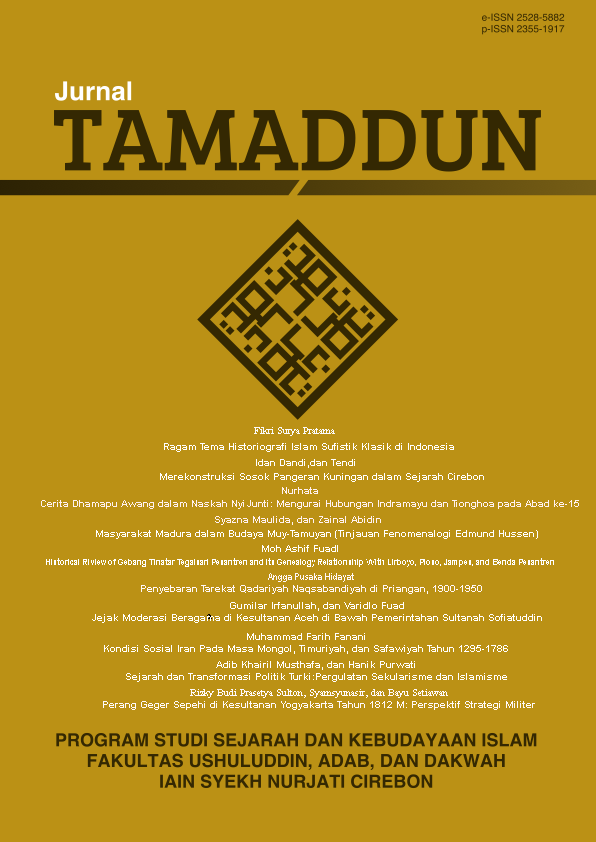
Masyarakat Madura dalam Budaya Muy-Tamuyan (Tinjauan Fenomenologi Edmund Husserl)
DOI:
https://doi.org/10.24235/tamaddun.v10i1.9051Keywords:
Masyarakat Madura, Muy-Tamuyan, FenomenologiAbstract
This article discusses how the Madurese community perceives one of the cultures found in Madura. Muy-tamuyan is considered the most important culture carried out by the Madurese community such as those in rural areas. This activity is growing rapidly in the Madurese community. As for the background of this research, it begins with how the enthusiastic attitude of the community in having Muy-tamuyan, talking until late, and the solidity that is built among other communities, this is the interest of researchers to investigate more deeply. Because, in addition to this culture is very important for the community, also because this culture is more than just a tradition because there are certain motives in it. In this article, the method used is a qualitative field method (field research) with a phenomenological approach to Edmund Husserl's theory. Sources of data obtained from interviews and literature studies are limited to matters that have relevance to this research. The findings in this study are that there are various perceptions of the Madurese community that make people very enthusiastic in carrying out this Muy-Tamuyan culture, including Muy-Tamuyan culture as a form of social solidarity, ukhwah Islamiyyah, and social interaction.
References
Referensi
Ali, M. (2010). Akomodasi nilai-nilai budaya masyarakat madura mengenai penyelesaian carok dalam hukum pidana. Jurnal Hukum Ius Quia Iustum, 17(1), 85–102.
Amalia, M. (2020). Mempererat Ukhuwah Islamiyah di Masa Pandemi Covid-19. Makmood Publishing.
Arzika, L. R., & Rahayu, R. (2021). BENTUK INTERAKSI SOSIAL MASYARAKAT PRIBUMI DENGAN MASYARAKAT PENDATANG DI DESA TAMBUSAI UTARA KECAMATAN TAMBUSAI UTARA KABUPATEN ROKAN HULU. Bakoba: Journal of Social Science Education, 1(1), 1–12.
De Jonge, H. (1989). Madura dalam empat zaman: Pedagang, perkembangan ekonomi, dan Islam: Suatu studi antropologi ekonomi. Diterbitkan atas kerja sama Perwakilan Koninklijk Instituut
Hasbullah, H. (2012). Rewang: Kearifan Lokal dalam Membangun Solidaritas dan Integrasi Sosial Masyarakat di Desa Bukit Batu Kabupaten Bengkalis. Sosial Budaya, 9(2), 231–243.
Hasnih, H. (2018). PERAN ORGANISASI KPPM ULAWENG SEBAGAI WADAH INTERAKSI SOSIAL REMAJA.
Jones, P. (2010). Pengantar Teori-Teori Sosial: Dari Fungsionalisme hingga Post-modernisme. Yayasan Pustaka Obor Indonesia.
Kumalasari, L. D. (2017). Makna Solidaritas Sosial Dalam Tradisi ‘Sedekah Desa’(Studi pada Masyarakat Desa Ngogri Megaluh Jombang). Research Report, 1110–1123.
Rochana, T. (2012). Orang Madura: Suatu Tinjauan Antropologis. Humanus, 11(1), 46–51.
Subaharianto, A. (2004). Tantangan Industrialisasi Madura: Membentur Kultur, Menjunjung Leluhur. Bayumedia Pub.
Ulwan, A. N. (1990). Pendidikan Anak Menurut Islam. Remaja Rosdakarya.
Wiyata, A. L. (2003). Madura yang Patuh? Kajian Antropologi Mengenai Budaya madura. CERIC-FISIP UI.
Wiyata, A. L. (2005). Model Rekonsiliasi Orang Madura. 4.
Zubairi, A. D. (2013). Rahasia perempuan Madura: Esai-esai remeh seputar kebudayaan Madura. Andhap Asor.
Zubairi, A. D. (2020). Wajah Islam Madura. Tare Books.
Wawancara
Faizi, M. I. (2021, Mei). Budaya Muy-Tamuyan di Madura [Wawancara].
Hadrowi. (2021, Mei). Budaya Muy-Tamuyan di Madura [Wawancara].
Hasanah. (2021, June 9). Budaya Muy-Tamuyan bagi kaum perempuan [Wawancara].
Ramadhani, R. (2021, June 6). Budaya Muy-Tamuyan di Madura [Wawancara].
Romadhoni. (2021, June 7). Budaya Muy-Tamuyan di Madura [Wawancara].
Salamet. (2021, June 8). Budaya Muy-Tamuyan masyarakat Madura [Wawancara].
Downloads
Published
Issue
Section
License
Copyright (c) 2022 Jurnal Tamaddun : Jurnal Sejarah dan Kebudayaan Islam

This work is licensed under a Creative Commons Attribution-NonCommercial 4.0 International License.
Authors who publish with this journal agree to the following terms:
- Authors retain copyright and grant the journal right of first publication with the work simultaneously licensed under a Creative Commons Attribution License that allows others to share the work with an acknowledgement of the work's authorship and initial publication in this journal.
- Authors are able to enter into separate, additional contractual arrangements for the non-exclusive distribution of the journal's published version of the work (e.g., post it to an institutional repository or publish it in a book), with an acknowledgement of its initial publication in this journal.
- Authors are permitted and encouraged to post their work online (e.g., in institutional repositories or on their website) prior to and during the submission process, as it can lead to productive exchanges, as well as earlier and greater citation of published work
