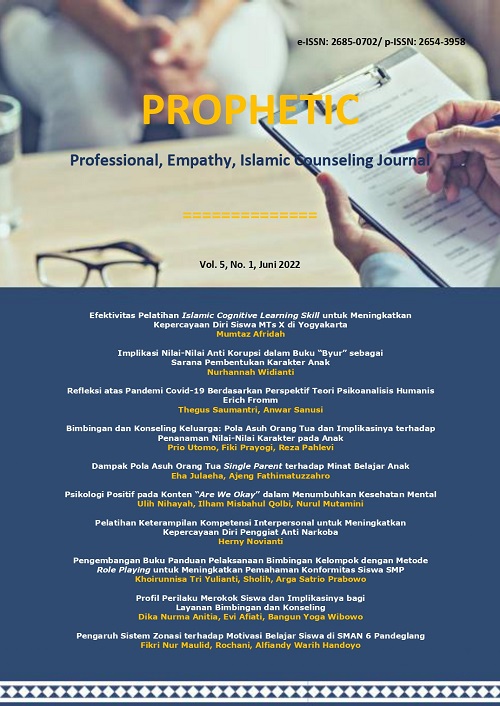
Efektivitas Pelatihan Islamic Cognitive Learning Skill untuk Meningkatkan Kepercayaan Diri Siswa MTs X Di Yogyakarta
DOI:
https://doi.org/10.24235/prophetic.v5i1.11167Keywords:
Islamic Cognitive Learning Skill, Pelatihan, Kepercayaan Diri.Abstract
Penelitian ini bertujuan untuk mengetahui efektivitas dari pelatihan Islamic Cognitive Learning Skill untuk meningkatkan kepercayaan diri siswa MTs X di Yogyakarta. Penelitian ini menggunakann desain penelitian quasi eksperimen non randomized pretest and posttest control group design. Partisipan penelitian ini dibagi ke dalam dua kelompok, kelompok kontrol dan kelompok eksperimen. Pelatihan ini hanya diberikan kepada siswa siswa yang memiliki skor kepercayaan diri yang sedang dan rendah serta melewati proses asesmen awal. Partisipan diminta untuk mengisi skala, skala yang digunakan untuk mengukur kepercayaan diri siswa adalah skala Lauster yang telah digubah oleh Nurroyani (2014) dan diuji coba pada siswa SMA X, di mana skala tersebut memiliki reliabilitas sebesar r = 0.871 yang berarti memiliki reliabilitas yang tinggi. Hasil analisis uji Wilcoxon menunjukkan bajwa nilai signifikansi (p) = 0.02 (p< 0.05). Hal tersebut menunjukkan bahwa adanya perubahan yang signifikan sebelum dan sesudah diberikannya pelatihan Islamic Cognitive Learning Skill.
Downloads
References
Afiatin, T & Andayani, B. (1998). Peningkatan Kepercayaan Diri Remaja Penganggur Melalui Kelompok Dukungan Sosial. Jurnal Psikologi UGM. 2. 36-46.
De Angelis, B. (2002). Percaya Diri : Sumber Sukses dan Kemandirian. Jakarta : PT Gramedia Pustaka Utama.
D. W. Pulmerr. (1999). Guidance, New York: Thomas. Y. Crowell.
Ghufron, M. Nur. (2010). Teori-Teori Psikologi. Ar-Ruzz Media: Yogyakarta.
Kaye. J & Raghavan, S.K. (2002). Spirituality in disability and illness. Journal of religion and health. 41,231-242.
Lauster, P. (1990). Tes Kepribadian. Jakarta: Bumi Aksara.
Nurroyani. (2014). Hubungan Antara Kecerdasan Emosi dan Kepercayaan Diri Pada Siswa SMA X di Jombang, Jawa Timur. Skripsi (tidak diterbitkan). Yogyakarta : Fakultas Psikologi dan Ilmu Sosial Budaya UII.
Paukert, A., dkk. (2009). Integration religion into cognitive behaviour therapy for geriatric anxiety and depression. Journal of Psychiatric Practice. – (15) 103-112.
Rusydi, A. (2012). Husn Al-Zhann: Konsep berfikir positif dalam perspektif Psikologi Islam dan manfaatnya bagi kesehatan mental. Proyeksi, 1-31.
Smith, D.W. (1994). Theory of Spirituality. Journal of Holistic Nursing. 9 () 34-43.
Suryaningrum, D.U. (2016). Efektivitas Pelatihan Harga Diri dengan Metode Instruksi Diri Untuk Meningkatkan Kepercayaan Diri pada Siswa BBRSBD Surakarta. Tesis (tidak diterbitkan). Surakarta : Fakultas Psikologi UMS.
Winda, A. L. (2012). Pelatihan Kognitif Spiritual Islam untuk Meningkatkan Kepercayaan Diri Remaja dengan Cacat Tubuh. Tesis (tidak diterbitkan).Yogyakarta : Fakultas Psikologi dan Ilmu Sosial Budaya UII.
Downloads
Issue
Section
License
Copyright (c) 2022 Prophetic : Professional, Empathy, Islamic Counseling Journal

This work is licensed under a Creative Commons Attribution-NonCommercial 4.0 International License.
Proposed Policy for Journals That Offer Open Access
Authors who publish with this journal agree to the following terms:
- Authors retain copyright and grant the journal right of first publication with the work simultaneously licensed under a Creative Commons Attribution License that allows others to share the work with an acknowledgement of the work's authorship and initial publication in this journal.
- Authors are able to enter into separate, additional contractual arrangements for the non-exclusive distribution of the journal's published version of the work (e.g., post it to an institutional repository or publish it in a book), with an acknowledgement of its initial publication in this journal.
- Authors are permitted and encouraged to post their work online (e.g., in institutional repositories or on their website) prior to and during the submission process, as it can lead to productive exchanges, as well as earlier and greater citation of published work (See The Effect of Open Access).
Proposed Policy for Journals That Offer Delayed Open Access
Authors who publish with this journal agree to the following terms:
- Authors retain copyright and grant the journal right of first publication, with the work [SPECIFY PERIOD OF TIME] after publication simultaneously licensed under a Creative Commons Attribution License that allows others to share the work with an acknowledgement of the work's authorship and initial publication in this journal.
- Authors are able to enter into separate, additional contractual arrangements for the non-exclusive distribution of the journal's published version of the work (e.g., post it to an institutional repository or publish it in a book), with an acknowledgement of its initial publication in this journal.
- Authors are permitted and encouraged to post their work online (e.g., in institutional repositories or on their website) prior to and during the submission process, as it can lead to productive exchanges, as well as earlier and greater citation of published work (See The Effect of Open Access).