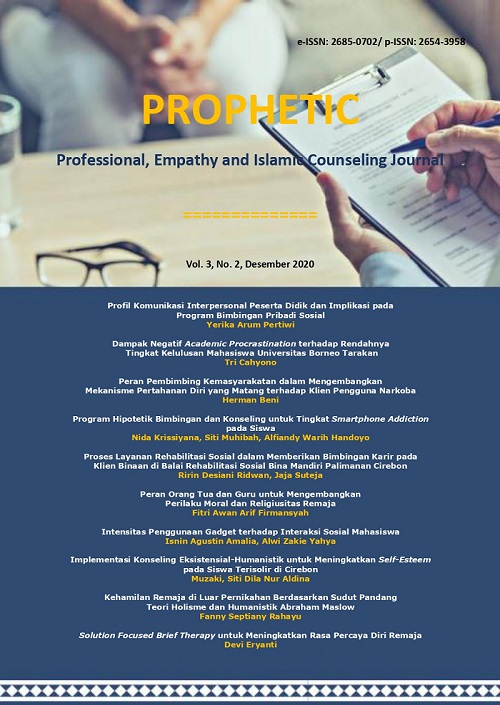
Intenitas Penggunaan Gawai terhadap Interaksi Sosial Mahasiswa (Studi Kasus Organisasi Primordial Ikatan Mahasiswa Tegal Wilayah Cirebon)
DOI:
https://doi.org/10.24235/prophetic.v3i2.7594Keywords:
Penggunaan Gawai, Interaksi Sosial, Mahasiswa.Abstract
Mahasiswa IMT sangat familiar dengan gawai. Hal tersebut berdampak kepada interaksi langsung antarmahasiswa IMT yang relatif berkurang dan canggung. Tujuan penelitian ini untuk mengetahui penggunaan gawai oleh mahasiswa IMT, mengetahui interaksi sosial mahasiswa di IMT, dan mengetahui intensitas penggunaan gawai. Metodologi yang digunakan dalam penulisan ini adalah kualitatif deskriptif. Sampel responden dalam penulisan ini sebanyak 13 mahasiswa yang terdiri dari 4 orang laki-laki dan 9 orang perempuan. Hasil penelitian menunjukkan bahwa penggunaan gawai pada mahasiswa IMT sangat berpengaruh. Selain dapat memudahkan mahasiswa untuk menjalin interaksi jarak jauh, manfaat lainnya memudahkan memperoleh informasi seputar perkuliahan. Berkaitan dengan interaksi sosial, mahasiswa mengalami disfungsi sosial. Di sisi lain, intensitas penggunaan gawai terhadap interaksi sosial di IMT dalam konsteks saat berkumpul sangat mengganggu.
References
Agusli, R. (2008). Panduan Koneksi Internet 3G & HSDPA di Handphone & Komputer. Jakarta: Mediakita.
Burhan, B. (2007). Penelitian Kualitatif Komunikasi, Ekonomi, Kebijakan Publik, dan Ilmu Sosial lainnya. Jakarta: Kencana
Soekanto, S. (2013). Sosiologi Suatu Pengantar. Jakarta: Raja Grafindo Persada.
Darmawan, D. (2012). Pendidikan Teknologi Informasi Dan Komunikasi.; Bandung; Remaja Rosdakarya.
Gunawan I. (2015). Metode Penelitian Kualitatif Teori dan Praktik. Jakarta: Bumi Aksara.
Partanto, dkk. (n.d.). Kamus Ilmiah Populer. Surabaya: Penerbit Arloka.
Rayan A. B. (2004). Rahasia Dibalik Handphone. Jakarta: Darul Falah.
Walgito, B. (2003). Psikologi Sosial. Yogyakarta: Andi.
Downloads
Issue
Section
License
Copyright (c) 2020 Prophetic : Professional, Empathy and Islamic Counseling Journal

This work is licensed under a Creative Commons Attribution-NonCommercial 4.0 International License.
Proposed Policy for Journals That Offer Open Access
Authors who publish with this journal agree to the following terms:
- Authors retain copyright and grant the journal right of first publication with the work simultaneously licensed under a Creative Commons Attribution License that allows others to share the work with an acknowledgement of the work's authorship and initial publication in this journal.
- Authors are able to enter into separate, additional contractual arrangements for the non-exclusive distribution of the journal's published version of the work (e.g., post it to an institutional repository or publish it in a book), with an acknowledgement of its initial publication in this journal.
- Authors are permitted and encouraged to post their work online (e.g., in institutional repositories or on their website) prior to and during the submission process, as it can lead to productive exchanges, as well as earlier and greater citation of published work (See The Effect of Open Access).
Proposed Policy for Journals That Offer Delayed Open Access
Authors who publish with this journal agree to the following terms:
- Authors retain copyright and grant the journal right of first publication, with the work [SPECIFY PERIOD OF TIME] after publication simultaneously licensed under a Creative Commons Attribution License that allows others to share the work with an acknowledgement of the work's authorship and initial publication in this journal.
- Authors are able to enter into separate, additional contractual arrangements for the non-exclusive distribution of the journal's published version of the work (e.g., post it to an institutional repository or publish it in a book), with an acknowledgement of its initial publication in this journal.
- Authors are permitted and encouraged to post their work online (e.g., in institutional repositories or on their website) prior to and during the submission process, as it can lead to productive exchanges, as well as earlier and greater citation of published work (See The Effect of Open Access).