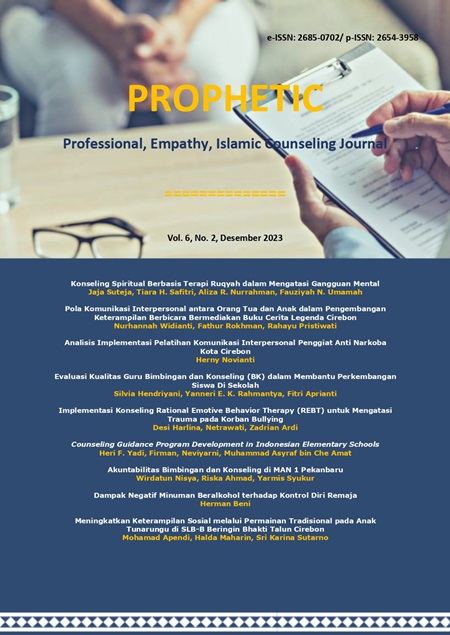
Counseling Guidance Program Development in Indonesian Elementary Schools
DOI:
https://doi.org/10.24235/prophetic.v6i2.16661Keywords:
Guidance and Counseling Service, Counseling Guidance Program, School Counseling.Abstract
This study aims to find out and understand the importance of the counseling program in elementary schools (SD), aiming to produce individuals achieving optimal development in accordance with their potential, interests and values that become their way of life, many elementary schools (SD) currently have guidance and counseling services not implemented , and there is no guidance counseling program with class teachers, because elementary school (SD) teachers lack knowledge of counseling guidance programs. The implementer of the BK program in SD is the class teacher in charge of carrying out guidance and counseling services in the class for which he is responsible. This research is a qualitative research with the method of literature review which is used as a reinforcement of the literature that is relevant to the things you want to study. Development of counseling guidance programs in elementary schools (SD). Guidance and counseling programs in elementary schools greatly influence the development of students' potential, interests and talents. So from this the guidance and counseling program in elementary schools (SD) must be considered so that the provision of services to students is also effective and the results are in accordance with what is desired.
References
Asosiasi Bimbingan dan Konseling Indonesia (ABKIN). (2013). Panduan Umum Pelayanan Bimbingan dan Konseling.
Creswell, W, J., Plano Clark, & L., V. (2014). Research Design, Qualitatif and Mixed Methods Approaches. In Sage Publications Ltd. (Issue 8).
Endriani, N., & Syukur, Y. (2015). Kesiapan Siswa dalam MenyelesaikanTugas Sekolah. Konselor, 4(3). https://doi.org/10.24036/02015436465-0-00
Habsy, B. A. (2017). Seni Memehami Penelitian Kuliatatif Dalam Bimbingan Dan Konseling : Studi Literatur. JURKAM: Jurnal Konseling Andi Matappa, 1(2). https://doi.org/10.31100/jurkam.v1i2.56
Mohammad Surya. (1988). Dasar-dasar penyuluhan. Jakarta: Depertemen pendidikan dan kebudayaan, Dirjen DIKTI.
Neviyarni, S. (2023). Manajemen Bimbingan dan Konseling Di Sekolah Konsep, Masalah, dan Solusi (1st ed.). KENCANA.
Prayitno. (1999). Panduan kegiatan pengawasan BK di sekolah. Jakarta: Rineka Cipta.
Prayitno. (1987). Profesionalisasi Konseling dan Pendidikan Konselor. Jakarta: Departemen pendidikan dan kebudayaan.
Prayitno. (1999). Panduan Kegiatan Pengawasan Bimbingan dan Konseling di Sekolah. Jakarta: Rineka Cipta.
Rahmadani, R. (2021). Manajemen Bimbingan Dan Konseling Di Sekolah. Jurnal Pendidikan Tambusai, 5.
Rahmiati, Firman, & Ahmad, R. (2021). Implementasi Pendidikan sebagai Hak Asasi Manusia. Jurnal Pendidikan Tambusai, 5(3).
Ridwan. (1998). Bimbingan dan Konseling di Sekolah. Yogyakarta: Pustaka Pelajar.
Stepy, Y., & Firman, F. (2020). Modal sosial paguyuban dalam pengembangan fasilitas pendidikan di sekolah dasar. JPGI (Jurnal Penelitian Guru Indonesia), 5(1). https://doi.org/10.29210/02503jpgi0005
Sugiarto, S., Neviyarni, S., & Firman, F. (2021). Peran Penting Sarana dan Prasarana Dalam Pembelajaran Bimbingan Konseling di Sekolah. JPT: Jurnal Pendidikan Tematik, 2(1).
Thantawy, R. (1995). Manajemen Bimbingan dan Konseling. Jakarta: Pamator Pressindo.
Winkel, W. S. (1997). Bimbingan dan Konseling di Institusi Pendidikan. Jakarta: Grasindo.
Yan, E. (2017). Pelaksanaan Kunjungan Rumah Oleh Guru Bimbingan Dan Konseling. Indonesian Journal Of Guidance And Counseling: Theory And Application, 6(October 2014).
Yuningsih, E., & Herawan, E. (2015). Kepemimpinan Transformasional Kepala Sekolah Dan Iklim Sekolah Terhadap Sekolah Efektif Pada Sd Negeri Di Purwakarta. Jurnal Administrasi Pendidikan UPI, XXII(2).
Downloads
Issue
Section
License
Copyright (c) 2024 Prophetic : Professional, Empathy, Islamic Counseling Journal

This work is licensed under a Creative Commons Attribution-NonCommercial 4.0 International License.
Proposed Policy for Journals That Offer Open Access
Authors who publish with this journal agree to the following terms:
- Authors retain copyright and grant the journal right of first publication with the work simultaneously licensed under a Creative Commons Attribution License that allows others to share the work with an acknowledgement of the work's authorship and initial publication in this journal.
- Authors are able to enter into separate, additional contractual arrangements for the non-exclusive distribution of the journal's published version of the work (e.g., post it to an institutional repository or publish it in a book), with an acknowledgement of its initial publication in this journal.
- Authors are permitted and encouraged to post their work online (e.g., in institutional repositories or on their website) prior to and during the submission process, as it can lead to productive exchanges, as well as earlier and greater citation of published work (See The Effect of Open Access).
Proposed Policy for Journals That Offer Delayed Open Access
Authors who publish with this journal agree to the following terms:
- Authors retain copyright and grant the journal right of first publication, with the work [SPECIFY PERIOD OF TIME] after publication simultaneously licensed under a Creative Commons Attribution License that allows others to share the work with an acknowledgement of the work's authorship and initial publication in this journal.
- Authors are able to enter into separate, additional contractual arrangements for the non-exclusive distribution of the journal's published version of the work (e.g., post it to an institutional repository or publish it in a book), with an acknowledgement of its initial publication in this journal.
- Authors are permitted and encouraged to post their work online (e.g., in institutional repositories or on their website) prior to and during the submission process, as it can lead to productive exchanges, as well as earlier and greater citation of published work (See The Effect of Open Access).
