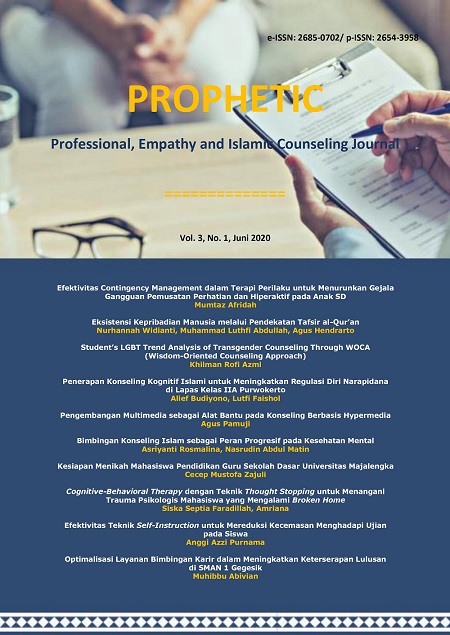
Efektivitas Contingency Management dalam Terapi Perilaku untuk Menurunkan Gejala Gangguan Pemusatan Perhatian dan Hiperaktif pada Anak Sekolah Dasar
DOI:
https://doi.org/10.24235/prophetic.v3i1.6951Keywords:
GPHH, Contingency Management, Terapi Perilaku.Abstract
Penelitian ini bertujuan untuk mengetahui efektivitas dari terapi perilaku dengan metode contingency management dalam menurunkan gejala gangguan pemusatan perhatian pada anak SD. Terapi perilaku dengan metode contingency management disusun sebagai upaya untuk menurunkan gejala perilaku GPPH yang dimunculkan saat belajar di sekolah. Penelitian ini menggunakan metode penelitian campuran, di mana peneliti menggunakan metode kuantitatif sekaligus metode kualitatif. Desain penelitian yang digunakan adalah exploratoris sekuensial, yaitu melibatkan pengumpulan dan analisis data kualitatif pada tahap pertama, yang kemudian diikuti oleh pengumpulan dan analisis data kuantitatif pada tahap kedua yang didasarkan pada hasil hasil tahap pertama. Sedangkan pengukuran perilaku dengan menggunakan time sampling. Responden dalam penelitian ini adalah anak GPPH berusia yang belum pernah mendapatkan terapi perilaku sebelumnya. Hasil dari penelitian ini ditunjukkan bahwa pemberian terapi perilaku dengan metode contingency management dapat menurunkan gejala perilaku GPPH.References
Adelman & Taylor. (2005). Guidebook : Common Psychosocial Problems of School Aged Youth : Development Variations, Problems, Disorders and Perspectives for Prevention and Treatment. Los Angels : UCLA
American Psychiatric Association. (2000). Diagnostics and Statistical Manual of Mental Disorders Fourth Edition Text Revision. DSM IV-TR. Arlington, VA: American Psychiatric Association.
Anastopoulus, A. D., Shelton, T. L. (1993). Parent training for attention deficit disorder and hiperactivity: it’s impact on parent functioning. Journal of Abnormal Child Psychology. Vol 21 (5) 581-596.
Bandura. (1997). Self Efficacy: The Exercise or Control. New York : W. H. Freeman and Company.
Barkley, R. A. (2006). Attention-Deficit Hyperactivity Disorder, Third Edition : A Handbook for Diagnosis and Treatment. NY : Guilford Publications.
Cresswell, J. W. (2010). Research Design: Pendekatan Kualitatif, Kuantitatif, Mixed. Yogyakarta:PT. Pustaka Pelajar.
Harlacher, J. E., Roberts, N. E., Merrel. K. E. (2006). Classwide interventions for students with ADHD. A sumarry of teacher options beneficial for the whole class. Teaching Exceptional Children. Vol 39, (2), 6-12.
Huda, N. & Istiklaili, F. (2017). Hubungan antara hipotyroid dengan kasus ADHD (Attention Deficit Hyperactivity Disorder) pada anak usia dini di area pertanian bawang kabupaten Brebes. Prosiding Temu Ilmiah X Ikatan Psikologi Perkembangan Indonesia: Peran Psikologi Perkembangan dalam Penumbuhan Humanitas pada Era Digital.
Kahn, W. J. (1999). The A-B-C’s of Human Experience: An Integrative Model. First Edition. England: Brooks Cole.
Keown, L. J. & Woodward, L. J. (2007). Early parent-child relation and familly functioning of preschool boys with pervasive hyperactivity. Journal of Abnormal Child Psychology. Vol 30, (6), 541-553.
Mangunsong, F. (2011). Psikologi dan Pendidikan Anak Berkebutuhan Khusus Jilid Kedua. Depok: LPSP3UI.
Mitchell, M. M. (2006). Parent’s stress and coping with their children’s ADHD Dissertation. College Park : Faculty of the Graduate School of the University of Maryland.
Nelson, R. W. & Israel, A. C. (2006). Behaviour Disorders of Childhood sixth edition. New Jersey: Pearson Education, Inc.
Paternotte, A. & Buitelaar, J. (Penerjemah: Julia Maria Van Tiel). (2008). ADHD: Attention Deficit Hyperactivity Disorder (Gejala, Diagnosis, Terapi, serta Penanganannya di Rumah dan di Sekolah). Jakarta: Prenada.
Peurotemad, H. M., Khosabi, K., & Jadidi, M. (2009). The effectiveness of group positive parenting program on parental stress of mothers of children with attention deficit and hyperactive disorder. Archieves of Iranian Medicine. Vol 12 (1).
Pfiffner, L. J. & Haack, L. M. (2014). Behaviour management for school aged children with ADHD. Child Adolescent Psychiatry Clinic of North America. Vol 23, (4), 731-746.
Saputro, D. (2009). Attention-Deficit/Hyperactivity Disorder. Segung Seto. Jakarta.
Schellack, N. & Meyer, J. C. (2016). The management of attention-deficit/hyperactive disorder children : updated 2016. S Afr Pharm J. 83 (4) 21-29.
Skinner. B. F. (1965). Science and Human Behaviour. New York: The Free Press.
Sunartini. (2000). Tumbuh Kembang Anak dengan GPP/H, Makalah dalam Simposium Penatalaksanaan Masa Kini Gangguan Pemusatan Perhatian/Hiperaktivitas. Bagian Ilmu Kesehatan Anak FK UGM/RS dr. Sardjito, Yogyakarta.
Sugiyono. (2013). Metode Penelitian Kuantitatif, Kualitatif, dan R & D. Bandung: Alfabeta.
Theighbulem, O. T., Theighbulem, V. N., & Igwebuike, D. (2011). The effect of token economy on academic achievement of secondery school students : implications for counselling. Proceeding of the 2011 International Conference on Teaching, Learning and Change.
Vitanza, S. A. & Guarnaccia, C. A. (1999). A model of psychology distress for mothers of children with attention-deficit hyperactivity disorder. Journal of Child and Family Studies. 8, (1), 27-45.
Wibawanti, I. P. (2013). Efektivitas media edukatif lembar balik pengasuhan anak GPPH dalam menurunkan tingkat stres pengasuhan pada ibu dengan anak gangguan pemusatan perhatian dan hiperaktif (GPPH). Thesis. Yogyakarta: Universitas Islam Indonesia.
Zirpoli, T. J. (2012). Behaviour Management Positive Application for Teachers. Sixth Edition. Boston: Pearson.
Downloads
Issue
Section
License
Copyright (c) 2020 Prophetic : Professional, Empathy and Islamic Counseling Journal

This work is licensed under a Creative Commons Attribution-NonCommercial 4.0 International License.
Proposed Policy for Journals That Offer Open Access
Authors who publish with this journal agree to the following terms:
- Authors retain copyright and grant the journal right of first publication with the work simultaneously licensed under a Creative Commons Attribution License that allows others to share the work with an acknowledgement of the work's authorship and initial publication in this journal.
- Authors are able to enter into separate, additional contractual arrangements for the non-exclusive distribution of the journal's published version of the work (e.g., post it to an institutional repository or publish it in a book), with an acknowledgement of its initial publication in this journal.
- Authors are permitted and encouraged to post their work online (e.g., in institutional repositories or on their website) prior to and during the submission process, as it can lead to productive exchanges, as well as earlier and greater citation of published work (See The Effect of Open Access).
Proposed Policy for Journals That Offer Delayed Open Access
Authors who publish with this journal agree to the following terms:
- Authors retain copyright and grant the journal right of first publication, with the work [SPECIFY PERIOD OF TIME] after publication simultaneously licensed under a Creative Commons Attribution License that allows others to share the work with an acknowledgement of the work's authorship and initial publication in this journal.
- Authors are able to enter into separate, additional contractual arrangements for the non-exclusive distribution of the journal's published version of the work (e.g., post it to an institutional repository or publish it in a book), with an acknowledgement of its initial publication in this journal.
- Authors are permitted and encouraged to post their work online (e.g., in institutional repositories or on their website) prior to and during the submission process, as it can lead to productive exchanges, as well as earlier and greater citation of published work (See The Effect of Open Access).
