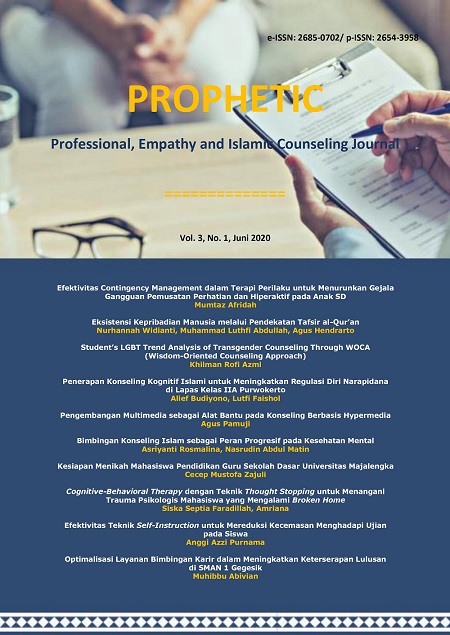
Eksistensi Kepribadian Manusia Melalui Pendekatan Tafsir Al-Qur’an
DOI:
https://doi.org/10.24235/prophetic.v3i1.6952Keywords:
Kepribadian, Nafs, Tafsir Al-Qur’an.Abstract
Tingkah laku yang kompleks dapat dipahami dan dianalisis melalui prespektif kepribadian. Dalam hal ini, menjadi hal penting bagi seseorang untuk memahami esensi dari kepribadian, khususnya tentang berbagai fenomena terkait menyikapi kehidupan. Melalui kepribadian yang sehat, maka akan membantu meminimalisir berbagai perilaku yang tidak terpuji. Adapun tujuan penelitian ini, yaitu mengungkapkan makna kepribadian berdasarkan penelusuran dari tafsir Al-Quran. Penelitian ini sendiri mendeskripsikan bahwa nafs merupakan eksistensi kepribadian manusis dan substansi yang tidak terpisah dari jasmani. Nafs diberikan oleh Allah Swt. dan akan menjadi bentuk kepribadian yang sehat apabila selalu disucikan.
References
Al-Maraghi, Ahmad M. (1993a). Tafsir Al-Maraghi Juz 28. Semarang: Ruhaputra.
________. (1993b). Tafsir Al-Maraghi Juz 29. Semarang: Ruhaputra.
________. (1993c). Tafsir Al-maraghi Juz 30. Semarang: Ruhaputra.
Alwi, H. (2005). Kamus Besar Bahasa Indonesia. Jakarta: Balai Pustaka.
Dominika dan Stevani V. (2018). Hubungan Tipe Kepribadian Ekstrovert-Introvert dengan Penerimaan Sosial pada Siswa. Konselor, 7 (1), hlm. 31-39.
Mujib, A. (2002). Nuansa-Nuansa Psikologi Islam. Jakarta: Raja Grafindo Persada.
Qardhawi, Y. (1999). Berinteraksi Dengan Al-Qur’an. Jakarta: Gema Insani Pres.
Quthb, S. (1992a). Tafsir Fi Zhilalil Qur’an Di Bawah Naungan Al-Qur’an Jilid 12. Jakarta: Gema Insani Pres.
________. (1992b). Tafsir Fi Zhilalil Qur’an Di Bawah Naungan Al-Qur’an Jilid 14. Jakarta: Gema Insani Pres.
Rahardjo, M. D. (1996). Ensiklopedi Al-Qur’an Tafsir Sosial Berdasarkan Konsep-Konsep Kunci. Jakarta: Paramadina.
Rahman, F. (1996). Tema Pokok Al-Qur’an. Bandung: Pustaka.
Shihab, M. Q. (1998). Wawasan al Qur’an (VII). Bandung: Mizan.
________. (2003). Tafsir Al-Misbah; Pesan, Kesan, dan Keserasian Al-Qur’an). Jakarta: Lentera Hati.
________. (2007). Wawasan Al-Qur’an: Tafsir Maudhu’i Atas Pelbagai Persoalan Umat. Bandung: Mizan.
Tasbih. (2018). Konsep Amal Saleh Menurut Al-Qur’an. Jurnal Al-Asas, 1(2), hlm. 23-35.
Widianti, N., Agus N., dan Bambang I. (2017). Nilai Moral dalam Cerita Babad Cirebon: Berdasarkan Penceritaan di Keraton Kanoman. Indonesian Language Education and Literature. 3 (1), hlm. 24-31.
Yusuf, S. dan Achmad Juntika N. (2008). Teori Kepribadian. Bandung: Remaja Rosdakarya.
Downloads
Issue
Section
License
Copyright (c) 2020 Prophetic : Professional, Empathy and Islamic Counseling Journal

This work is licensed under a Creative Commons Attribution-NonCommercial 4.0 International License.
Proposed Policy for Journals That Offer Open Access
Authors who publish with this journal agree to the following terms:
- Authors retain copyright and grant the journal right of first publication with the work simultaneously licensed under a Creative Commons Attribution License that allows others to share the work with an acknowledgement of the work's authorship and initial publication in this journal.
- Authors are able to enter into separate, additional contractual arrangements for the non-exclusive distribution of the journal's published version of the work (e.g., post it to an institutional repository or publish it in a book), with an acknowledgement of its initial publication in this journal.
- Authors are permitted and encouraged to post their work online (e.g., in institutional repositories or on their website) prior to and during the submission process, as it can lead to productive exchanges, as well as earlier and greater citation of published work (See The Effect of Open Access).
Proposed Policy for Journals That Offer Delayed Open Access
Authors who publish with this journal agree to the following terms:
- Authors retain copyright and grant the journal right of first publication, with the work [SPECIFY PERIOD OF TIME] after publication simultaneously licensed under a Creative Commons Attribution License that allows others to share the work with an acknowledgement of the work's authorship and initial publication in this journal.
- Authors are able to enter into separate, additional contractual arrangements for the non-exclusive distribution of the journal's published version of the work (e.g., post it to an institutional repository or publish it in a book), with an acknowledgement of its initial publication in this journal.
- Authors are permitted and encouraged to post their work online (e.g., in institutional repositories or on their website) prior to and during the submission process, as it can lead to productive exchanges, as well as earlier and greater citation of published work (See The Effect of Open Access).