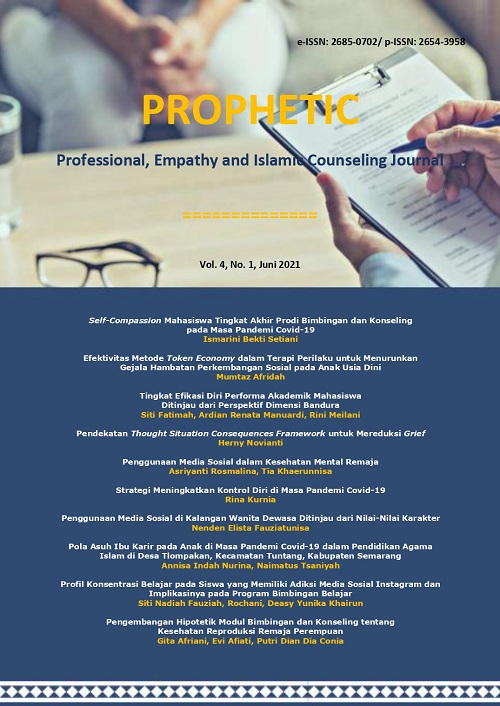
Strategi Meningkatkan Kontrol Diri di Masa Pandemi COVID-19
DOI:
https://doi.org/10.24235/prophetic.v4i1.8756Keywords:
Pandemi Covid-19, Kontrol Diri, Kenormalan Baru.Abstract
Pandemi COVID-19 yang tengah mewadah seluruh dunia termasuk Indonesia memberikan dampak yang negatif bagi seluruh aspek kehidupan. Pandemi COVID-19 berhasil mengubah kebiasaan sehari-hari baik di rumah, di sekolah, di tempat kerja, di jalan, di tempat ibadah, dan dimanapun. Kebiasaan baru untuk hidup bersih dan sehat mesti dilakukan oleh masyarakat sehingga menjadi norma individu dan norma sosial baru dalam kehidupan sehari-hari. Perubahan sikap dan perilaku masyarakat pada masa kenormalan baru di tengah pandemi COVID-19 membutuhkan perjuangan dalam bentuk penyesuaian diri dan kontrol diri yang tinggi untuk memutus penyebaran virus agar kehidupan kembali tertata dengan baik. Tujuan penelitian ini adalah memberikan pandangan mengenai strategi meningkatkan kontrol diri di masa pandemi COVID-19. Adapun metode penelitian yang digunakan yaitu metode kualitatif dengan pendekatan kepustakaan. Sumber data didapatkan dari artikel, jurnal, buku, dokumen resmi, penelitian terdahulu, dan media sosial. Hasil penelitian ini diketahui melalui strategi-strategi yang dapat dilakukan untuk meningkatkan kontrol diri individu atau masyarakat di tengah pandemi diharapkan dapat memutus mata rantai penyebaran COVID-19.
References
Adani, Neno. (2018). Pengaruh Keterlibatan Ayah Terhadap Kontrol Diri pada Remaja Akhir di Jakarta. (Skripsi). Program Studi Psikologi, Uniersitas Negeri Jakarta. Jakarta.
Adrian, Kevin. (2021). Informasi Berbagai Vaksin COVID-19 di Indonesia. [Online]. Diakses dari https://www.alodokter.com/informasi-berbagai-vaksin-covid-19-di-indonesia (Diakses pada 21 Mei 2021).
Agung, I. M. (2020). Memahami Pandemi Covid-19 Dalam Perspektif Psikologi Sosial. Psikobuletin: Buletin Ilmiah Psikologi, 1(2), hlm. 68-84.
Biro Humas Kemnaker. (2020). Menaker: Badai Pasti Berlalu, Panggil Kembali Pekerja yang ter-PHK Nanti. [Online]. Diakses dari https://www.kemnaker.go.id/news/detail/menaker-badai-pasti-berlalu-panggil-kembali-pekerja-yang-ter-phk-nanti (Diakses pada 18 November 2020).
Choirudin, M. (2016). Penyesuaian Diri: Sebagai Upaya Mencapai Kesejahteraan Jiwa. Hisbah: Jurnal Bimbingan Konseling Dan Dakwah Islam. https://doi.org/10.14421/hisbah.2015.121-07
Fanani, Q., & Jainurakhma, J. (2020). Kemampuan penyesuaian diri mahasiswa terhadap pembelajaran daring di tengah pandemi Covid-19. Jurnal KomtekInfo, 7(4), hlm, 285-292.
Ginting, P. (2019). Penyesuaian Diri Dalam Organisasi. Mpu Procuratio: Jurnal Penelitian Manajemen, 1(2), 2019. file:///C:/Users/User/Downloads/314-Article Text-553-1-10-20191102.pdf
Hurlock, Elizabeth B. (2011). Psikologi Perkembangan: Suatu Pendekatan Sepanjang Rentang Kehidupan. Jakarta: Erlangga.
Iskandarsyah, A & Yudiana, W (2020). Informasi COVID-19, Perilaku Sehat Dan Kondisi Psikologis Di Indonesia. Laporan Survei. Fakultas Psikologi Universitas Padjajaran.
Istiqlal, Arfin Hatta. (2019). Hubungan Kontrol Diri dengan Impulse Buying pada Mahasiswa. (Skripsi). Program Studi Psikologi, Universitas Islam Negeri Sunan Ampel, Surabaya.
Juntika Nurihsan, Ahmad. (2012). Stategi Layanan Bimbingan dan Konseling. Bandung: PT. Refika Aditama.
Kelly, H. (2011). The Classical Definition of a Pandemic is Not Elusive. Bulletin of the World Health Organization, 89(1), hlm. 540-541. doi: 10.2471/BLT.11.088815 dari http://www9.who.int/bulletin/volumes/89/7/11-088815/en/
Lazarus, R. S. (1976). Patern of Adjustment. Third Edition. Tokyo: McGraw Hill Kogakusha, Ltd.
Li, S., Wang, Y., Xue, J., Zhao, N. & Zhu, T. I. (2020).The Impact of COVID-19 Epidemic Declaration on Psychological Consequences: A Study on Active Weibo Users International Journal of Environment Research and Public Health, 17, 2032.
Mahardhani, A. J., & KP, M. (2020). Menjadi Warga Negara yang Baik pada Masa Pandemi Covid-19: Persprektif Kenormalan Baru. JPK (Jurnal Pancasila dan Kewarganegaraan), 5(2), hlm. 65-76.
Rohmah, N. (2021). ADAPTASI KEBIASAAN BARU DI MASA PANDEMI COVID-19. AL-MIKRAJ: Jurnal Studi Islam dan Humaniora (E-ISSN: 2745-4584), 1(2), hlm. 78-90.
Sugiyono. (2018). Metode Penelitian Kualitatif (3rd ed.). Bandung: Alfabeta.
Tangney, J. P., Baumister, R. F., & Boone, A.L. (2004). High Self-Control Predict Good Adjustment, Less, Pathology, Better Grades, and Interpersonal Success. Journal Of Personality, 72(2), hlm. 271-282.
Downloads
Issue
Section
License
Copyright (c) 2021 Prophetic : Professional, Empathy and Islamic Counseling Journal

This work is licensed under a Creative Commons Attribution-NonCommercial 4.0 International License.
Proposed Policy for Journals That Offer Open Access
Authors who publish with this journal agree to the following terms:
- Authors retain copyright and grant the journal right of first publication with the work simultaneously licensed under a Creative Commons Attribution License that allows others to share the work with an acknowledgement of the work's authorship and initial publication in this journal.
- Authors are able to enter into separate, additional contractual arrangements for the non-exclusive distribution of the journal's published version of the work (e.g., post it to an institutional repository or publish it in a book), with an acknowledgement of its initial publication in this journal.
- Authors are permitted and encouraged to post their work online (e.g., in institutional repositories or on their website) prior to and during the submission process, as it can lead to productive exchanges, as well as earlier and greater citation of published work (See The Effect of Open Access).
Proposed Policy for Journals That Offer Delayed Open Access
Authors who publish with this journal agree to the following terms:
- Authors retain copyright and grant the journal right of first publication, with the work [SPECIFY PERIOD OF TIME] after publication simultaneously licensed under a Creative Commons Attribution License that allows others to share the work with an acknowledgement of the work's authorship and initial publication in this journal.
- Authors are able to enter into separate, additional contractual arrangements for the non-exclusive distribution of the journal's published version of the work (e.g., post it to an institutional repository or publish it in a book), with an acknowledgement of its initial publication in this journal.
- Authors are permitted and encouraged to post their work online (e.g., in institutional repositories or on their website) prior to and during the submission process, as it can lead to productive exchanges, as well as earlier and greater citation of published work (See The Effect of Open Access).
