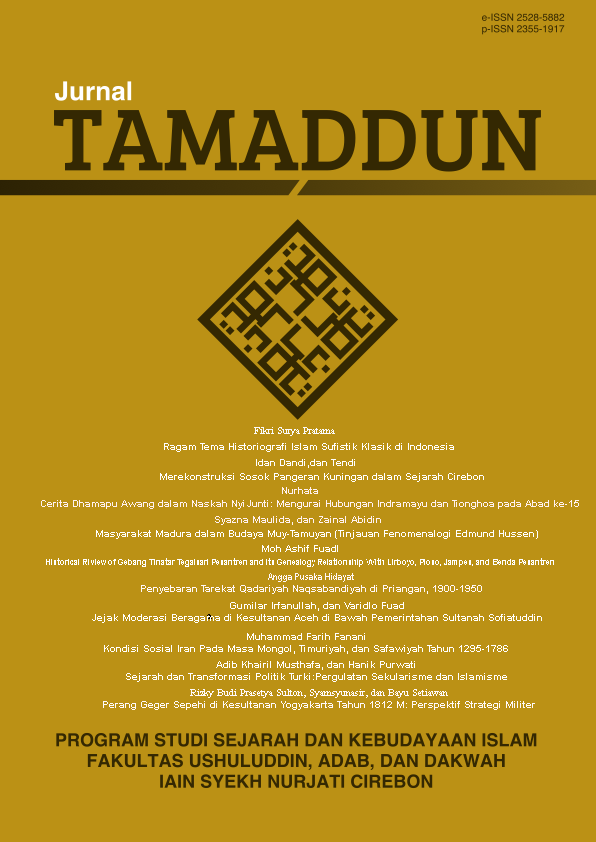
Cerita Dhampu Awang dalam Naskah Nyi Junti: Mengurai Hubungan Indramayu dan Tionghoa pada Abad ke-15
DOI:
https://doi.org/10.24235/tamaddun.v10i1.9752Keywords:
Indramayu, Manuscript, Dhampu Awang, Nyi JuntiAbstract
The story of Dhampu Awang or known as Ma Huan is very popular among the coastal community groups of Indramayu. Traces of the past associated with Dhampu Awang can be traced from ancient sites, oral traditions, and manuscripts. A more specific story about Dhampu Awang is described in the Nyi Junti manuscript. This study describes the traces of the Chinese in Indramayu in the 15th century based on the Tamanan Site (Situs Tamanan), the Dhampu Awang folklore, and the Nyi Junti manuscript. The three sources after the dialogue affirmed each other. After being analyzed, we get a picture of the role of the Chinese in filling the early stages of the development of the Islamic sultanate of Cirebon (15th century), in which Dhampu Awang's position is a key figure. The results of the analysis obtained an overview of the role of the Chinese in filling the development phase of the coastal area of Indramayu, where Dhampu Awang is the key figure. The relationship between the Indramayu community and Chinese immigrants is mutually beneficial, giving a distinct impression, especially for those who live in coastal areas
References
Arsip Nasional Republik Indonesia. 1678. Daghregister van Kasteel Batavia Anno
Atja. 1986. Carita Purwaka Caruban Nagari. Bandung: Proyek Pengembangan Permuseuman Jawa Barat.
Christomy, Tommy dan Nurhata. 2016. Katalog Naskah Indramayu. WWS: Jakarta.
Ma‘mun, Titin Nurhayati, R. Achmad Opan Safari, and Nurhata. 2018. Cariyos Walangsungsang: Transliterasi dan Terjemahan. Jakarta: Perpustakaan Nasional RI.
Mills, J.V.G. 1970. Ying-yai Sheng-lan: 'The Overall Survey of the Ocean's Shores' [1433]. Cambridge: Cambridge University Press.
Naskah Babad Darmayu, koleksi Ki Tarka S (alm.), Indramayu.
Naskah Nyi Junti, koleksi Ki Tarka S (alm.), Indramayu.
Nurhata. 2014. “Naskah Indramayu Koleksi Dalang Wayang: Memperkenalkan kembali Cagar Budaya melalui Katalogisasiâ€. Prosiding seminar internasional Manassa (Naskah dan Relevansinya dalam Kehidupan Masa Kini). Diselenggarakan di UNAND Padang pada bulan September 2014.
Nurhata. 2022. Kajian Pernaskahan Cirebon dan Indramayu. Yogyakarta: K-Media.
Saptono, Nanang. 2008. “Situs Tamanan di Indramayu: Gambaran Singkat Permasalahan dan Kemungkinan Penanganannyaâ€. Makalah ini disampaikan pada Pertemuan Ilmiah Arkeologi XI. The Sunan Hotel, Solo, 13 - 16 Juni 2008. Ikatan Ahli Arkeologi Indonesia.
Saptono N, Widyastuti E, dan Radea P. 2020. “Kajian Pendahuluan Temuan Struktur Bata di Sambimaya Indramayuâ€. Tumotowa, Volume 3, No. 2, Desember 2020: 66 - 77.
Suroyo, A. M. Djuliati., 2013. “VOC dan Eksploitasi Kolonial di Jawa: Monopoli, Tanam Paksa, dan Beli Paksaâ€, dalam Forum Dialog Indonesia-Belanda, VOC: Dua Sisi dari Perusahaan Multinasional Dunia yang Pertama. Jakarta: Yayasan Pancur Siwah.
Tendi. 2018. “Islam dalam Perjuangan Bagus Rangin Melawan Pemerintah Kolonial Belanda-Prancis dan Inggris, 1810-1812â€. Tamaddun, Vol. 6. No. 2, Desember 2018: 149-175.
Zoetmulder, P.J. dan S.O. Robson. 2011. Kamus Jawa Kuna Indonesia. Penerjemah Darusuprapta dan Sumarti Suprayitna. Jakarta: Gramedia Pustaka Utama.
Downloads
Published
Issue
Section
License
Copyright (c) 2022 Jurnal Tamaddun : Jurnal Sejarah dan Kebudayaan Islam

This work is licensed under a Creative Commons Attribution-NonCommercial 4.0 International License.
Authors who publish with this journal agree to the following terms:
- Authors retain copyright and grant the journal right of first publication with the work simultaneously licensed under a Creative Commons Attribution License that allows others to share the work with an acknowledgement of the work's authorship and initial publication in this journal.
- Authors are able to enter into separate, additional contractual arrangements for the non-exclusive distribution of the journal's published version of the work (e.g., post it to an institutional repository or publish it in a book), with an acknowledgement of its initial publication in this journal.
- Authors are permitted and encouraged to post their work online (e.g., in institutional repositories or on their website) prior to and during the submission process, as it can lead to productive exchanges, as well as earlier and greater citation of published work