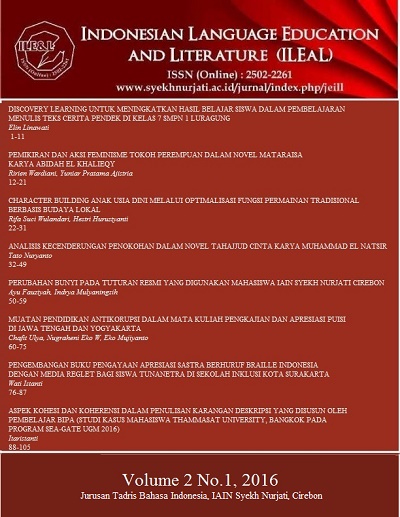
MUATAN PENDIDIKAN ANTIKORUPSI DALAM MATA KULIAH PENGKAJIAN DAN APRESIASI PUISI DI JAWA TENGAH DAN YOGYAKARTA
DOI:
https://doi.org/10.24235/ileal.v2i1.1086Keywords:
anti-corruption education, study and appreciation of poetry, internalizationAbstract
This study aims to describe and explain the content of anti-corruption education in the study and appreciation of poetry in Central Java and Yogyakarta. The object of this research is five universities in Central Java and Yogyakarta, ie UNS, UAD, UMP, Unsoed, and Unikal. The content of anti-corruption education obtained through interviews with the lecturer of the course poem in five universities. Data were collected and analyzed by an interactive model. The results obtained from this study are as follows. (1) The values of anti-corruption education has been internalized into the course study and appreciation of poetry; (2) The value of anti-corruption education that internalized is still general and not concretely lead to anti-corruption values; (3) The value of anti-corruption education that internalized through poems containing the noble values of character education.
Downloads
References
Anedo, O. A.. (2011). “The Place of Poetry in Contemporary Chinese and Igbo Politicsâ€. African Journal of Political Science and International Relations Vol. 5(6), pp. 271-282, June 2011
Balitbang Kemendiknas. (2011). Pedoman Pelaksanaan Pendidikan Karakter. Jakarta: Pusat Kurikulum dan Perbukuan.
Battistich, Victor. (2010). “Character Education, Prevention, and Positive Youth Developmentâ€. http://www.rucharacter.org/file/Battistich%20Paper.pdf. Diunduh pada 2 September 2011.
Berkowitz, Marvin W. dan Melinda C. Bier. (2004). “Research-Based Character Education†dalam The ANNALS of the American Academy of Political and Social Science 2004; 591; 72.
Bura, Romie O dan Nanang T. Puspito. (2011). “Nilai dan Prinsip Anti Korupsiâ€. Dalam Pendidikan Antikorupsi untuk Perguruan Tinggi (Ed. Nanang T. Puspito). Jakarta: Kementerian Pendidikan dan Kebudayaan RI.
Indonesia Corruption Watch. (2016). “Kerugian Negara Akibat Korupsi Sebesar 3,1 Triliunâ€. Dalam www.antikorupsi.org
Joshepson, Michael. (2007). Making Ethical Decisions. Josephson Institute of Ethics.
Lickona, Thomas. (1996). “Eleven Principles of Effective Character Education†dalam Journal of Moral Education. Vol. 25, No. 1, 93 – 100.
Lickona, Thomas and Matthew Davidson. (2005). Smart & Good High Schools: Integrating Excellence and Ethics for Success in School, Work, and Beyond. Washington DC: Character Education Partnership.
Miles, M. B. & Huberman, A.M.. (1984). Analisis Data Kualitatif. (Terjemahan Tjetjep Rohendi Rohidi). Jakarta: UI Press.
Moleong, L. J.. (2004). Metodologi Penelitian Kualitatif. Bandung: Remaja Rosdakarya.
Nurinten, Dinar, dkk. (2016). “Kearifan Lokal Sebagai Media Pendidikan Karakter Antikorupsi pada Anak Usia Dini Melalui Strategi Dongkrakâ€. Jurnal Integritas Volume 2 No 1 Agustus 2016.
Rendra, W.S. (1982). “Saya Punya mental Juara†dalam Horison No. 11, 1982
Sofia, Asriana Issa. (2011). “Model Pembelajaran Mata Kuliah Pendidikan Antikorupsiâ€. Dalam Pendidikan Anti Korupsi untuk Perguruan Tinggi (Ed. Nanang T. Puspito). Jakarta: Kementerian Pendidikan dan Kebudayaan RI.
Srestha, A. P. (2000). “Protest Poetry: The Voice of Conciencesâ€. CNAS Journal Vol 27, No 2 (July 2000)
Transparency International. (2015). “Corruption Perceptions Index 2015â€. Dalam www.ti.or.id
Downloads
Published
Issue
Section
License
Copyright (c) 2022 Indonesian Language Education and Literature

This work is licensed under a Creative Commons Attribution 4.0 International License.
- The journal retains the copyright of the work and publishes it under the terms of the Creative Commons Attribution 4.0 International License (CC BY), which permits others to share, adapt, and use the work with proper acknowledgment of the authorship and initial publication in this journal.Â
- The author is able to enter into separate, additional contractual arrangements for the non-exclusive distribution of the journal's published version of the work (e.g., post it to an institutional repository or publish it in a book) with the acknowledgment of its initial publication in this journal.
- The author is permitted and encouraged to post his/her work online (e.g., in institutional repositories or on their website) prior to and during the submission process, as it can lead to productive exchanges, as well as earlier and greater citation of the published work.