
The Current Hadith Interpretation on Wife's Obedience among Muslim Conservatives and Progressives on Online Media
Article Sidebar
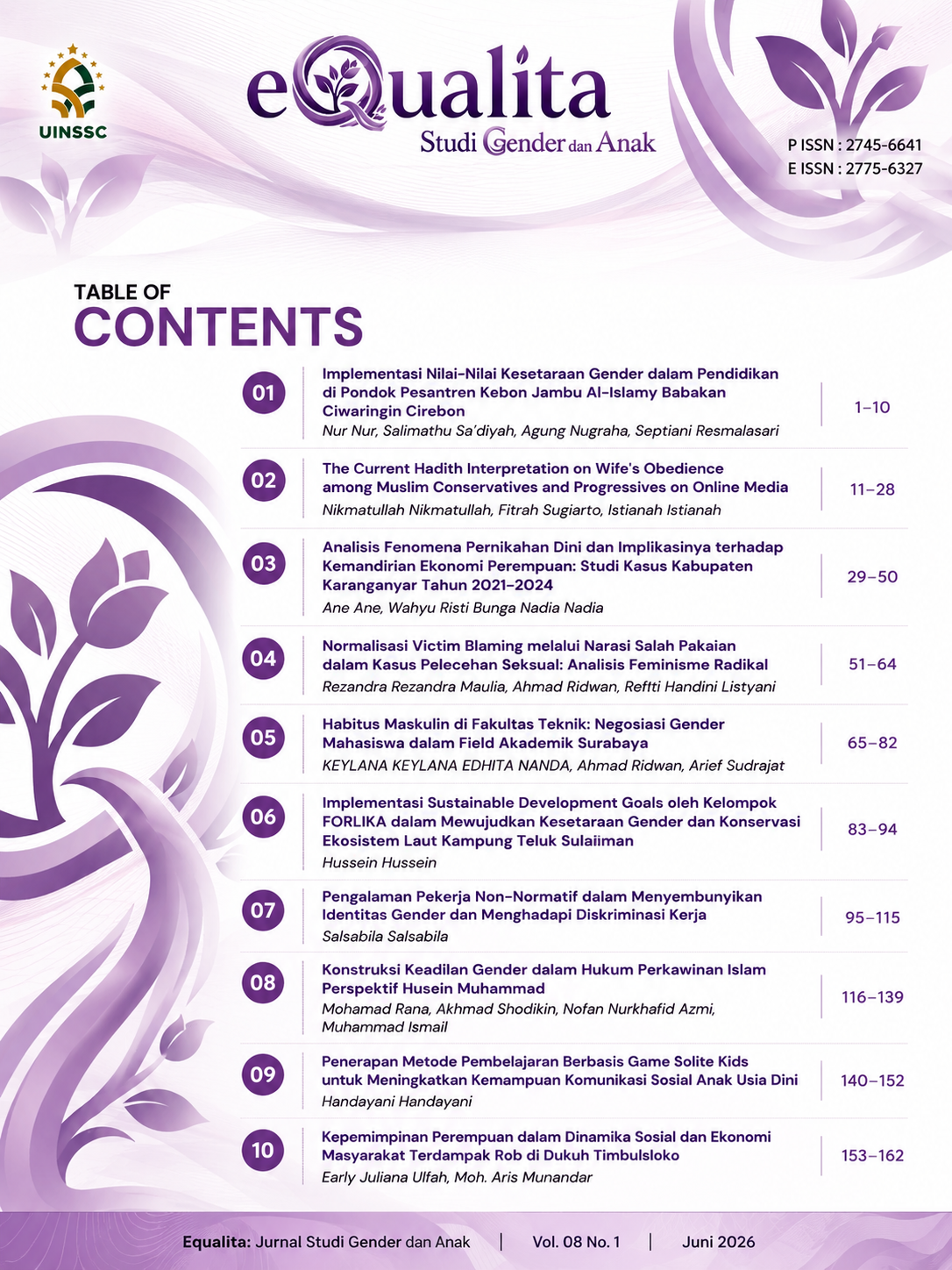
Main Article Content
Abstract
ABSTRACT: Conservative and progressive Muslim groups differ in their interpretation of the hadith on a wife's obedience to her husband, which reinforces female subordination and seeks to establish a just gender relation within the family. The data for this qualitative research is drawn from an online Islamic-based media website, confirmed through interviews with three scholars related to their understanding of the research subject. The research findings show three forms of interpretation of the hadith on female obedience. Firstly, absolute obedience is a form of husband's domination over his wife based on a literal textual interpretation of the famous hadith among conservative Muslims. Secondly, conditional obedience responds to the husband's responsibility towards his wife. Thirdly, obedience is based on Tauheed, Muasyarah Bil Ma'ruf, and Mubadala, with a contextual reciprocal understanding popular among progressive Muslims. This article encapsulates that reinterpreting the hadiths on the wife's obedience and other misogynistic hadiths is crucial to establish a harmonious Sakinah Mawaddah wa Rahmah family. Keywords: Wife's obedience, hadith interpretation, conservative Muslim, progressive Muslim, online media
Article Details
Issue
Section

This work is licensed under a Creative Commons Attribution 4.0 International License.
Authors retain copyright and grant the journal right of first publication with the work simultaneously licensed under a Creative Commons Attribution 4.0 International License that allows others to share the work with an acknowledgement of the work's authorship and initial publication in this journal.
Authors are able to enter into separate, additional contractual arrangements for the non-exclusive distribution of the journal's published version of the work (e.g., post it to an institutional repository or publish it in a book), with an acknowledgement of its initial publication in this journal.
Authors are permitted and encouraged to post their work online (e.g., in institutional repositories or on their website) prior to and during the submission process, as it can lead to productive exchanges, as well as earlier and greater citation of published work (See The Effect of Open Access).