
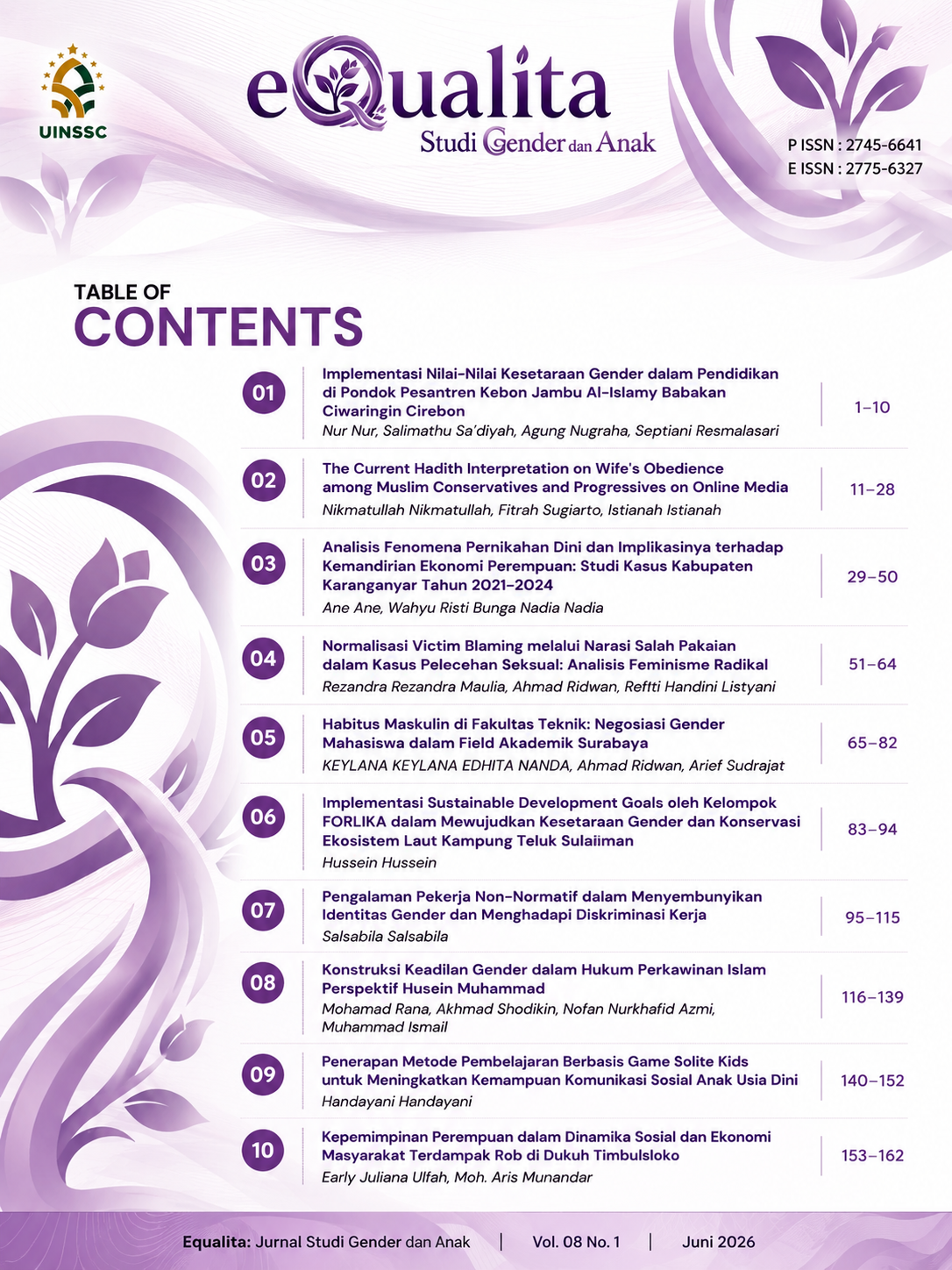
Konstruksi Keadilan Gender dalam Hukum Perkawinan Islam Perspektif Husein Muhammad The Construction of Gender Justice in Islamic Marriage Law from Husein Muhammad's Perspective
Article Sidebar
Main Article Content
Abstract
ABSTRAK: Artikel ini bertujuan menganalisis konstruksi keadilan gender dalam hukum perkawinan Islam menurut Kiai Husein Muhammad serta implikasinya bagi pengembangan hukum keluarga Islam di Indonesia. Subjek penelitian adalah gagasan dan perangkat argumentasi Kiai Husein Muhammad dalam membaca teks, tradisi, dan realitas sosial terkait relasi suami–istri. Metode yang digunakan ialah penelitian kualitatif berbasis studi kepustakaan dengan analisis konseptual-argumentatif terhadap karya-karya Kiai Husein dan literatur ilmiah relevan. Hasil penelitian menunjukkan bahwa keadilan gender dibangun melalui reposisi relasi suami–istri sebagai kemitraan berbasis musyawarah, pembacaan kritis qiwāmah sebagai mandat tanggung jawab protektif, peneguhan mu‘āsyarah bi al-ma‘rūf sebagai standar operasional relasi, koreksi atas pemaknaan ijbār dan kewalian yang berpotensi meniadakan agensi perempuan, serta penempatan poligami sebagai uji etik keadilan substantif yang harus dinilai melalui dampak relasional dan pencegahan mudarat. Rekomendasi penelitian menekankan perlunya pengembangan hukum keluarga Islam yang memperkuat parameter kemitraan, persetujuan, musyawarah, dan ma‘rūf sebagai indikator keadilan substantif, serta memperluas orientasi maqāṣid al-sharī‘ah dalam kebijakan dan praktik kelembagaan agar hukum keluarga berfungsi sebagai instrumen perlindungan martabat dan keselamatan relasional.
Kata Kunci: Keadilan Gender; Hukum Keluarga Islam; Husein Muhammad.
ABSTRACT: This article aims to analyze Kiai Husein Muhammad’s construction of gender justice in Islamic marriage law and its implications for the development of Islamic family law in Indonesia. The research subject is Kiai Husein Muhammad’s ideas and argumentative framework in reading scriptural texts, interpretive traditions, and social realities concerning spousal relations. The study employs a qualitative library-based method with a conceptual–argumentative analysis of Kiai Husein’s works and relevant scholarly literature. The findings show that gender justice is formulated through (1) repositioning husband–wife relations as partnership grounded in deliberation, (2) a critical reading of qiwāmah as a mandate of protective responsibility rather than dominance, (3) affirming mu‘āsharah bi al-ma‘rūf as an operational standard of marital conduct, (4) correcting interpretations of ijbār and guardianship that risk undermining women’s agency, and (5) treating polygamy as an ethical test of substantive justice assessed through relational impacts and harm prevention. The article recommends strengthening partnership, consent, deliberation, and ma‘rūf as indicators of substantive justice and expanding a maqāṣid al-sharī‘ah orientation in policy and institutional practice so that family law functions as an instrument for protecting dignity and relational safety.
Keywords: Gender Justice; Islamic Family Law; Husein Muhammad;
Article Details
Issue
Section

This work is licensed under a Creative Commons Attribution 4.0 International License.
Authors retain copyright and grant the journal right of first publication with the work simultaneously licensed under a Creative Commons Attribution 4.0 International License that allows others to share the work with an acknowledgement of the work's authorship and initial publication in this journal.
Authors are able to enter into separate, additional contractual arrangements for the non-exclusive distribution of the journal's published version of the work (e.g., post it to an institutional repository or publish it in a book), with an acknowledgement of its initial publication in this journal.
Authors are permitted and encouraged to post their work online (e.g., in institutional repositories or on their website) prior to and during the submission process, as it can lead to productive exchanges, as well as earlier and greater citation of published work (See The Effect of Open Access).