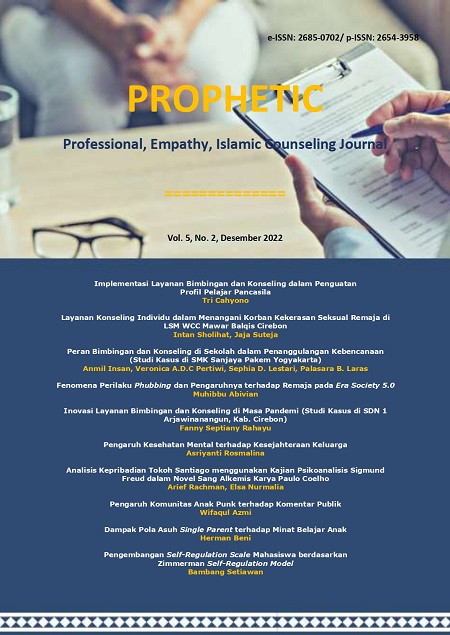
Analisis Kepribadian Tokoh Santiago menggunakan Kajian Psikoanalisis Sigmund Freud dalam Novel Sang Alkemis Karya Paulo Coelho
DOI:
https://doi.org/10.24235/prophetic.v5i2.12865Keywords:
Kepribadian, Psikoanalisis Sigmund Freud, Novel Sang Alkemis.Abstract
Banyak ahli psikologi yang mendefinisikan kepribadian. Freud membagi 3 struktur kepribadian meliputi, id, ego dan superego. Penelitian ini bertujuan mengkaji kepribadian dari tokoh utama yang Bernama Santiago dalam novel Sang Alkemis karya Paulo Coelho. Penelitian ini merupakan penelitian kualitatif deskriptif. Teknik yang digunakan dalam pengumpulan data yaitu dengan menggunakan proses mencatat serta membaca kembali novel. Sumber data diperoleh dari buku teks novel Sang Alkemis karya Paulo Coelho dengan bersumber dari perkataan, maupun pikiran dan perasaan tokoh Santiago. Analisis deskriptif dengan menganalisis teori psikoanalisis Sigmund Freud meliputi struktur kepribadian yaitu id, ego dan superego kepada tokoh utama novel Sang Alkemis yaitu Santiago. Kesimpulan dari penelitian ini adalah diantara 3 struktur kepribadian, aspek yang paling dominan yang dimiliki tokoh utama Santiago adalah aspek id.
References
HS, Apri Kartikasari & Suprapto, Edy. (2018). Kajian Kesusastraan Sebuah Pengantar. Magetan: CV AE Media Grafika.
Alwisol. (2017). Psikologi Kepribadian Edisi Revisi. Malang: UMM Press.
Wiyatmi. (2011). Psikologi Sastra Teori dan Aplikasinya. Yoyakarta: Kanwa Publisher.
Hall, C.S. (2019). Psikologi Freud:Sebuah Bacaan Awal. A Primer of Freudian Psychology: Yogyakarta.
Hardiani, dkk. (2020). Metode Penelitian Kualitatif & Kuantitatif. Yogyakarta: CV. Pustaka Ilmu Group Yogyakarta.
Hidayat, D.R. (2011). Psikologi Kepribadian Dalam Konseling. Bogor: Ghalia Indonesia.
Schesser, Carla. (2015). Why Paulo Coelhoe’s Book The Alchemist Sold Over 150 Millions Copies. https://addicted2success.com/news/why-paulo-coelhos-book-the-alchemist-sold-over-150-million-copies/#:~:text=The%20Alchemist%20has%20sold%20over,York%20Times%20bestseller%20list%20today (diakses pada 27 September 2022).
Downloads
Issue
Section
License
Copyright (c) 2023 Prophetic : Professional, Empathy, Islamic Counseling Journal

This work is licensed under a Creative Commons Attribution-NonCommercial 4.0 International License.
Proposed Policy for Journals That Offer Open Access
Authors who publish with this journal agree to the following terms:
- Authors retain copyright and grant the journal right of first publication with the work simultaneously licensed under a Creative Commons Attribution License that allows others to share the work with an acknowledgement of the work's authorship and initial publication in this journal.
- Authors are able to enter into separate, additional contractual arrangements for the non-exclusive distribution of the journal's published version of the work (e.g., post it to an institutional repository or publish it in a book), with an acknowledgement of its initial publication in this journal.
- Authors are permitted and encouraged to post their work online (e.g., in institutional repositories or on their website) prior to and during the submission process, as it can lead to productive exchanges, as well as earlier and greater citation of published work (See The Effect of Open Access).
Proposed Policy for Journals That Offer Delayed Open Access
Authors who publish with this journal agree to the following terms:
- Authors retain copyright and grant the journal right of first publication, with the work [SPECIFY PERIOD OF TIME] after publication simultaneously licensed under a Creative Commons Attribution License that allows others to share the work with an acknowledgement of the work's authorship and initial publication in this journal.
- Authors are able to enter into separate, additional contractual arrangements for the non-exclusive distribution of the journal's published version of the work (e.g., post it to an institutional repository or publish it in a book), with an acknowledgement of its initial publication in this journal.
- Authors are permitted and encouraged to post their work online (e.g., in institutional repositories or on their website) prior to and during the submission process, as it can lead to productive exchanges, as well as earlier and greater citation of published work (See The Effect of Open Access).