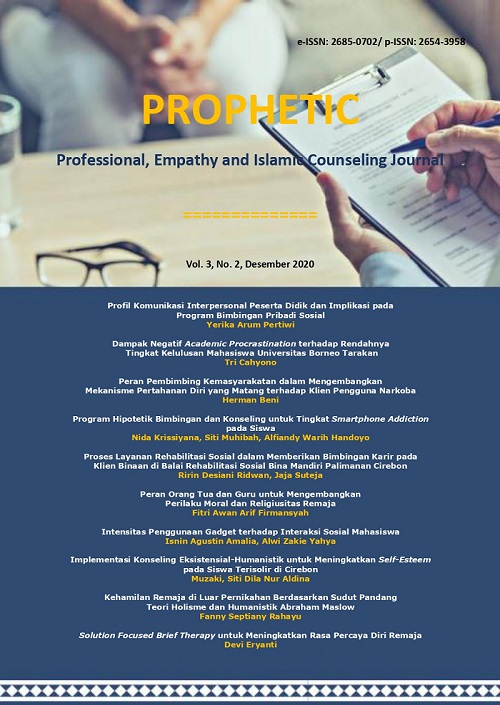
Proses Layanan Rehabilitasi Sosial dalam Memberikan Bimbingan Karier pada Klien Binaan di Balai Rehabilitasi Sosial Bina Mandiri Palimanan Cirebon
DOI:
https://doi.org/10.24235/prophetic.v3i2.7592Keywords:
Rehabilitasi Sosial, Bimbingan Karier, Klien Binaan.Abstract
Tujuan dari penelitian ini mendeskripsikan proses layanan bimbingan karier dan hasil dari rehabilitasi sosial yang dilakukan di Bina Mandiri Palimanan Cirebon. Metode penelitian menggunakan kualitatif deskriptif. Teknik pengumpulan data berupa obervasi, wawancara, dan dokumentasi. Teknik analisis data yang digunakan melalui pengaturan data secara logis dan sistematis. Hasil penelitian ini menunjukkan pembimbingan karier dilakukan melalui tahap awal, pelaksanaan, evaluasi, dan tindak lanjut. Hasil yang tampak dari bimbingan tersebut adalah adanya perubahan dari aspek keterampilan dan semangat kerja. Perubahan itu muncul dari segi jenis keterampilan, penguasaan keterampilan, kesungguhan, dorongan semangat kerja, disiplin, tanggung jawab, produktivitas, dan kualitas kerja. Selain itu, klien binaan menjadi lebih memahami tentang potensi yang ada pada dirinya. Terutama pada hal memahami minat dan bakat yang ada pada diri klien.
References
Anwar, M. F. (2014). Landasan Bimbingan Konseling Islam.Yogyakarta: Deepublish.
Hartono. (2016). Bimbingan Karier. Jakarta : Prenadamedia Group.
Lubis, N. L. (2014). Memahami Dasar-Dasar Konseling dalam Teori dan Praktik. Jakarta: Kencana Prenadamedia Group.
Mu’awwanah, E. & Rifa H. (2012). Bimbingan Konseling Islam di Sekolah Dasar. Jakarta: Bumi Aksara.
Nurhayati, E. (2016). Bimbingan, Konseling & Psikoterapi Inovatif. Yogyakarta : Pustaka Pelajar.
Suci, R.W., dkk. (2017). Proses Rehabilitasi Sosial Wanita Tuna Susila Balai Rehabilitasi Karya Wanita (BRSKW). Bandung : Universitas Padjadjaran.
Soetomo. (2015). Masalah Sosial dan Upaya Pemecahannya. Yogyakarta : Pustaka Pelajar.
Walgito, B. (2010). Bimbingan dan Konseling (Studi & Karier). Yogyakarta : Andi.
Willis, S. S. (2014). Konseling Individual, Teori dan Praktek. Bandung : Alfabeta.
Downloads
Issue
Section
License
Copyright (c) 2020 Prophetic : Professional, Empathy and Islamic Counseling Journal

This work is licensed under a Creative Commons Attribution-NonCommercial 4.0 International License.
Proposed Policy for Journals That Offer Open Access
Authors who publish with this journal agree to the following terms:
- Authors retain copyright and grant the journal right of first publication with the work simultaneously licensed under a Creative Commons Attribution License that allows others to share the work with an acknowledgement of the work's authorship and initial publication in this journal.
- Authors are able to enter into separate, additional contractual arrangements for the non-exclusive distribution of the journal's published version of the work (e.g., post it to an institutional repository or publish it in a book), with an acknowledgement of its initial publication in this journal.
- Authors are permitted and encouraged to post their work online (e.g., in institutional repositories or on their website) prior to and during the submission process, as it can lead to productive exchanges, as well as earlier and greater citation of published work (See The Effect of Open Access).
Proposed Policy for Journals That Offer Delayed Open Access
Authors who publish with this journal agree to the following terms:
- Authors retain copyright and grant the journal right of first publication, with the work [SPECIFY PERIOD OF TIME] after publication simultaneously licensed under a Creative Commons Attribution License that allows others to share the work with an acknowledgement of the work's authorship and initial publication in this journal.
- Authors are able to enter into separate, additional contractual arrangements for the non-exclusive distribution of the journal's published version of the work (e.g., post it to an institutional repository or publish it in a book), with an acknowledgement of its initial publication in this journal.
- Authors are permitted and encouraged to post their work online (e.g., in institutional repositories or on their website) prior to and during the submission process, as it can lead to productive exchanges, as well as earlier and greater citation of published work (See The Effect of Open Access).