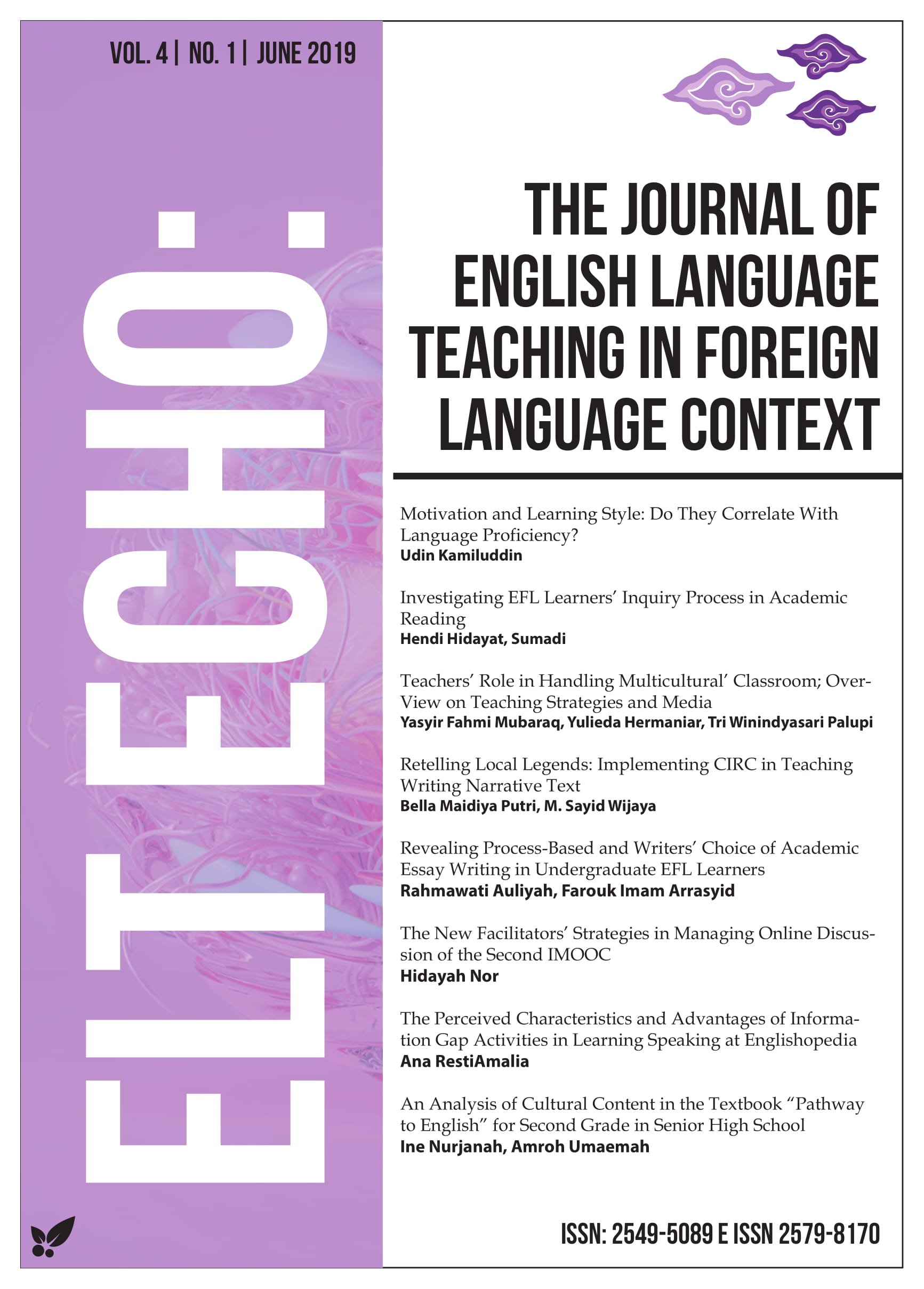
TEACHERS’ ROLE IN HANDLING MULTICULTURAL’ CLASSROOM; OVERVIEW ON TEACHING STRATEGIES AND MEDIA
DOI:
https://doi.org/10.24235/eltecho.v4i1.4266Keywords:
Teachers’ role, Multicultural classroom, Strategies, MediaAbstract
Multicultural classroom deals with variety of students’ background in terms of mother tongue, etnicity, and culture. In the teaching and learning process, the variety is considered in deciding the appropriate strategies in media. Therefore, the discussion on teaching strategies as well as the media used applied in the classroom is considered important. This research is aimed at finding out those aspects in the perspective of descriptive qualitative study. The subject of the study are English teachers who teach at vocational school with various majors. the data obtained through observation are analized descriptively using Cresswell’s stages; transcribing, coding and classifying, interpreting, and drawing the conclusion. The result of this research shows that teachers still take significant role in classroom. Teachers’ strategies and media are also decided based on students’ characteristics from different kind of school.References
Anggrosini,M.V. (2007). Naturalistic Observation. Walnut Creek, CA: Left Coast Press Inc
Badan Pengembangan Sumber Daya Manusia Pendidikan dan Penjaminan Mutu Pendidikan Kementrian Pendidikan dan Kebudayaan. (2013). Rasional Kurikulum 2013. Jakarta: Kementrian Pendidikan dan Kebudayaan
Brown, H.D. (2007). Teaching by Principles : An Integrative approach to langauge pedagogy (3rd Ed.) New York: Pearson Education.
Bhoraskar. S. (2019). Teaching Multicultural Students. https://www.accreditedschoolsonline.org/education-teaching-degree/ multicultural-students/) retrieved online on 7th May, 2019.
Christiani, Paulina. (2016). Penerapan Model Three Phase Technique dalam meningkatkan aktifitas dan hasil belajar menulis teks monolog berbentuk descriptive/procedure. BRILIANT: Jurnal Riset dan Konseptual, 1.(1), 102-112
Cooper, James M., et all. (2011). Classroom Teaching Skill (9th Ed). Belmont: Wadsworth Cengage Learning.
Constantinescu, R. S. (2012). Learning by playing: Using computer games in teaching English grammar to high school students. Education Source. 110-115.
Creswell, John W. (2007). Qualitative Inquiry & Research Design : Choosing Among Five Approaches (2nd Ed.). London: Sage Publication
Damen, L., & Savignon, S. J. (1987). Culture learning: The fifth dimension in the language classroom (Vol. 11478). Reading, MA: Addison-Wesley Publishing Company.
Dean, Joan. (1991). Professional development in school. Open University.
Deesri, A. (2002). Games in the ESL and EFL Class. The Internet TESL Journal, 8(9), 1-5.
Fachrurrazy. (2013). Teaching English as a Foreign Language for Teachers in Indonesia. Malang: State University of Malang
Fatmawaty, R. (2016). The effect of using flashcards on student vocabulary mastery. JURNAL REFORMA, 2(1).
Hesar, Mohammad, Yafuz konca, ELham Zarfsam. 2012. Why and how to apply culture in an EFL Classroom. International Conferences on Language, Media, and Culture IPEDR. 33 (12). 68-72.
Harmer, Jeremy. (2007). The Practice of English language Teaching. Edinburg gate: Pearson Education Limited.
Gozcu, E. & Caganaga, C., K. (2016). The importance of using games in EFL classrooms. Cypriot Journal of Educational Science. 11(3), 126-135.
Perso, T.F. (2012). Cultural Responsiveness and School Education: With particular focus on Australia‟s First Peoples; A Review & Synthesis of the Literature. Menzies School of HealthResearch, Centre for Child Development and Education, Darwin Northern Territory.
Prator, C.H. and Celce-Murcia, M. (1979). An outline of language teaching approaches. In celce-Murica,M. And Mclntosh, L. (Eds). Teaching English as a second or foreign language. New York: Newbury House
Rosado (2019). http://www.edchange.org/multicultural/papers/caleb/multicultural.html retrieved online on 8th May, 2019
Salmona, M., Partlo, M., Kaczynski, D., & Leonard, S. N. (2015). Developing culturally competent teachers: An international student teaching field experience. Australian Journal of Teacher Education, 40(4), 3.
Sa-ngiamwibool, A. (2012). Raising Learner Awareness Of Local Wisdom In Tour-Related Project Teaching. Indonesian Journal of Applied Linguistics, 1(2), 1-16.
Sarjan, N., & Mardiana, H. (2017). An Analysis On The English Teachers Strategies in Teaching Reading Comprehension SMP 1 Wonomulyo. ETERNAL (English, Teaching, Learning, and Research Journal), 3(2), 151-160.
Septy, A.P. (2016). Managing Local Wisdom In English Teaching Materials. Proceedings of ISELT FBS Universitas Negeri Padang, 2016, 4.1: 81-88.
Sudjana, Nana.(2010). Dasar-dasar Proses Belajar Mengajar. Bandung: Sinar Baru Algensindo
Supriyono, Y., & Dewi, N. S. N. (2017). English Language Immersion Berbasis Kearifan Lokal Bagi Siswa Sekolah Dasar. Sarwahita, 14(02), 140-144.
Kementrian Pendidikan Nasional. (2003). “Undang-Undang Sistim Pendidikan Nasional Tahun 2003.†Departemen Pendidikan Nasional Accessed 8th March 2019. http://www.depdiknas.go.id.
Kardena, A. (2016). Teacher’s Role As A Promoter Of Multicultural Perspective: A Case In Teaching English As A Foreign Language. Proceedings of ISELT FBS Universitas Negeri Padang, 4(1), 62-68.
Kementrian Pendidikan Nasional. (2006). KTSP Pendidikan Kewarganegaraan (PKn): Standar Kompetensi dan Kompetensi Dasar Tingkat SMA, MA, SMALB, SMK dan MAK [KTSP Citizenship Education: Standardised Competencies and Basic Competencies for All Types of Senior Secondary Schools]. Jakarta: Depdiknas.
Kunandar. (2007). Guru Profesional: Implementasi Kurikulum Tingkat Satuan Pendidikan (KTSP) dan Sukses dalam Sertifikasi Guru. Jakarta: Rajagrafindo Persada.
Downloads
Published
Issue
Section
License
Copyright (c) 2019 ELT Echo : The Journal of English Language Teaching in Foreign Language Context

This work is licensed under a Creative Commons Attribution 4.0 International License.